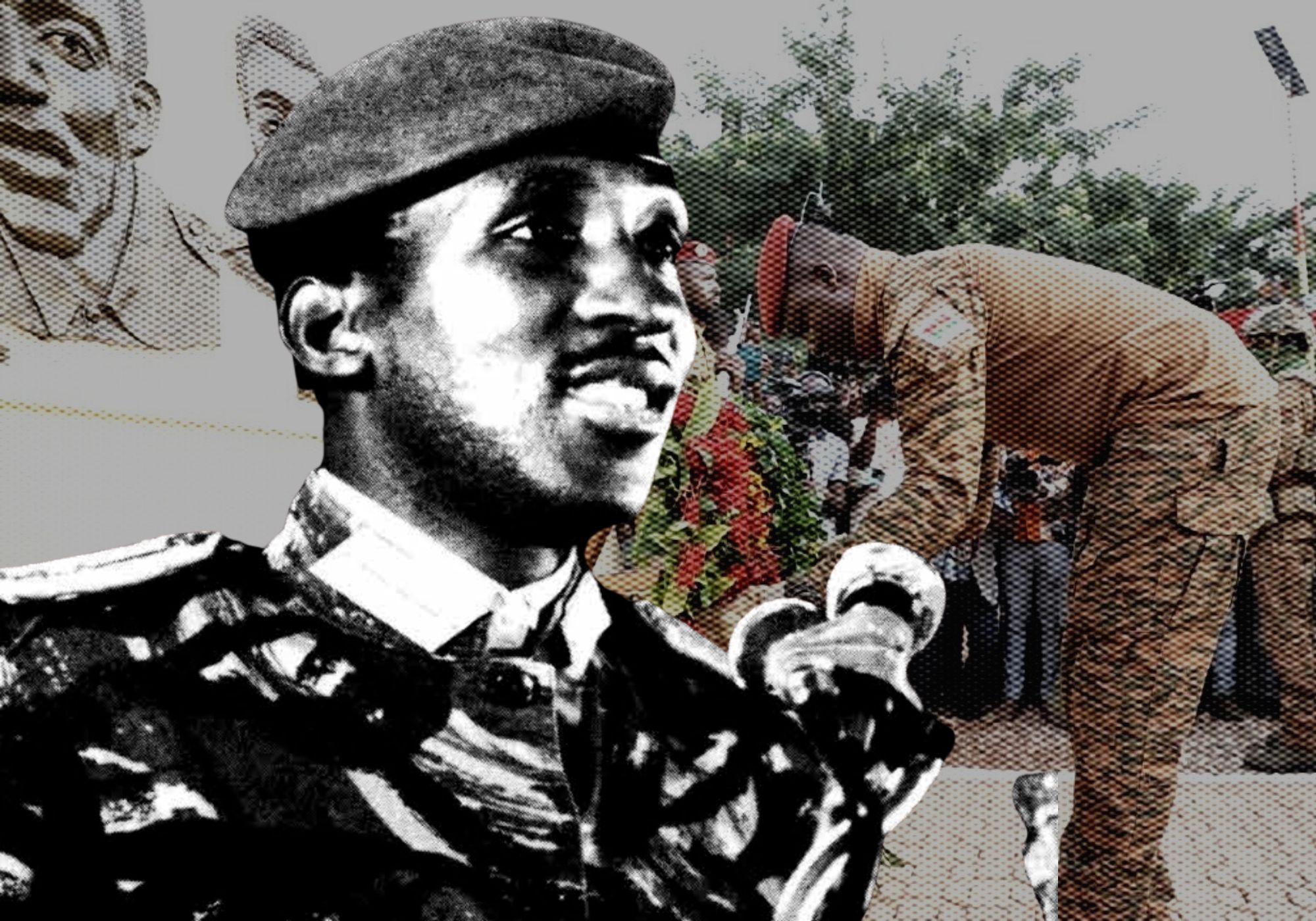
“Revolutions around the world do not resemble one another. Each revolution brings its own originality, which sets it apart from the others,” observed Captain Thomas Sankara, who was brought to power by a group of young officers on 4 August 1983. Taking the measure of his responsibilities in the light of the immense and countless expectations of the people of Upper Volta, renamed Burkina Faso a year later, he proclaimed the Democratic and Popular Revolution (RDP) and then delivered the Political Orientation Speech (DOP).
In that address, given on 2 October 1983, Captain Sankara and his comrades-in-arms set out their plans in a document meant to serve as a programme and a point of reference, in keeping with the tradition of revolutionary regimes. The DOP thus took its place alongside Muammar Gaddafi’s Green Book, Mao Zedong’s Little Red Book and Karl Marx and Friedrich Engels’s Communist Manifesto.
The speed with which the new course was charted shows how carefully Thomas Sankara and his comrades-in-arms had prepared. They had organised themselves into Marxist-leaning discussion circles, Sankara having founded, in 1976, the Regroupement des officiers communistes (ROC, Communist Officers’ Group), whose best-known members were Henri Zongo, Boukaré Kaboré and Jean-Baptiste Lingani. These men had already experienced war against Mali in 19741, as well as the exercise of power in various forms. They had also joined the National Council of the Armed Forces at the request of President Saye Zerbo, after his coup in November 1980.
Unlike the charismatic leader of the RDP, Burkina Faso’s new strongman, Captain Ibrahim Traoré, unknown to the general public, forced his way into the country’s history, outmanoeuvring Lieutenant-Colonel Emmanuel Zoungrana, whose name was chanted by part of the crowd that welcomed the coup of 30 September 2022.
Two years of improvisation, and five more
Once installed at the summit of the state apparatus, the captain decreed the advent of the Patriotic Movement for Safeguard and Restoration (MPSR), supposedly the embodiment of the transition, then, a few weeks later, its second version, “MPSR 2”. In practice, he has governed through a mixture of improvisation, climbdowns and accusations. Tearing up the civilian transition and the elections scheduled on the original timetable – which he had judged too long when he seized power, boasting that he would solve the country’s insecurity within six months – he awarded himself, in May 2024, five more years in office.
It took two and a half years, until 1 April 2025, at the end of a flag-raising ceremony at the Koulouba Palace, for Captain Ibrahim Traoré finally to announce the outlines of “his transmutation”: “Let us stay focused and, if it must be said loud and clear here, we are not in a democracy. We are indeed in a progressive popular revolution… This question of democracy or of licence in action or expression has no place. […] We would end up in a society of disorder.” He then dawdled until 26 April 2026, more than a year later, before allowing his head of government to present the Manifesto of the Progressive Popular Revolution (RPP) officially.
AT THE UN GENERAL ASSEMBLY, BURKINA FASO DOES NOT BOYCOTT ISRAEL!
Click the arrow to read the box
On 24 September, around twenty countries, including Senegal and Niger (the latter being a member of the Alliance of Sahel States, AES, alongside Mali and Burkina Faso), walked out of the UN General Assembly chamber during the speech by Benjamin Netanyahu, the Israeli Prime Minister. Burkina Faso and Mali did not take part in this boycott, which was intended to protest against the ongoing genocide being committed by Israel against the Palestinian people.
The stance taken by Captain Ibrahim Traoré, who came to power in Burkina Faso following a coup in September 2022, may come as a surprise: it stands in stark contrast to the position of Thomas Sankara, whose legacy he nevertheless regularly invokes. Thomas Sankara, who came to power in 1983 and was assassinated along with other comrades in 1987, certainly did not mince his words when it came to Israel.
In a long-forgotten interview, unearthed by Afrique XXI, he compared Zionism to ‘racism’: “We know that both Israel and South Africa have police forces and armies that know exactly where their fascist methods come from. Just as they were all opposed to Hitler’s fascism, so too were they close to it,” he asserted. This stance is a far cry from that of Burkina Faso’s new strongman, who openly maintains ties with Tel Aviv2. M.P.
This strategic document, which sets out the main political, economic and social orientations of Captain Ibrahim Traoré’s regime, remains impossible to find, like the remains of the mite, a microscopic creature that stores its waste in its own body and releases it only after its death. The much-discussed guide circulates only among the captain’s cronies and henchmen, who have commented on it at length on social media. But very little can be learned from it. The local press, brought to heel, barely reports that the manifesto runs to 52 pages and six chapters, covering the vision of national defence and war, inclusive socio-economic progress, cultural rearmament, diplomacy and international relations, the strengthening of governance and societal issues.
For Sankara, “it is no longer enough to call oneself a revolutionary”
In adopting this reference document, the aim, according to Prime Minister Rimtalaba Jean Emmanuel Ouédraogo, was to set the course for Burkina Faso’s current momentum, which, he said, reveals the great historic, transformational projects the president of Faso has in store for the country. The real question is whether that momentum can withstand the test of “revolutionary morality”.
The concept is spelled out in a section of the DOP entitled “On revolutionary morality within the CDR”, delivered by Captain Sankara on 2 October 1983. In it he drew the typical portrait of the RDP militant:
It is no longer enough to call oneself a revolutionary; one must also absorb the deep meaning of the revolution of which one is a fervent defender, by linking revolutionary theory to revolutionary practice, matching one’s deeds to one’s words, and so distinguishing consistent revolutionaries from those driven by motives foreign to the revolutionary cause.
President Sankara lived his commitments in a spirit of sacrifice. His legacy speaks volumes, with no trunk of cash and no djembe stuffed with banknotes. The list of his possessions is meagre: a racing bike, a guitar, a suitcase containing a few personal effects, found in his student room at his father’s home in the Paspanga district of Ouaga, and a plot of land and a well in sector no. 1 of Bokin, his native village, as his cousin Amadou Sankara points out.
2.5bn CFA francs transferred to IB every week
That degree of sacrifice invites comparison with the one made by the leader of the Progressive Popular Revolution, Captain Ibrahim Traoré. Having appointed soldiers to strategic civilian posts, such as the heads of the national hydrocarbons company (Sonabhy) and the national food-security stockpile agency (Sonagess), Burkina Faso’s new strongman has put in place a mafia-style network, embodied by the businessman Ali Konaté, a leader of the Dozo brotherhood (traditional hunters) born in the western city of Bobo-Dioulasso.
A member of the Konaté family acknowledges that the captain’s rise brought the two men closer, even though they had known each other long before. At the start of Ibrahim Traoré’s reign, she explains, the businessman travelled to Senegal to consult leading marabouts, with a view to consolidating the soldier’s grip on power. Moreover, “he regularly sacrifices oxen at his home in Bobo-Dioulasso. The meat is shared out free of charge to the neighbours,” she says.
At Ibrahim Traoré’s side, Ali Konaté has stepped up a level, going from spiritual adviser to business adviser. At the head of Kangala Holding, registered in Dubai and Ouagadougou, he is active in construction, mining, gold brokerage, fuel transport, property, logistics and investment funds, as well as in the airline Kangala Air Express, launched on 30 January 2024. Every week he pays 2.5bn CFA francs through informal transfer channels, outside the conventional banking system, on behalf of Captain Traoré, according to an investigation by the outlet Ouest Afrik published in November 20253.
Big cars all round, and patrimonialisation
The DOP established that the revolutionary must “forge a new consciousness and new behaviour, through their own qualitative transformation, in order to set a good example to the popular masses”. Thomas Sankara led by example, renouncing luxury cars and material goods. His official car was a modest Renault 5, which he also imposed on the other members of the government. He also had the vehicles acquired before the advent of the RDP requisitioned and sold at auction.
Today, Burkina Faso is embodied by a president who travels in style. He visits relatives in top-of-the-range vehicles such as the Luxury V8 SUV and the Hyundai Crossover, says a military source, who notes that junior officers appointed to positions of responsibility also drive big, powerful cars, mostly Toyota V8s. “You will find non-commissioned officers at the wheel of that make. Some stole them from the homes of prominent figures who fled the country. That is how a former minister lost at least two big motors,” the source adds.
An activist, a member of a pro-MPSR 2 civil-society organisation who has since fallen out of favour, recounts, on condition of anonymity and with a hint of bitterness, how two pillars of the regime have grown rich: Commander Azaria Sorgho, head of the 4th Rapid Intervention Battalion and spokesman of the Collective of Republican Organisations for Support to Governance (Korag4), and Commander Oumarou Yabré, president of the National Council for State Security, both now sidelined by Captain Traoré. According to this source, the first built a gigantic mansion in Borgo, a peripheral neighbourhood of Saaba, a rural commune of Ouagadougou, after having his father appointed minister in charge of infrastructure. The second is said to own petrol stations in Ouagadougou and in towns around the country, and to have bought dozens of tanker lorries, put at the disposal of the national hydrocarbons company (Sonabhy) through the good offices of its former managing director, Aimé Wendpanga Nongkouni, whom he had had appointed in September 2023.
Taxes on everything, everywhere
The DOP states clearly: “The revolutionary must constantly bear in mind that the interest of the popular masses takes precedence over personal interest.” In that spirit, the RDP’s leader built housing developments and social housing in Ouagadougou and across the country. Under MPSR 2, however, in the era of the RPP, people have yet to see the colour of promises made for the benefit of the greatest number. On the contrary, under cover of the RPP, gold-panning sites in the regions of Djoro, Yaadga and Guirko have been cleared. According to Ibrahim Traoré, these young gold-panners contribute to the squandering of national resources. “Many go off to pay for vehicles. Take 1,000 people who each pay for a vehicle costing 20m CFA francs, that makes 20bn CFA francs we have given away just like that, to someone somewhere. Yet we have no roads,” he said.
Market gardeners based around the Boulmiougou and Tanghin dams in Ouagadougou, and in zone C of Ouaga 2000, have been evicted following complaints from residents about the discharge of wastewater. The operations have thrown onto the streets growers who had worked on the sites for decades.
For now, it is above all these “popular masses” who help to finance the Patriotic Support Fund (FSP), the mechanism that supports the Volunteers for the Defence of the Homeland (VDP), into which Burkinabè are sometimes enrolled by force. Taxes abound – on services and mobile-phone transactions, fuel, alcoholic drinks and sodas – while 1 % of the net salaries of public- and private-sector workers, 25 % of the bonuses of staff in ministerial departments, state-owned companies and public bodies, and 2 % of company profits are systematically levied and paid into the FSP. In sum, the population is subjected to new sacrifices, without being involved in decision-making and with no scope to voice grievances.
“If anyone screws up, I will bring them to heel, without a qualm”
The RDP’s revolutionary morality also holds: “The activism of certain militants nursing the counter-revolutionary dream of amassing goods and profits must be denounced.” To that end, Captain Sankara set up the People’s Revolutionary Tribunals, along with departmental and conciliation tribunals, to deal with cases of embezzlement, corruption, extortion and misuse of company assets. Former ministers, heads of state, senior civil servants and traders were tried. In all, 16 hearings were held, 139 people were tried and 106 of them convicted. A sum of 3bn CFA francs, at the time’s value, was recovered.
Under the RPP, Burkinabè have witnessed a case of embezzled humanitarian funds, estimated at 3bn CFA francs, which gave rise to two big moments of televised debate. First, on 26 November 2024, with the opening of the trial of the alleged mastermind of the scandal, Amidou Tiégnan, an official in the Directorate of Administration and Finance of the ministry in charge of humanitarian action. Then, on 27 March 2026, the former minister in charge of that department, Laure Zongo-Hien, was sentenced to five years in prison, with no suspension, and fined 10m CFA francs. Since then, nothing: Korag’s cameras have not caught a single serving official under the RPP red-handed.
The RDP’s revolutionary morality also lays down that the revolutionary “must eliminate showiness from his behaviour, affecting modesty while carrying out tasks with determination, without boasting”. Sankara shared powers and responsibilities with his comrades-in-arms, Captains Blaise Compaoré (who took power after the assassination of Thomas Sankara in 1987 and held it until 2014) and Henri Zongo, and Commander Jean-Baptiste Lengani, often described as numbers two, three and four. Unthinkable for the RPP’s leader. A great boaster, he claims a power that he conquered for himself alone, by force of arms. His latest statement, on 16 July, on the sidelines of a meeting with the “forces vives” (civil-society and community leaders) in Ouahigouya, in the Yaadga region, is memorable: “There is no number one, no number two, no number whatever… There are not two captains in one boat… If anyone screws up, I will bring them to heel, without a qualm.”
On occasion, he has tried to rewrite the history of his putsch of 30 September 2022, claiming that he had the men and the equipment to impose himself, in a balance of power, on special-forces and air-force units still loyal to President Paul-Henri Damiba. That is an imposture because, in his interview of 1 October 2022 with Voice of America (VOA), he had asked for the support of the army commanders and appealed to many soldiers to rally to his side. If IB won, it was mainly thanks to the mediation of religious and customary leaders who, anxious to avoid a bloodbath, ruled in his favour.
Blind repression and prisons filled with opponents
Moreover, the image of the revolutionary that the RDP intended to imprint on minds is “that of the militant who is at one with the masses, who has faith in them and respects them; the militant who sheds all attitude of contempt towards them, who does not regard himself as a master and does not demand obedience and submission from the masses. On the contrary, he goes to school with them, listens to them attentively and heeds their opinions, while shedding the authoritarian methods worthy of reactionary bureaucrats”.
Thomas Sankara made these prescriptions his own, in the service of the popular masses, turning the Committees for the Defence of the Revolution (CDR) into a forum for listening, information, awareness-raising and training. In a less inspired imitation, the RPP created the Wayiyans, a group of activists who haunt the roundabouts. Their mission has more to do with promoting revolutionary terrorism and state terrorism, and relaying propaganda. Zealots and thugs from another century, machetes and cudgels at their wrists, they applaud noisily when Captain Traoré represses and crushes every dissenting voice through forced abductions, requisitions, illegal detentions, torture and dispatches to the front.
Today, the secret prisons of the capital, Ouagadougou, and of the interior teem with thousands of soldiers, journalists, religious leaders, politicians, leaders of civil-society organisations, human-rights defenders and anonymous citizens, held for offences of opinion. Among them are Imam Kindo, recently abducted from his home, the doctor Arouna Louré, our fellow journalist Atiana Serge Oulon and the lawyer Guy Kervé Kam, held for more than two years, and lieutenant-colonels such as Evrard Somda, Yves Didier Bamouni, Hamza Ouattara and Paul-Henri Damiba, the former head of state. The repression makes no distinction, and elders suffer the same fate: Mousbila Sankara, an octogenarian and uncle of the former president Thomas Sankara; Hermann Yaméogo, an octogenarian and former minister of state; Ablassé Ouédraogo, a septuagenarian and former foreign minister; and Kalifara Séré, a septuagenarian and former secretary-general of the Ministry of Territorial Administration… All, sadly, have experienced the dungeons of Captain Traoré’s subjugation.
In 1983, Burkina Faso underwent a democratic and popular transformation that equipped itself with a revolutionary morality, with the ambition to serve the people as its political pole star. Since 2022, the second revolution, supposedly progressive and popular, has been devoid of morality, in the service and glory of the great sachem, Captain Ibrahim Traoré, and of his personal enrichment. It sows terror, represses and consolidates its hold on power, ad vitam aeternam. That is the essence of Traoreism, a profusion of illusions and manipulations designed to plunder the legacy of Sankarism.

1The two-day war, from 15 to 17 December 1974, pitted Mali against Burkina Faso over control of the Agacher Strip, which includes the villages of Douma, Dionouga, Kounia and Oukoulourou. Thomas Sankara, then a lieutenant, distinguished himself by his bravery and was subsequently appointed head of the National Commando Training Centre in Pô.
2«Ibrahim Traoré soigne ses relations avec Israël», Africa Intelligence, 14 avril 2026 .
3Armand Kaboré, « Ali Konaté, le “banquier” d’Ibrahim Traoré, au centre d’un vaste système de blanchiment et de déstabilisation », Ouest Afrik, 5 November 2025.
4Body tasked with “defining, monitoring and overseeing the implementation of Burkina Faso’s strategic vision in all fields and by all means”, according to the transition charter, and whose powers have also been extended to the fight against corruption.