“From N’Djamena to Libreville, and from Niamey to Yaoundé, relations between Africa and the rest of the world are undergoing a deep realignment. Criticsms against France — and more broadly against Western powers — are on the rise, while ‘pro-Russian’ and ‘sovereignist’ narratives are gaining ground. This shift is unfolding against a volatile political backdrop: coups d’état in the Sahel, Guinea, and Gabon; constitutional revisions in Chad, Côte d’Ivoire, and Togo; as well as pivotal elections in Senegal.”
It is against this background that Tournons la page (TLP), in partnership with the Center for International Research (Ceri) of Sciences Po, conducted a comparative survey in West and Central Africa to better understand the African activists’ perception of non-African leaders. Between May 2023 and March 2024, quantitative surveys and think tanks were organized in six countries (Benin, Cameroon, Côte d’Ivoire, Gabon, Niger and Chad) highlighting the perceptions of local activists.
This study summarized in the report1 “Why France’s rejection in Africa?” (TLP–Ceri, 2024), allowed not only to take a step back, both historically and in terms of the feelings of the actors on the ground, from what the French authorities describe as “anti-French sentiment”, but also to question the image of African and international leaders: which ones are perceived positively? Which ones, on the contrary, cause mistrust?
“Vladimir Putin, a Partner in ‘Sovereignty’”
As part of the quantitative survey, all respondents were asked to express their views on a range of African and international heads of state, identifying those who inspired trust and those who inspired mistrust.
The findings reveal a clear focus on a small number of figures. On top of the list is Vladimir Putin, cited as the most trusted foreign leader. In many Sahelian countries, he embodies the partner “of sovereignty”, in opposition to former colonial powers. Russian flags and pro-Russian slogans have thus appeared in several demonstrations calling for the departure of French troops, notably in Niger between 2020 and 2023.
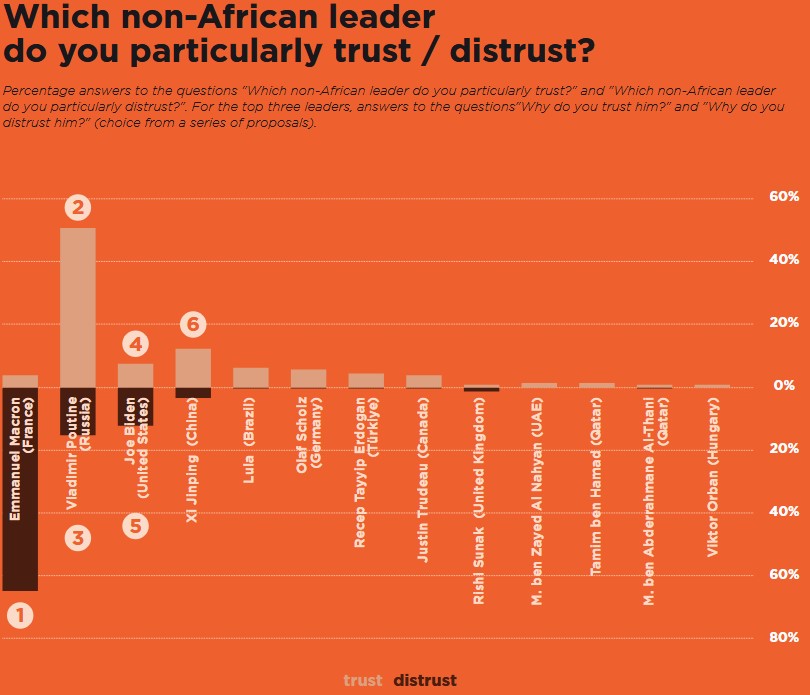
However, this perception is also ambivalent: while more than half of the respondents trust him, a significant proportion (15% on average) expressed distrust of him in 2024, particularly in Côte d’Ivoire (26%) and Benin (20%), where the invasion of Ukraine, which has had significant consequences for Africa, is seen as an attack on the territorial integrity of a sovereign state. “In activist discourse, the trust placed in Russia is not naïve, and there is no question of simply ‘changing masters.’” For many of them, Russia is a partner that listens and responds to the needs of African countries and does not simply seek to impose its vision.
Trust in Xi Jinping and Recep Tayyip Erdoğan
Xi Jinping is another figure that emerges from the investigation. The Chinese president enjoys a trust rate of more than 10% in the countries studied, with the exception of Cameroon. His image as a pragmatic leader, respectful of commitments and focused on economic cooperation is appealing. China, the continent’s first trading partner since 2009, benefits from a discreet diplomacy that contrasts with the often moralistic tone of the Western powers. As for Russia, it is China’s perceived respect towards its international commitments and towards its African partners that is particularly highlighted.
Turkish President Recep Tayyip Erdoğan also garners some support, especially in Côte d’Ivoire, where 14% of respondents trust him. It is important to emphasize that Turkey is one of the main investors in the country, ahead of France and China in 2023, with rapidly growing trade. Turkey has also become an essential partner in the entire Sahel, whether with increased exchanges2, or with military support in the fight against jihadism in the central Sahel, where Bayraktar drones are seen as a quick and effective solution to the action of armed groups.
On the South American side, the Brazilian Luiz Inácio Lula da Silva arouses the sympathy of activists from the African left, particularly in Cameroon. It is seen as a partner that can be trusted by activists who particularly mention Brazilian ambitions to reconnect with Africa, and its weight within the alliance of BRICS (Brazil, Russia, India, China, South Africa). This organization is today perceived as a trust worthy alternative to the Western axis.
Emmanuel Macron, the Most Criticized
Western leaders, for their part, struggle to inspire trust, with relatively weak mentions of former German chancellor Olaf Scholz (5.49% on average) and former Canadian Prime Minister Justin Trudeau (3.66%). Joe Biden, the US president at the time of the study, stands out in the survey as being the first Western leader in this ranking, with about 7% of respondents stating they trusted him. During the debates, it is the humanism of US politics that was emphasized, and the commitment that the country has towards African states (two things that seem to be buried with the advent of the Trump administration). Biden particularly benefited from support in Côte d’Ivoire and Chad, where he was seen as more moderate and more respectful than his European counterparts.
In the francophone context of the study, Emmanuel Macron is the most criticized non-African leader, with an average rate of 65%. His largely negative image is due to the fact that he is often perceived as arrogant and contemptuous of African heads of state (24%), defending above all French interests (29%) or threatening the sovereignty of other countries (28%), which amplifies the rejection of French policy in Africa. Chad, a country where French presence is very marked historically, is particularly hostile, with 93% of Chadian participants expressing distrust. The explanation comes in part from the presence of the French president at the funeral of dictator Idriss Déby, in 2021, experienced by many as an “enthronement” of his son, Mahamat Idriss Déby, who had just suspended the Constitution to proclaim himself president of the transition. In Côte d’Ivoire, the breeding ground for this rise in “anti-French sentiment” since French intervention in the Ivorian crisis in 2004, this distrust is less pronounced but remains significant, with 47% of Ivorians surveyed saying they are wary of Emmanuel Macron.
Are African activists attracted to authoritarian regimes and strongman leaders? The answer is no. This is not a fascination with authoritarianism as such, as confirmed by data published in 2024 by Afrobarometer3: 66% of Africans say they prefer democracy over any other form of government. Moreover, large majorities clearly reject autocratic systems, whether it is a one-man rule (80%), a single-party system (78%), or a military regime (66%).
Disillusionment with Democratic Systems
Support for democracy, although still prevailing, has nevertheless eroded over the past decade, with a 7-point decline at the continental level. Some countries show particularly sharp setbacks, such as South Africa (−29 points) or Mali (−23 points). These figures reflect growing disillusionment with the actual functioning of democratic systems.
What this study highlights above all is a strong expectation for respect, sovereignty, and autonomy in international relations. These values appear to be fundamental in the eyes of a great majority of respondents. In a context where many Africans perceive a condescending, even neocolonial attitude on the part of certain foreign partners, the image of the ‘strong leader’ may, rightly or wrongly, symbolize a desire for rupture, of resistance, and sometimes even a form of national pride or regained dignity.
The survey also reveals significant gender differences, particularly in the perception of non-African leaders. Women, for example, are slightly more likely to trust Vladimir Putin (55%) than men (49%). They also give a little more credit to Joe Biden (13%) but are, on the other hand, more reserved towards Xi Jinping (6.9%).
What is striking from the statistical analysis is that women who responded to the survey adopt, on average, more favourable positions towards figures perceived as ‘strong men’ and express generally more conservative opinions. This observation invites us to further delve into the sociopolitical drivers of these preferences, which could be explained by a combination of cultural and social factors, or even by a search for ‘stability’ in an environment often marked by uncertainty.
Ibrahim Traoré, Icon of the Decolonial Struggle
The findings of the survey by Tournons la page and Ceri clearly show varied but lucid perceptions on the part of the participants. Opinions about non-African leaders have diversified according to the interests, history and commitment of each country with external powers. If Emmanuel Macron remains a controversial figure, Xi Jinping and Recep Tayyip Erdoğan are gradually gaining ground, while Vladimir Putin’s Russia arouses both fascination and suspicion.
As part of the dissemination activities of the study, numerous exchanges, presentations and discussions were organized, notably within Ghanaian and Kenyan universities. These meetings allowed English-speaking master’s students to discover in detail the methodology used as well as the main findings of the research. These sessions offered a space for expression where students were able to share their perceptions and opinions on African leaders, identifying in turn those in whom they place trust as well as those towards whom they express distrust.
The observation that emerges is that, despite a greater representation of leaders from English-speaking countries, Ibrahim Traoré (IB), the strongman of Burkina Faso, has established himself as the new icon of the decolonial, pan-African and sovereignist struggle. Unfortunately, although his speeches or even the videos generated by AI dedicated to his cult are spreading across the continent, few seem aware of the human rights situation in Burkina Faso. On his part, Emmanuel Macron, who did not hide his ambitions in English-speaking Africa, enjoys a very mixed appreciation.
Mixed Reviews for Trump
And the student environment is not the only one to be swept away by IB dynamics. On June 30th, The Republic Bar and Grill – a true institution of nightlife in Accra – welcomed for its thirteen years of existence a solidarity concert with the Alliance of Sahel States (AES, composed of Mali, Burkina Faso and Niger). Carried by an eclectic line-up, the event illustrated how the new figures of African sovereignism are now imposing themselves on mainstream scenes. And if some still doubted it, the effigies of Ibrahim Traoré on the windows of trotros (minibus) or on the walls of Accra testify unequivocally.
On the international stage, with the presentation of the study taking place shortly after Donald Trump took office for his second term, several African students also mentioned him as a trusted figure. They highlighted, to justify their choice, his direct communication style and his alleged connection with a large part of the population. More than six months after his return to the White House, this appreciation seems to be wavering, whether with Trump’s aggressive action on the world stage or even the annihilation of USAID, even if it was greeted by the military in Bamako.
This work highlights the evolution of relations between Africa and the rest of the world. Africans, in their diversity, are not passive in the face of this geopolitical reconstitution: they express clear expectations regarding respect for sovereignty and balanced partnership. According to an activist interviewed in Niamey: “We don’t need new masters - only genuine partners. "

2Emile Bouvier, “Turkey: Emerging as a Regional Power in Africa (Part 2/3) – A Flourishing Turkish Economic Presence,” Les Clés du Moyen-Orient, November 15, 2024, available online.