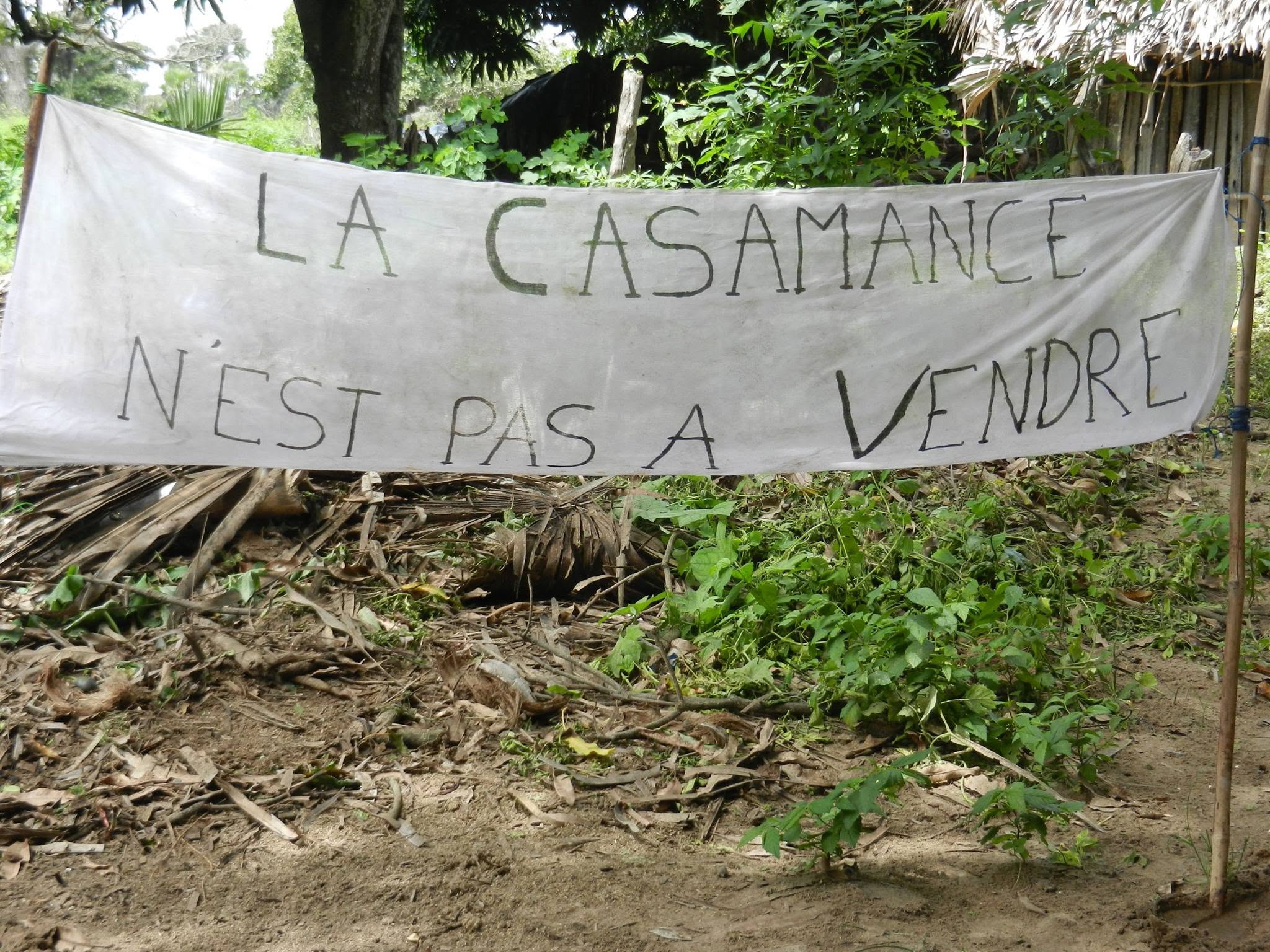
It has been a twenty-year fight, waged relentlessly against pressure and threats. In the village of Niafrang (also known as Niafourang), in Casamance, in southern Senegal, residents have stood firm against a mining project that threatens their coastline.
In November 2025, their struggle reached a decisive turning point: Senegal’s Supreme Court struck down the zircon extraction licence granted by the mining ministry for a site next to the village. A major legal victory — and a final one.
Yet the ruling has not been enough to halt operations. Just a few kilometres from Niafrang, the mining company continues working the mineral-rich sands to extract this highly sought-after ore.
The origins of this long battle go back to 2004. That year, the Senegalese state granted the Australian company Carnegie Minerals an exploration permit for the mineral-rich sands along the Casamance coast, which are rich in zircon, titanium and other strategic minerals. Around a hundred square kilometres of coastal dunes were affected, including the one bordering Niafrang.
A coastline vulnerable to flooding
The extraction project quickly stirred concern among local people: behind the dune lies a vast area of around 50 000 hectares, home to close to 25 000 people spread across some forty villages. Sitting at sea level, the area would be especially vulnerable to flooding should the dune deteriorate further.
From 2006 onwards, a committee against zircon mining, bringing together forty-four villages, began lobbying the media and public authorities. “We carried out research and visited sites where zircon had already been mined. That’s how we became aware of just how serious the consequences of this kind of extraction could be for our environment,” the group’s leader, Ousmane Sané, who lives in Niafrang, where he runs an eco-tourism camp, told Afrique XXI.
Opposition to the project grew so fierce that Carnegie Minerals eventually gave up without ever starting work. Another Australian company, Hong Kong-based Astron Corporation Limited, then took up the project and, in 2017, secured an operating permit. But it too ran into the same determined resistance from residents.
In 2023, the government eventually cancelled Astron’s permit for “inactivity.” “We tried everything necessary to get the project off the ground — the authorities in the Ziguinchor region launched consultations. Unfortunately, there was a lack of buy-in from the local population,” Roseline Mbaye Carlos, the mining ministry’s director-general of mines, told Le Quotidien newspaper in October 20231.
At Abéné, a car and envelopes stuffed with cash
But the reprieve was short-lived. Even before Astron’s permit was withdrawn, the state had granted another permit to a different company, G-Sand, which has Chinese backing and is based in the Gambia. This licence covers the Abéné area, a town roughly five kilometres from Niafrang as the crow flies.
This time, something changed: G-Sand met with no significant opposition on the ground. Although it was a member of the anti-mining committee, the population of Abéné no longer stood in the way of the project. G-Sand began operations in 2024, led by around ten Chinese nationals and dozens of workers recruited locally in Abéné.
Several accounts point to corruption as the reason for this reversal. “The day after the agreement with the mining company was signed, the mayor of one of the municipalities covered by the zircon mining plan — the one where Abéné is located — received a car worth 3 million CFA francs [€4,500], along with an envelope containing 3.5 million,” journalist Pape Sané reported2. According to Amnesty International, cheques worth 200 000 CFA francs were also handed out to certain families who hold local power.
A resident of Abéné, who asked not to be named, says: “G-Sand bribed local officials with a few thousand euros and token promises — repairing the mosque, providing an ambulance — to win their backing.” In a local political system with a strong hierarchy, these influential figures were then able to impose their position on the rest of the population, particularly on young people, who were generally opposed to the project.
“Today, after serious tensions, the subject has become almost taboo in Abéné: most people don’t want to talk about it anymore. Many are disgusted by the mining under way, but have now resigned themselves to it,” the same source adds. Contacted by email, neither G-Sand nor Senegal’s mining ministry responded.
Niafrang keeps up the resistance
In Niafrang, the mood is altogether different: there is no question of backing down or giving in. If anything, concern and anger keep growing. Two events in particular have shaken residents.
In February 2025, they first discovered that G-Sand had gone beyond its permitted mining area and begun working part of their land. They then found out that, as far back as October 2023, the company had filed a request to extend its permit to include the Niafrang dune, seen as the most promising part of the deposit.
For the village, home to around 250 people, the stakes are existential: nothing less than the balance of the whole territory is at risk. Niafrang’s ecosystem is particularly fragile, as Ousmane Sané explains: “To the east are the houses, with the rice paddies and other crops down in the lowlands, at sea level; to the west is the dune, the mangrove and the Atlantic Ocean. Over roughly a decade, we’ve seen the sea advance by more than thirty metres. And our only defence against that is the dune. In the village, everyone knows it’s a natural sea wall — without it, salt water would flood the rice paddies, the other crops and the houses. For a village that depends on farming, that would be catastrophic: we’d lose everything.”
In 2015, geographers Luc Descroix and Jean-Claude Marut3 were already warning that the coastal dune belt where the zircon deposit lies had been weakened by climate change and was subject to accelerated marine erosion. As they put it at the time: “With the ocean already advancing from the west, is it really wise to add the advance of the excavators from the east?”
Fears of a water shortage
The mining work would also threaten the mangrove that separates the dune from the ocean. Both fragile and exceptionally rich in biodiversity, this ecosystem plays a crucial role in maintaining the balance of the coastline. It is also a vital resource for part of the population, who gather shellfish and fish there.
Niafrang’s concerns extend to water as well. Since zircon mining began, residents of several surrounding villages have noticed the water table dropping. Women, who grow vegetables, are finding it increasingly difficult to irrigate their crops. With too little water to go round, they now have to take turns — some watering one day, others the next.
These observations echo warnings raised by scientists back when the project was first conceived. They had cautioned that the pumping operations needed for mining risked lowering the water table. Extracting mineral-rich sands requires millions of cubic metres of water drawn from underground. In northern Senegal, where another company, the French group Eramet4, also mines zircon, farmers report similar water disruptions.
The water has also changed colour, according to Ousmane Sané: it has reportedly turned reddish. Is it toxic? Impossible to say for certain at this stage. Experts had nonetheless warned of pollution risks linked to the mining operation, particularly from the use of heavy machinery.
Procedures under challenge
Alongside these environmental concerns come questions about how the project has been run. Niafrang residents point to a lack of transparency and say several procedures have not been followed. They say they have found it extremely difficult to get information, both on the project itself and on the administrative steps that preceded it.
According to a legal source, the permit application for Abéné was filed without an environmental and social impact assessment ever having been carried out beforehand. Yet such an assessment is mandatory, and is required to obtain the environmental compliance certificate that is itself a precondition for any mining to begin.
The impact assessment required to apply for the Niafrang permit extension was, likewise, reportedly carried out after the fact. It was in this context that a public hearing was held in October 2025. It was not, however, held in Niafrang, despite the village being directly affected — it took place in Kabadio, a nearby town. Niafrang residents nonetheless travelled there to voice their opposition to the project.
Another major issue, according to Bocar Kanté, a lawyer representing a group of Niafrang residents, concerns compliance with regulatory setback distances. Article 48 of the Environment Code requires this category of facility — industrial zircon mining — to be sited at least 200 metres from any watercourse. Yet the Niafrang dune lies no more than 108 metres from a river at most. At that distance, industrial zircon mining should not, in principle, be authorised at all.
“The MPs did nothing to stop G-Sand”
Faced with these risks and alleged failings, around fifteen residents have pursued several legal actions, despite threats and attempted bribery, in an effort to protect their land.
It was one of these legal challenges that led to the November 2025 ruling: the Supreme Court struck down the operating permit granted to G-Sand for the Abéné area, finding that procedures for consulting the population and protecting the environment had not been followed. That ruling also removes the legal basis for the permit extension covering the Niafrang area.
In principle, G-Sand should therefore have stopped its operations. But after a brief suspension, work resumed as though nothing had happened. “The company keeps mining five kilometres from our homes despite the Supreme Court’s ruling,” a local source laments. Since then, Niafrang residents have stepped up efforts to get the court’s ruling enforced.
“We wrote to a group of MPs, including one who represents our department, Ousmane Sané notes bitterly. We called on them to act and put a stop to the project, given the many failings we had documented. A parliamentary delegation, including the chair of the mining committee, came to see for themselves. They saw the mining operation and met with us. But we came to understand that the Senegalese state was firmly committed to a pro-mining agenda. No one ever said so openly, but these MPs did nothing to stop G-Sand.”
“They’re trying to isolate me”
“People in this area live off farming, fishing and tourism. So the state should be protecting them, not exposing them to risk,” says Serigne Sarr, one of the group’s supporters and president of Senegal’s Association for the Defence of Water and Sanitation Rights.
But the village’s resistance is gradually isolating it. After nearly twenty years of solidarity among villages in the area, Niafrang’s stance is now viewed unfavourably across the region. Relations have soured, to the point that the village now “finds itself alone, facing everyone else,” a local source observes.
Ousmane Sané says he has been the target of verbal and physical attacks, attempted bribery and threats. “I’ve become a scapegoat because I’m originally from another part of Casamance, and the people behind the project think I’m influencing the villagers. The fact that I speak to the media and at press conferences bothers them. They’re trying to isolate me.”
He also describes several intimidation attempts that could have turned violent: “Last year, some people came all the way to my house. They surrounded it, armed with machetes and knives, intending to set it on fire. I wasn’t there, but my wife went outside and stood up to them. They were young men from Kabadio.”
After the mining, “hardship”
Niafrang residents do not reject the idea of development for their region, but they favour a different vision for its future. In their view, it is possible to create jobs and economic activity without sacrificing the ecosystem’s fragile balance. To make the case for this alternative, the anti-mining committee has drawn up a “community protocol”5, setting out principles for managing the land, preserving biodiversity and traditional knowledge, while reaffirming local people’s right to take part in decisions over their resources and to share fairly in the benefits.
“This area has real potential and simply needs support to pursue a form of development that is sustainable and beneficial for the population, explains Ousmane Sané. Zircon mining is an activity that will only last a few years. After that, people will be left facing hardship, because by then they will have lost a forest and the mangrove’s resources…” A group of residents has therefore filed a request to have Niafrang classified as a mining protection zone, under the Mining Code. Another battle to safeguard the future, against the odds.

1« Exploitation du zircon de Niafrang : l’État ferme la mine à Astron », Le Quotidien, 13 octobre 2023.
2« Sénégal : extractivisme prédateur », magazine Amnesty n°117, juin 2024.
3Luc Descroix et Jean-Claude Marut, « L’exploitation des sables métallifères du littoral casamançais (Sénégal) : un projet à risques », Regards géopolitiques, 1 (3), 2015, p. 11-17.
4Fanny Pigeaud, « Un groupe minier français détruit un désert unique au Sénégal », Reporterre, 13 janvier 2025.
5« Protocole communautaire bioculturel de la communauté de Niafrang », Natural Justice, 2025.