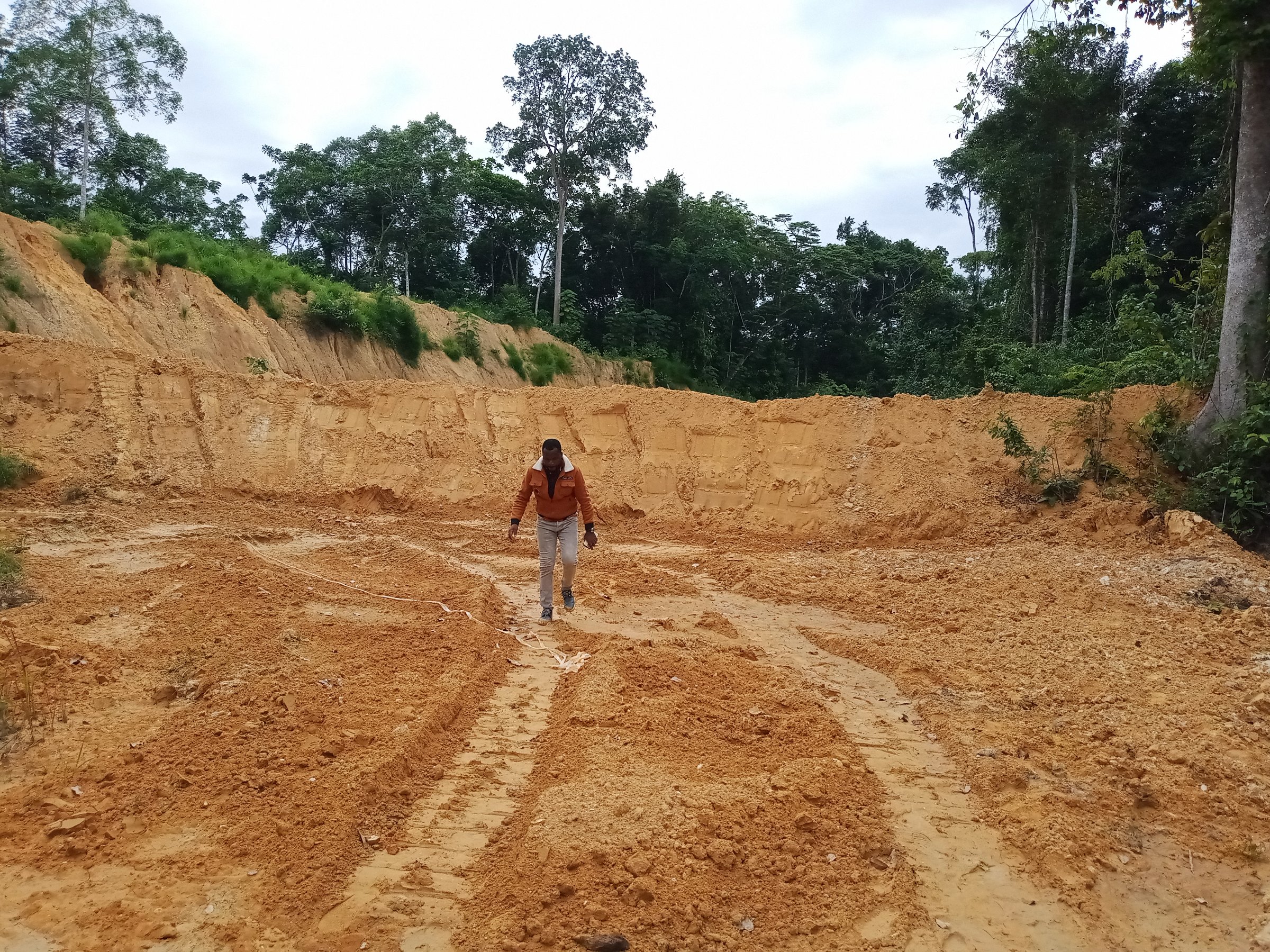
“Look where they started digging, right behind our houses,” says a resident of the village of Afan-Oveng, not far from the town of Kribi in southern Cameroon, pointing. He remembers the arrival of the machines, hulking things. “They turned up with their machinery. Nobody had explained anything to us,” he says angrily. Then, a year and a half later, they vanished, again without explanation. Behind the houses, the landscape has been gutted, the contours reshaped and the ground left rutted. Excavations several metres deep are filled with water. In places, vegetation has reclaimed the embankments. Elsewhere, pools of greenish or yellowish water now lie where, according to residents, there were once cultivated fields or footpaths.
At the Afan-Oveng quarry, Keda Ceramics extracted white clay, needed to make tiles for the Cameroonian market. The site is now idle, but the pits left behind still tell a story that goes beyond the mere extraction of a raw material. It is above all the story of a village that became one of the supply points for an ambitious Chinese venture in Cameroon.
Since 2023, Keda Cameroon Ceramics, a subsidiary of the Chinese group Keda Industrial Group, has obtained permits to mine white and red clay and feldspar in several localities in the Océan department, in the South Region. These raw materials are processed at the Bipaga 1 plant, in the district of Lokoundjé, some 30km from Kribi. On paper, the activity was meant to benefit local people. On the ground, a number of residents and local officials now say the books do not add up.
Liang Tongcan, China’s ceramics king
Founded in 1992 in Foshan, in Guangdong, a province in southern China, Keda Industrial Group long ago outgrew the Middle Kingdom. It has been listed on the Shanghai stock exchange since 2002 and on the SIX Swiss Exchange since 2022. In building materials, its international expansion, notably in Africa, runs through Twyford International.
Its main shareholder is Liang Tongcan ($1.4bn estimated fortune according to the Hurun Global 2026 ranking), who owns 19.5 % of the capital. The businessman, who at one point held as much as 35 % of China’s ceramics market, directs operations through his holding company, Hongyu. In 2025 Keda posted nearly €2.65bn in turnover worldwide, according to its latest annual report. In Africa, the Chinese industrial group is present in Ivory Coast, Kenya, Ghana, Tanzania, Senegal, Zambia and Cameroon.
In the first half of 2026, its African factories produced about 110m square metres of tiles. Through its subsidiary Twyford International, the manufacturer operates several tile lines and is also present in glass and sanitaryware. In Cameroon, Twyford says it has created 1,200 direct jobs. But workers describe safety and pay conditions as precarious: they earn a basic monthly wage of 60,000 CFA francs (€91.47), sometimes working close to kilns where tiles are fired at very high temperatures.
The Chinese group has formed partnerships with oil and gas companies to power its production lines. Under these agreements, the National Hydrocarbons Corporation (SNH) and the Franco-British group Perenco supply its Bipaga plant, near Kribi. The arrangement forms a complete industrial chain: the gas is produced and processed by Perenco, then bought by the SNH, which delivers it to Keda to run the factory.
“It was like an earthquake”
The dispute over the Afan-Oveng quarry is not an isolated case. At Mangouma, a village where the Chinese giant is working a huge rock massif to extract feldspar, a mineral prized in tile-making, communities likewise describe tensions over the exploitation of resources, benefits that fall far short of the promises and damage they attribute to blasting. “Come and see the cracks in the walls of my house,” an octogenarian tells us.
Her home is about a kilometre from the quarry. Several cracks are visible to the naked eye on the walls. It is impossible, however, to establish a causal link with the blasting carried out at the site. She, for her part, has no doubts: “These cracks appeared just after their blasts. It was like an earthquake,” she says, still stunned. To seek redress, she petitioned the prefect of the Océan department on 30 July. In her complaint, which we were able to consult, she states: “If nothing is done, we are very afraid that our house will one day collapse on top of us.”
At Afan-Oveng, the presence of Keda Cameroon Ceramics Limited is not illegal. In 2023 the company applied to the authorities for the temporary occupation of a plot of the natural public domain in order to run a semi-mechanised artisanal quarry. The application led to the setting-up of an administrative commission chaired by the prefect of the Océan department. After visiting the site, the commission noted the presence of a watercourse, crops and graves. The authorities reminded the company of its responsibility towards the local population and recommended drawing up participatory terms of reference involving Keda and the communities.
The document sets out several commitments. The company is to maintain the access road to the site, compensate those affected, give priority to local labour, rehabilitate a borehole at the Afan-Oveng public school, electrify a stretch of about a kilometre and renovate a classroom. The terms of reference also provide for socio-cultural support to three churches, as well as chairs for the chiefdom.
“The whole environment has been turned upside down”
In the village, several residents say they were never told what the terms of reference contained. Above all, compensation became one of the first points of friction. Eric Ekavela, one of the affected residents of Afan-Oveng, says the compensation was won only after a long administrative tussle. He describes protracted procedures and the use of bailiffs. For the renovation of classrooms, the company reportedly offered 300,000 CFA francs (€457), according to the communities. They found the sum inadequate.
At Mangouma, residents see the record on commitments as just as thin. “Nothing at all, nothing concrete, apart from the food and wine they came to hand out to the villagers,” says a local notable we met in the town centre of Lolodorf.
The other bone of contention concerns the open pits left behind, which have profoundly altered the landscape. Cameroon’s mining code stipulates that “the restoration, rehabilitation and closure of sites are the responsibility of the operator”. The text also requires affected areas to be restored. Yet for Martin Biyong, coordinator of the Centre for Alternative Local Development (CeDLA), a Kribi-based NGO working on environmental protection, “the whole environment has been turned upside down”.
Tax revenues slow to arrive
And what of the revenue that mining is supposed to bring local authorities? Villagers suspect town halls of having profited from the operation at the expense of the communities. In Lolodorf, the mayor acknowledges that a tax is levied on the transport of quarry products. “Our town hall collects 3,000 CFA francs for each lorry of stone leaving the quarry,” says Félicien René Mballa. As for the rest, the elected official says he has no direct visibility on sums linked to the operation. By contrast, in the commune of Nieté, a neighbour of Lolodorf, the mayor is categorical. “I have never received any money from Keda Ceramics,” insists Marthe Minko Abolo.
Approached for comment, Keda Cameroon Ceramics says it is acting in accordance with Cameroonian law and the guidance of the authorities. The company disputes the criticism levelled at it. “We pay the state and the communes what is due to them, which is why we are still operating,” the Chinese giant says in its defence.
On complaints and community claims, Paul Yves Boyolo Biondi, the company’s head of raw materials, also denounces what he regards as a form of “overbidding” by some communities. “At the Mangouma site there is a sort of exaggeration of the damage by the communities. Yet we have repaired all, or almost all, of the damage caused by our blasting operations,” he says. He also believes that some of the cracks are not directly linked to the company’s work, but to the “dilapidated state of the houses”.
Keda also says it took security measures after its departure to limit villagers’ access to the site, notably by building embankments to serve as barriers. “We did it because we know we will be going back to continue mining,” the company says.
“A casual approach to environmental management”
To accusations that its industrial activities pollute watercourses in villages, the Chinese giant points to its recycling facilities. “We discharge nothing into the environment. The water used in the factory is recycled in large basins, then reused to cool the production lines,” explains the head of HSE (health, safety and environment). Residents, for their part, complain of a watercourse that has turned whitish. When Afrique XXI asked to tour the recycling basins in order to check that there were no muddy discharges or pipes that might lead to the watercourse a few metres from the factory, the manager flatly refused.
In Cameroon, environmental matters fall under the Ministry of Environment and Nature Protection. In the Océan department, where Keda operates, field monitoring is the responsibility of the departmental delegation. Jean Daniel Mewoli, head of the monitoring unit in that administration, laments “a casual approach to environmental management at some Keda quarries”, even if efforts have reportedly been made at other sites. “We are hopeful that the company will bring itself up to standard on the environmental front once it actually moves from artisanal to industrial mining,” says the official.
According to data published by the Ministry of Mines, Industry and Technological Development, the group obtained further quarry permits in Cameroon between 2024 and 2025, notably at Mengong, in the South, but also at Manjo and Dizangué, in the Littoral region.
