Across the continent, the Internet has gradually established itself as a fundamental infrastructure of social, economic, and political life, far beyond its purely technological dimension. Studying, working, accessing healthcare, getting informed, mobilizing, paying taxes, or receiving money now all depend on connectivity. Yet, despite decades of reforms, privatization, and technological innovation, access to the Internet remains deeply unequal, precarious, and expensive for a large share of African populations. In Africa, only 40% of the population is connected, and disparities are particularly pronounced between rural and urban areas, with rural zones having connectivity rates roughly half those of urban areas1.
It is within this landscape that Starlink has emerged since 2023. This Low Earth Orbit (LEO) satellite internet project, led by SpaceX, the company run by billionaire Elon Musk, is presented as a revolutionary solution capable of connecting the most remote territories where conventional telecommunications infrastructure are almost non-existent. Starlink has raised great hopes. However, as our investigation shows2, this technology does not mechanically resolve Africa’s connectivity problems. Rather, it reconfigures them by redefining forms of access, exclusion, and power.
In many African countries, access to the Internet continues to be marked by instability and scarcity. The case of Cameroon is quite telling. Although the country is crossed by several fibre-optic backbones connected to submarine cables, effective access remains concentrated along a few urban corridors. In Yaoundé or Douala, fibre often stops just a few hundred metres from major boulevards. Once one moves away from these areas, connectivity disappears. For example, in the university town of Dschang, located about 330 kilometres from the capital, Camtel’s fibre-optic network – the national telecommunications operator – covers only a very limited area. It is still impossible to connect users living more than 300 metres from relay points located along the city’s main axis. Moreover, mobile internet – long presented as Africa’s flagship alternative – now shows its limits. In 2023 and 2024, many users experienced frequent slowdowns, unexplained outages, and sudden switches to very low-quality networks, even in capital cities. Students, journalists, remote workers, and small entrepreneurs complain about poor communication network quality, despite having paid for data packages that they are unable to use. Added to this are opaque pricing strategies, where operators multiply promotional offers (call bonuses, night plans, “social media” bundles) that create an illusion of abundance but expire within a few days – or even a few hours. In practice, users purchase connectivity several times a week. In a country where the minimum wage is below 70 dollars (around 60 euros) per month, connectivity under these conditions becomes a daily luxury.
Outages, Disruptions… Distant and Fragile Infrastructures
The fragility of the Internet in Africa became strikingly visible in 2024 and 2025, when several major submarine cables (WACS, SAT-3, and ACE) were damaged off the coasts of West and East Africa3. From Côte d’Ivoire to South Africa, connections slowed down or were completely interrupted for several days. Banks were paralyzed, universities suspended online examinations, and technological hubs such as Lagos and Accra operated at reduced capacity. In Cameroon, many users found themselves unable to access administrative platforms or even send emails. Although operators issued apologies to subscribers via SMS, for users the conclusion was clear: the continent’s connectivity relies on distant, fragile infrastructure that are largely beyond any form of local democratic control.
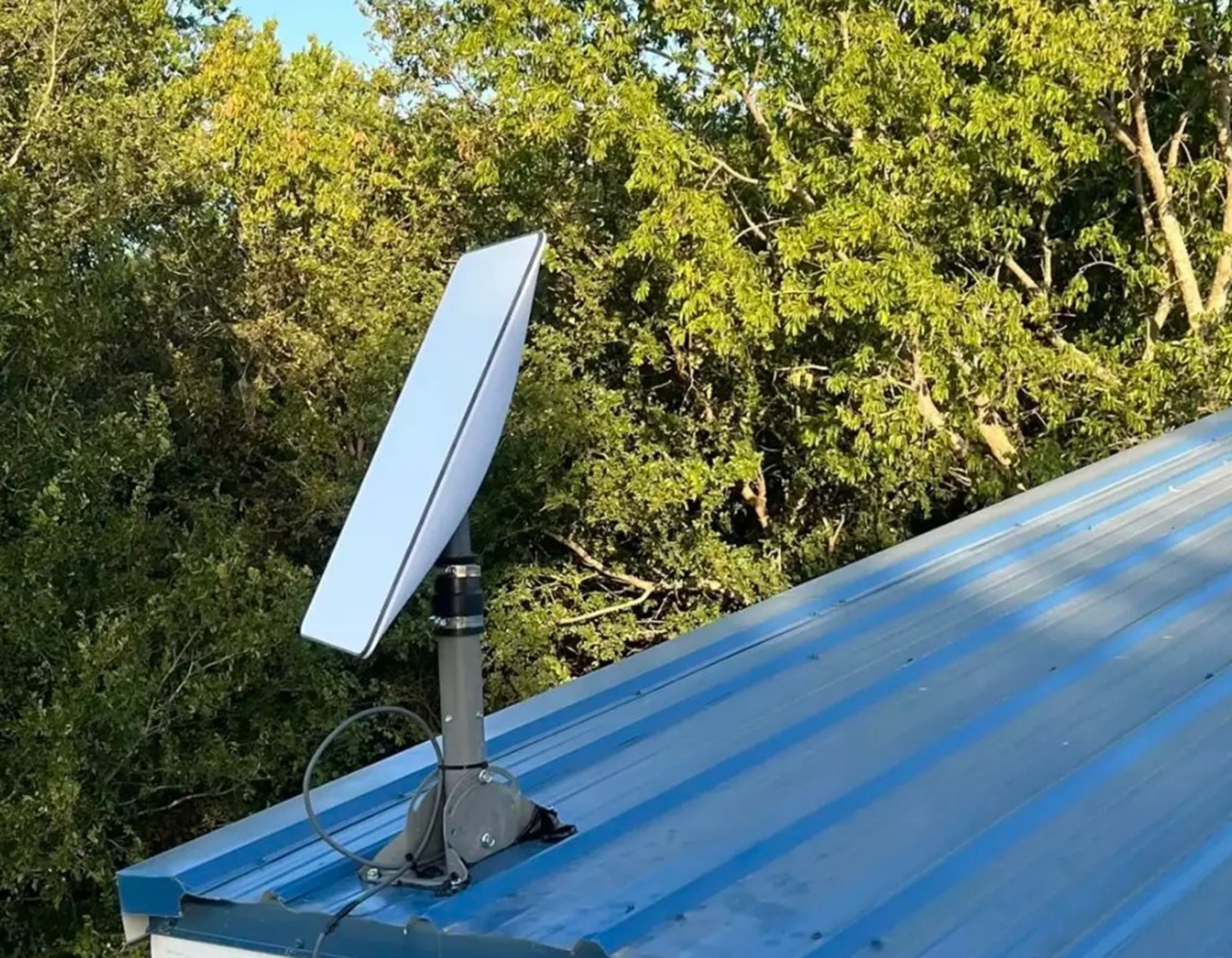
In this context, Starlink appears as a credible alternative. Unlike traditional technologies such as fibre optics, mobile telephony antennas, or ADSL, Starlink relies on a constellation of satellites. This configuration reduces dependence on terrestrial physical infrastructure, which are often difficult to deploy in geographically constrained environments such as mountainous areas. This does not mean that Starlink is based on a simplified infrastructure, but rather on a technically sophisticated system whose complexity is displaced into space, making ground installations lighter and faster than that of conventional networks. Operating according to a “kit” logic, this technology offers great flexibility and adaptability, particularly in situations involving user mobility or emergency contexts. The most technical step of the installation consists of mounting the antenna at a height – ideally on a rooftop – and connecting it to the router using the provided cable (15 metres). Once this is done, activation is carried out simply via the Starlink application, which the user downloads onto a smartphone and configures by following the instructions.
Starlink’s LEO satellite internet bypasses submarine cables and national networks. During the 2024 outages, certain embassies, NGOs, companies, and institutions equipped with this technology remained fully connected. This difference did not go unnoticed. Today, Starlink is used in several niches such as mining sites, humanitarian operations, tourist lodges, industrial facilities, security services, and numerous public administrations across several African countries. For these actors, the service works – and sometimes performs better than national networks. However, this selective reliability raises a central question: connectivity, yes – but for whom?
Starlink as a Deeply Political Object
While Starlink’s official discourse is built around a promise of universality, the reality is one of selective inclusion. With a standard installation kit costing around 370 US dollars and a monthly subscription varying by country (between 28 and 50 dollars) but often approaching the minimum wage, Starlink remains inaccessible to the majority of African households. In the history of technologies on the continent, the advent of mobile telephony helped reduce inequalities in access to communication. The democratization of this market fostered competition that ultimately benefited consumers. Can a similar scenario be expected with Starlink? We believe this is possible in the coming years, insofar as Starlink is an emerging technology operating alongside other ongoing projects (OneWeb, Amazon Kuiper, Telesat Lightspeed, SES O3b mPOWER, China’s Hongyan and Hongyun, among others) that could feed the market if they come to fruition. For instance, Starlink is working to make its service compatible with smartphones, as evidenced by partnerships with mobile operators such as Airtel in certain countries. That said, like any technological development, the market is currently subject to a high degree of uncertainty and to disruptive dynamics that may emerge at any moment. It is therefore also possible that developments take a different path, and that solutions such as Starlink instead contribute to widening inequalities in Internet access for the continent’s most disadvantaged populations. Both scenarios remain possible, but for now Starlink does not replace failing systems; it simply allows some users to exit them. In doing so, it creates a parallel Internet – fast and stable – reserved for a solvent minority. This is where Starlink becomes a deeply political object.
Unlike traditional operators, Starlink possesses a form of “topological power”4 that enables it to operate beyond national territories and regulatory frameworks. This global technological infrastructure exerts influence at a distance, without physical presence or local institutional anchoring, apart from a few Points of Presence (PoPs) in Ikire and Lekki (Nigeria), Accra (Ghana), and Nairobi (Kenya). Decisions made in the United States have immediate effects on connectivity conditions and on the digital economy in Africa, without any real mechanisms of accountability. This raises major issues of digital sovereignty. How can a private orbital infrastructure be regulated? Who controls data, pricing, and service continuity? On a continent already shaped by the privatization and fragmentation of infrastructure, Starlink opens a new era of technological dependence, masked by the language of innovation and inclusion.
In Africa, Starlink has concluded formal agreements with only about a dozen countries, while negotiations are still ongoing with several governments. In many cases, however, the technology has been deployed without official authorization, provoking strong reactions from the states concerned. Regulatory agencies in countries such as Mali, Côte d’Ivoire, Burkina Faso, the Democratic Republic of the Congo, Zimbabwe, South Africa, Chad, Senegal, and Cameroon have demanded that Starlink regularize its activities and comply with national telecommunications frameworks, citing risks to national security and fair competition5. The absence of physical infrastructure and official corporate presence (with the exception of Nigeria) complicates regulatory oversight, accountability regarding distributed content, and the taxation of Starlink’s activities. Indeed, the company generates revenue in several countries without paying taxes there, while making very limited investments locally.
Operating Without Authorization
In Southern Africa, Starlink has been banned in most countries, with the exception of Zambia. In South Africa, Elon Musk’s refusal to comply with the Black Economic Empowerment policy6 has prevented the authorization of the service, despite persistent illegal use through devices delivered to South African addresses and operating via regional roaming. In Zimbabwe, following an initial ban marked by arrests7, a regularization agreement was reached in May 2024. However, this agreement was tainted by favouritism practices, ultimately leading to the cancellation of a controversial exclusive partnership.
In some countries, repressive measures have been implemented to prevent the use of Starlink without a formal agreement. In Cameroon, for instance, an official notice8 issued in April 2024 banned the importation of Starlink kits and ordered their seizure, citing national security concerns and compliance with regulatory frameworks. Despite Starlink’s announcement of the suspension of its services in unauthorized countries, this measure has not been effectively enforced. In practice, Starlink kits have continued to be used informally, notably through the registration of equipment in countries where the service is authorized, often at a higher cost and under time-limited usage conditions.
The massive Internet outages that have occurred in recent years have highlighted the profound vulnerability of telecommunications infrastructure on the continent. These disruptions, combined with the chronic dysfunctions of mobile networks, have deeply affected public services, economic activity, and the daily lives of African users. They have also fuelled a widespread sense of distrust toward operators and digital infrastructure. In this context of instability, the issue of trust in infrastructure becomes central. Trust does not rest solely on technical performance, but also on a set of sociotechnical, institutional, and normative relations that make systems reliable, predictable, and legitimate. Like science or financial systems, the digital economy depends on a trustworthy Internet to function.
A Competition Between the United States and China
Starlink is gradually establishing itself as an alternative trusted infrastructure, capable of bypassing terrestrial vulnerabilities thanks to its low Earth orbit satellite network. By offering more stable connectivity, Starlink helps restore at least temporarily confidence in Internet access and supports entire ecosystems that depend on connectivity.
However, this reconfiguration raises critical issues. Far from being neutral, Starlink is embedded in geopolitical, commercial, and epistemic logic that shift infrastructure governance toward a private, extra-national actor largely shielded from public oversight. Dependence does not disappear; it is transformed. Trust thus becomes a commodified experience, delegated to a global corporation, at the risk of erasing the political, historical, and social dimensions that underpin the legitimacy of infrastructure.
Finally, the rise of LEO satellite Internet is part of a broader geopolitical competition, particularly between the United States and China, raising the question of Africa’s future technological dependencies. While Starlink redefines what is possible in terms of connectivity, it also illustrates the contradictions of contemporary technological capitalism. It is an innovation presented as inclusive, yet one that – through its costs and business model – deepens inequalities and turns the Internet into a luxury product.
For these reasons, Starlink should be understood as neither an enemy nor a saviour in Africa. The real issue lies in the absence of a collective vision for connectivity on the continent. As long as the Internet is conceived primarily as a market, new technologies will continue to reinforce existing inequalities. Yet another path is possible: one that conceives the Internet as a “common public good”, articulating public infrastructure, community networks, democratic regulation, and technological innovation. The question, therefore, is not whether Starlink works – it does. The real question is who gets to decide the digital future of Africa: companies in orbit, or societies rooted on the ground.

1International Telecommunication Union, “Internet surge slows, leaving 2.7 billion people offline in 2022”, press release, 16 September 2022.
2Georges Macaire Eyenga, “Satellite Internet and the Disruption of Telecommunications Infrastructures in Cameroon”, Social Studies of Science, 26 December 2025, available here.
3“Major internet outages in at least 10 West African countries”, Africanews, 13 August 2024. See also Julian Pecquet & Sheriff Bojang Jnr, “Internet Outages in East Africa: causes and solutions?” Jeune Afrique, 21 May 2024, updated on 19 March 2025.
4John Allen, Topologies of Power: Beyond Territory and Networks, Routledge, 2016.
5Patrick-Félix Abely, “How Starlink is winning over users in the DRC despite its ban”, 9 April 2024, Jeune Afrique. See also Beaugas Orain Djoyum, “Starlink to suspend its Internet service in Cameroon and several African countries from 30 April 2024”. Digital Business Africa, 16 April 2024.
6Nqobile Dludla and Bhargav Acharya, “South Africa is not changing policy to suit Musk’s Starlink, minister says”, Reuters, 27 May 2025, available here.
7Jacob Kudzayi Mutisi, “Starlink can operate without government approval in Zimbabwe”, Bulawayo 24 News, 6 March 2024.