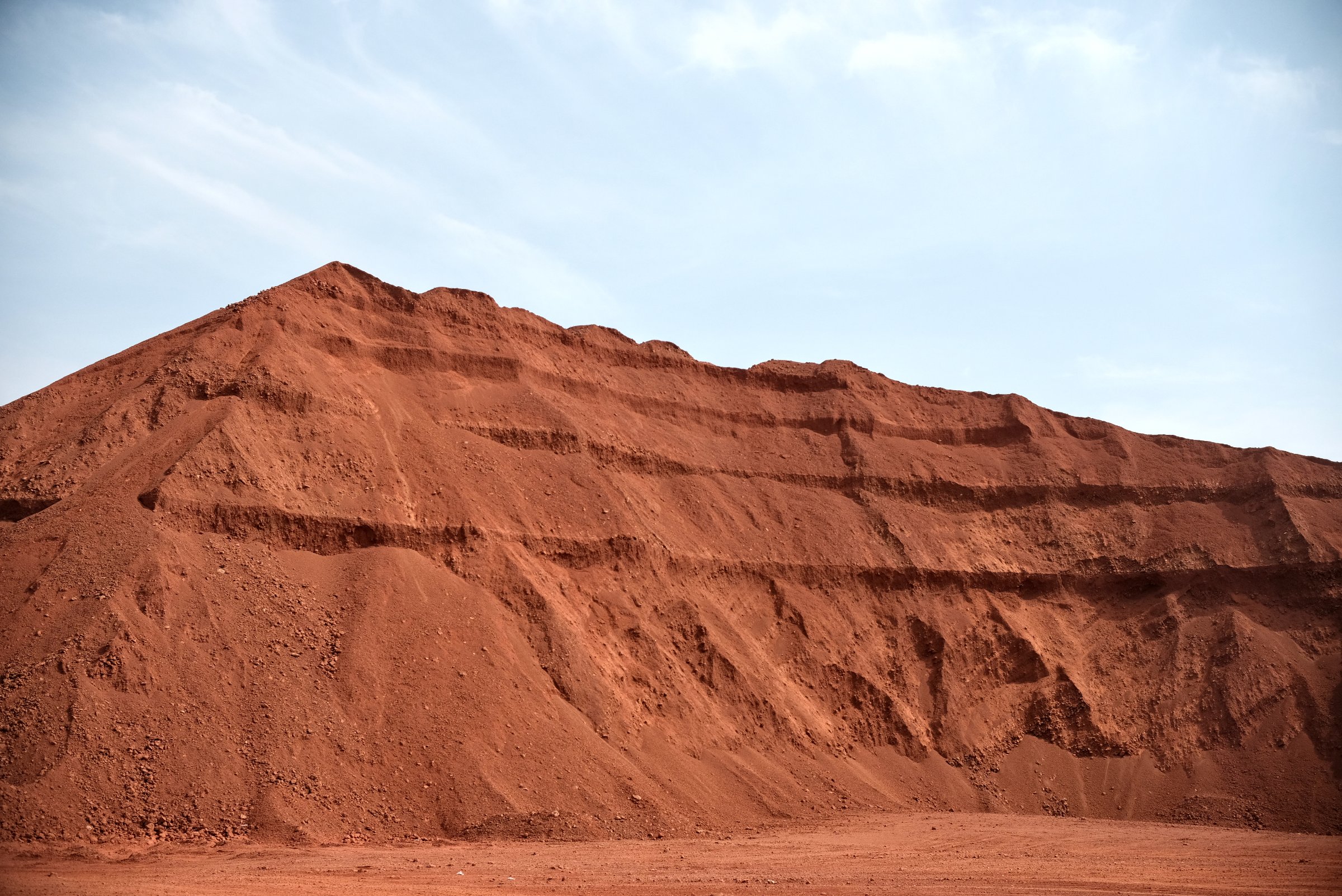
To bleed the earth. To make tonnes of laterite run off and to watch the stones pile up, growing ever redder as the soil is torn apart. From Boffa to Sangarédi, bauxite is everywhere. Loaded onto the backs of trucks criss-crossing the roads, stockpiled along ports, jolted along conveyor belts belonging to mining companies… In barely ten years, the exploitation of this sedimentary rock has experienced an unprecedented boom in Guinea.
The Boké region, in the north-west of the country, is particularly affected, as more than half of the country’s bauxite reserves is concentrated there. Estimated at 40 billion tonnes by the Guinean Ministry of Mines and Geology, they are among the largest in the world. Guinea, which despite its mineral wealth remains among the poorest countries—ranking 179th out of 193 countries in the Human Development Index established by the United Nations Development Programme (UNDP) in 2023—has made bauxite one of the pillars of its economy.
-
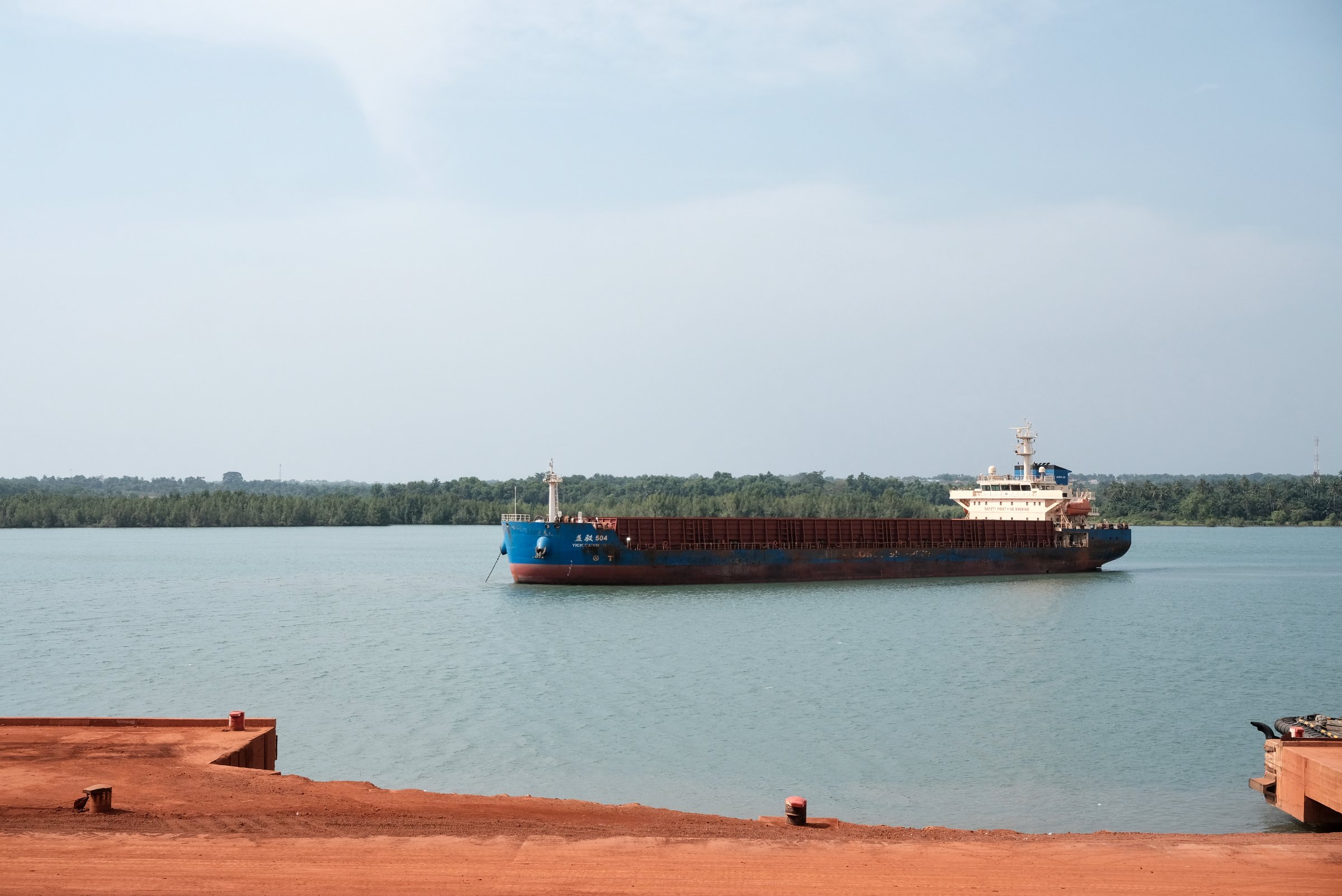
 A bulk carrier carrying bauxite at the port of Kokaya (Guinea).
 -
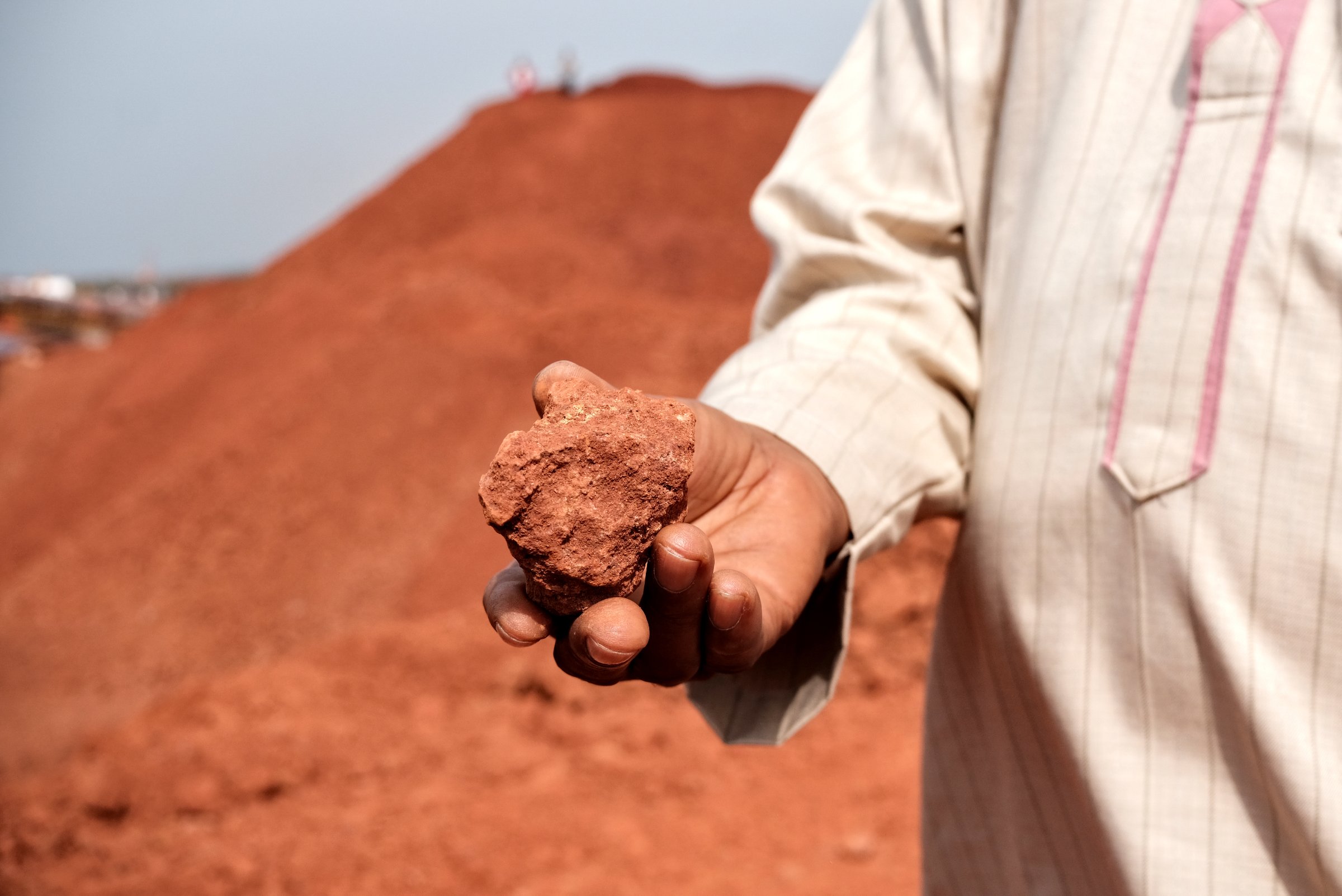
 A piece of bauxite (Kokaya Port, Guinea).
The ore is essential to the manufacture of aluminium, itself indispensable to the design of electric vehicles, which are becoming increasingly numerous on the market. Lighter than most metals, it reduces the weight of cars, thereby lowering their energy consumption. Driven by the automotive industry, demand is expected to increase by a further 30% by 2030, according to the International Renewable Energy Agency (IRENA) in its report published in April 2025. Although aluminium is recyclable, the sector still relies, one time out of two, on the metal in its “primary” form—that is, produced directly from bauxite, exports of which continue to grow: up 25% between 2024 and 2025, according to figures from the Guinean government reported in January by Reuters.
Sixty years of hope
Today, Conakry ranks as the world’s leading exporter of bauxite. A turning point in prospects for the country?
“It has been sixty years that Guinea has been exploiting its minerals. And the increase in national revenues has never translated into an increase in the standard of living of the population. Boké is a martyred region,” says Oumar Totiya Barry, head of the Guinean Observatory of Mines and Metals.
Along the 120 kilometres between the towns of Boffa and Boké, from the small village of Katibini to the brand-new port of Kokoya, bauxite exploitation divides. And it profoundly alters the structure of the region.
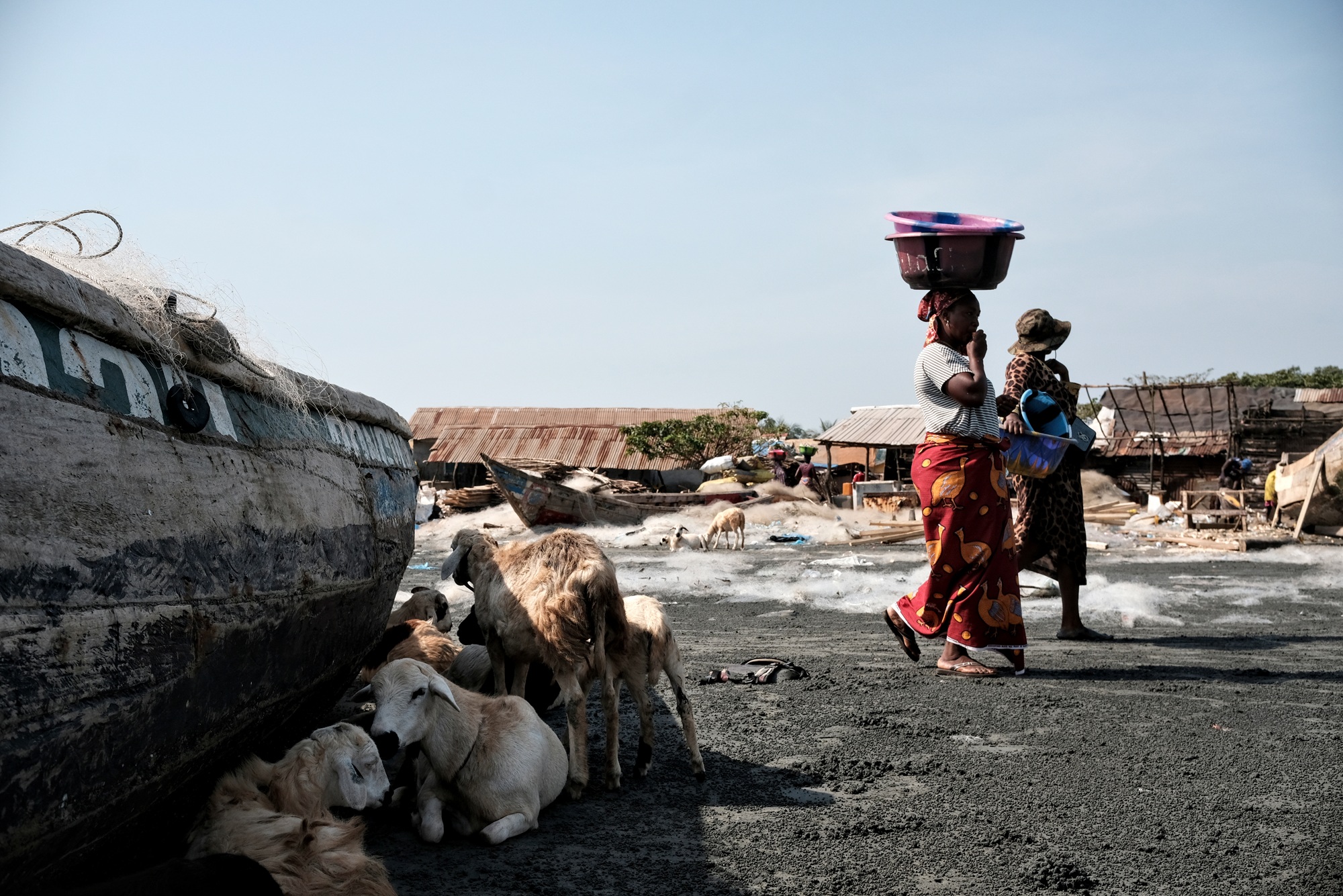
Bongolon, a traditional fishing port bordering the Atlantic Ocean, bears witness to this. Around twenty pirogues lie stranded on its shores, the Guinean flag raised to the wind, paint barely flaking on the dry wood. They should be at sea, says sadly, Fodet Bangora, president of the district of Siranka, to which Bongolon belongs.
From his office—a table and two chairs under a corrugated iron roof—he looks at the empty nets scattered across the beach.
“The main activity here is fishing. But we only have problems! There is no longer any point in going out to sea. The quality of the fish has changed, some species can no longer be found… It’s just small, small now.”
According to him, the cause lies in the ports built by mining companies. There are nine across the Boké region, for a total of fourteen companies (eleven international, two “mixed” and one national). Some are operated by a single company—such as the ports of Dapilon, by the Compagnie de développement des mines (CDM)-China, or Kamsar, by the Compagnie des bauxites de Guinée (CBG)—others by a consortium.
“There are so many mining ships that they are driving the fish away,” confirms Ibrahima Kalil Scylla, a 35-year-old fisherman met on site.
Faced with the depletion of fish stocks, he must venture ever further out. But the pirogues are not suited to the open sea, so each outing is perilous.
“Before, I would go out for three hours and come back with one million Guinean francs [around €95] worth of fish per day. Today, you have to go beyond the Chinese ships. When I come back, if I have more than 500,000 Guinean francs [less than €50], I have done very well,” the young man complains.
Impact on ecosystems and the social fabric
Fishermen also point to the large quantities of rock that spill into the ocean, altering its ecosystems. In the absence of deepwater infrastructure—although the construction of a terminal is being considered in the district of Kouffin—bauxite is transported to export vessels using flat-bottomed barges or bulk carriers (which have greater capacity). During each transfer, part of the cargo falls into the water.
There are also potential health risks. “Oil changes, fuel… all the large ships discharge here. As soon as you finish fishing, you have to wash your hands to avoid contact with chemical substances. We don’t know exactly what it is, but it burns— everyone can tell you that,” explains fisherman Ibrahima Kalil Scylla.
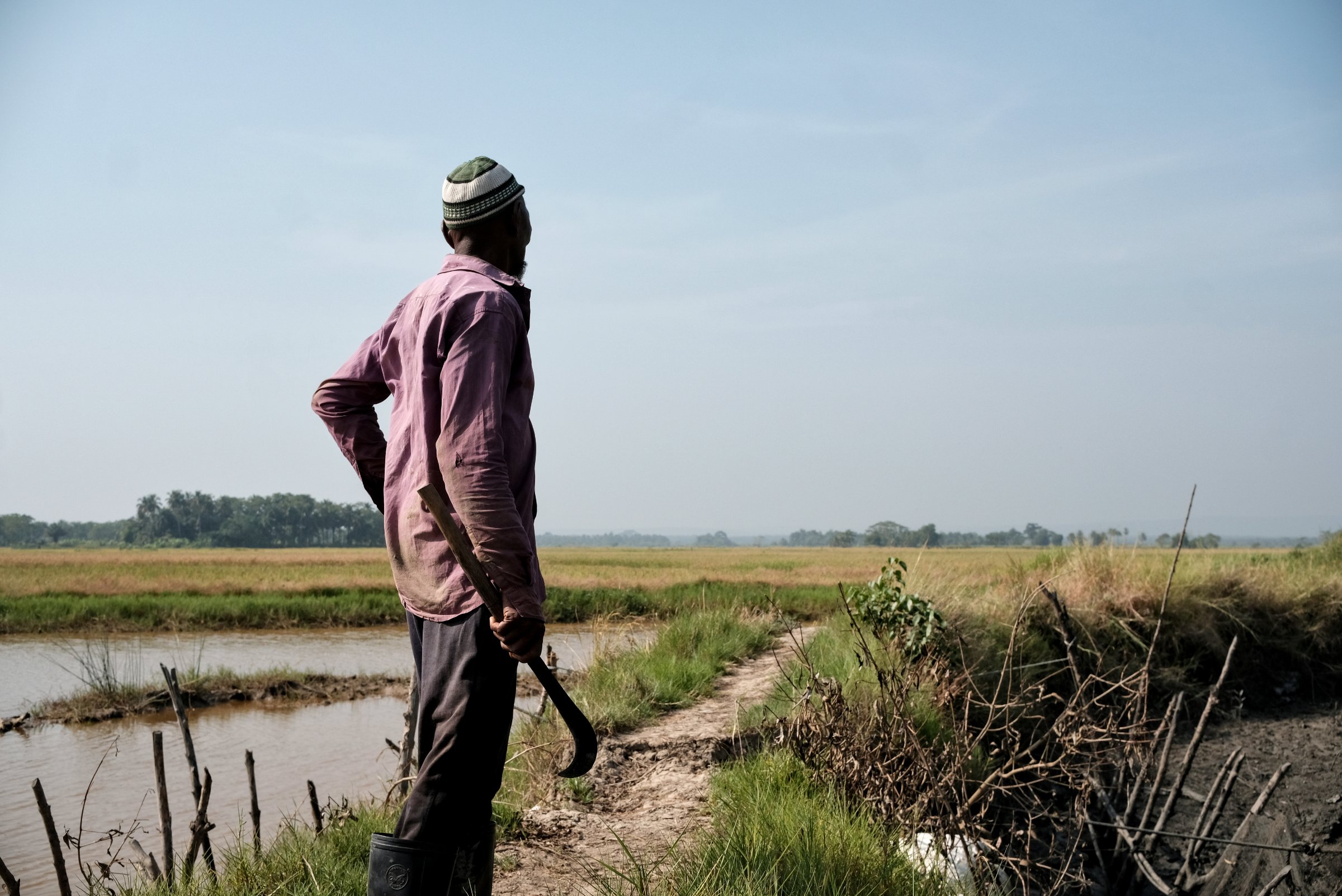
Contacted by Afrique XXI, Guinea’s Minister of Environment and Sustainable Development, Djami Diallo, acknowledges the “particularly significant” impact caused by the multiplication of ports on coastal erosion. Saltwater submerges the dykes, erected in vain, and then rushes inland, floods villages and drowns rice fields in its path.
One example of “dividing” the inhabitants is the tiny village of Siranka, a few kilometres east of Bongolon. “Faced with the situation, there are those who stayed and those who left to farm elsewhere,” says Arsène Souma, one of the salt producers met on site. “It has torn apart the social fabric.”
The suffocation of crops
Around thirty people in the village still make a living from rice farming and salt production, a traditional activity in Guinea. Previously immaculate white, the crystals are now orange, and the first layer has to be discarded. But above all, nothing grows anymore.
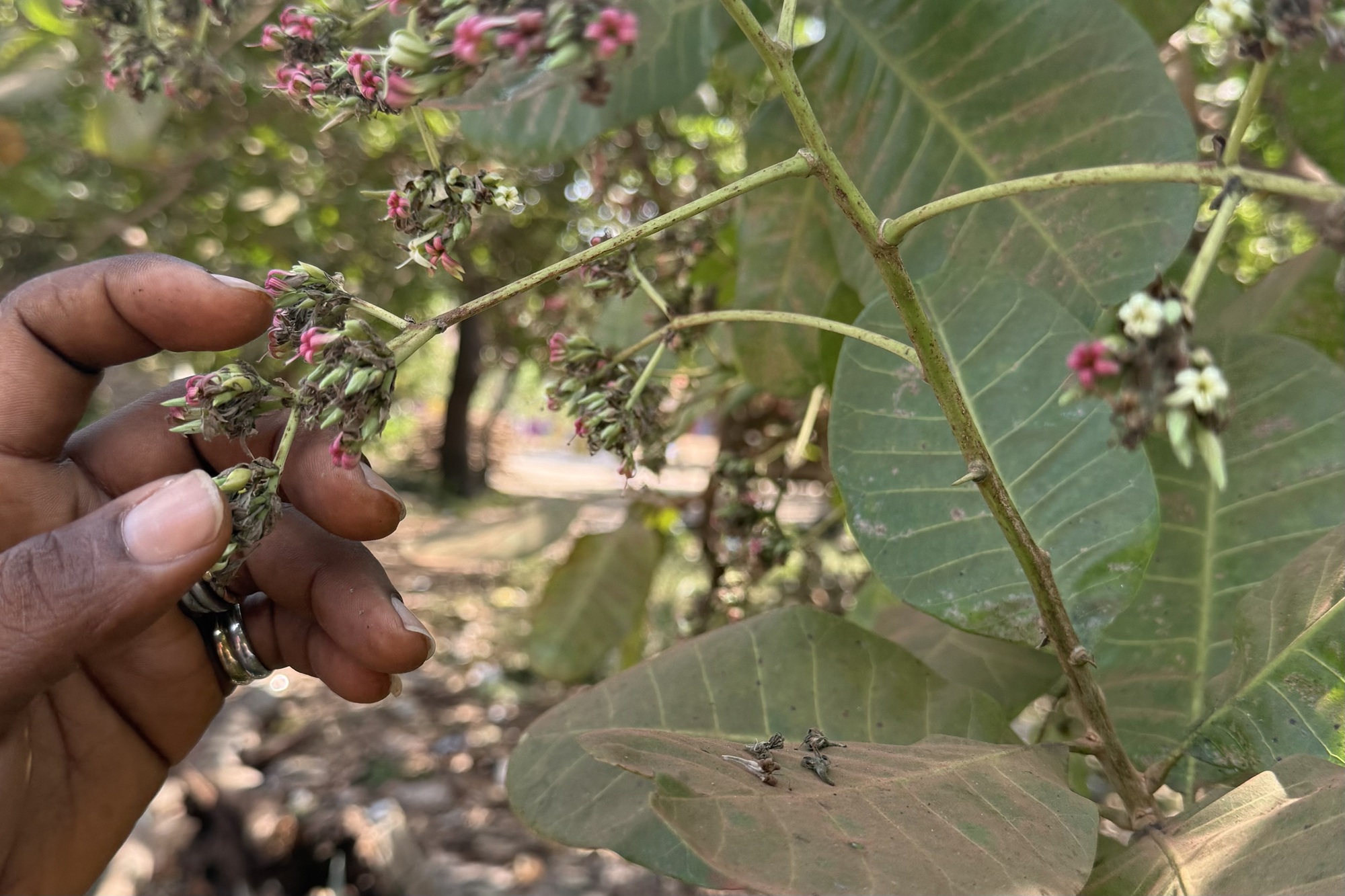
Mangoes, tomatoes, cashew trees… branches remain bare and flowers wither, suffocated by the ochre veil that covers them. In some localities, entire crops have had to be relocated.
-
 In Siranka, the branches of the cashew trees remain bare and the flowers are withering due to bauxite pollution.
 -
 Lorries loaded with bauxite on the road to Kokaya Port (Guinea).

“Everything in the region changes colour. Even your white shirt—you can’t wash it and hang it over there. The Boké region is dust,” says Arsène Souma.
Stirred up by the constant movement of trucks transporting bauxite from quarries to ports, the laterite particles form a greasy powder. Carried by the wind and washed along by rainwater, it obscures the roads, to the point of causing numerous accidents. Several villagers also report an increase in respiratory illnesses.
Underestimated damage
A whole section of the damage is underestimated.
When mining companies claim to compensate local communities affected by their activities, they refer to relocated villages and expropriated farmers. But there are all the others.
“A whole section of the damage is underestimated,” says Johannes Knierzinger, from the Institute of Research for Development (IRD).
The inhabitants of Siranka, for example, are not entitled to any compensation—considered “too far away” from extraction zones and roads to be affected.
“Yet the arrival of mining in Boffa has brought us to our knees,” Mamadou Ba, the village chief insists firmly.
The parade of trucks
While some companies have indeed revised their extraction methods to minimise their impact, the solutions put forward are unconvincing.
Dynamite, used to blast rock despite noise pollution and the significant cracks it causes in the walls of homes, has gradually been replaced by massive “surface miners”. By scraping the ground, these machines reduce vibrations.
But in Soumbouyadi, a village at the crossroads of roads leading to the ports, the problem is far from resolved.
A crack of a few millimetres already runs through the concrete blocks of the house being built by Salif Nabi Sylla. Here, it is not dynamite that is blamed, but the compactors used to pack down the roads.
“Everything vibrates! Even your feet!” exclaims the father.
Struggles over compensation
Those who are entitled to financial compensation often have to fight for their rights. Elhadj Karamba Guirassy can vouch for this.
This landowner, still upright despite his age, manages 310 hectares of farmland around Katibini, some forty kilometres from Boké—the work of a lifetime.
“From one day to the next, I saw trucks from the Chinese group TBEA arrive and drive across my fields. I stopped them from entering. I asked them to leave and take all the equipment they had brought with them,” he recounts.
The next day, a government representative came to negotiate. A new port is to be built—79 hectares are at stake.
“He called me ‘father’ to put me at ease. At first, he didn’t want to talk about money. He simply assured me that since the port would be on my land, I would be its owner. But I know that such statements mean nothing—and I have land titles.”
Few families possess the legal documents required to prove ownership of their land.
Elhadj Karamba Guirassy says he is still in negotiations but has not yet received any compensation, even as construction is already well under way.
Contacted, TBEA did not respond to our requests for an interview.
According to a report by the Mining Governance Support Project (Pagsem) published in June 2019, mining exploration and exploitation permits already cover nearly 61% of the Boké prefecture.
“Ridiculous” compensation
“The amounts paid as compensation are ridiculous,” according to researcher Johannes Knierzinger. “We’re talking about a few euros for each fruit tree cut down—what are farmers supposed to do with that? They no longer have regular income and cannot reinvest elsewhere. It’s derisory. A whole section of the damage is completely underestimated.”
“The problem is that, at present, there is no institutional constraint forcing companies to be more responsible,” adds Amadou Bah, founder of the NGO Action Mines.
The government has attempted to introduce an environmental and social management plan. But it struggles to be implemented due to a lack of technical and human resources.
A national reference framework on compensation, indemnification and the resettlement of populations affected by mining activities has also been drafted and validated by all stakeholders since 2020. Yet it has still not been adopted.
In the meantime, each company appears to follow its own rules, taking advantage of this legal vacuum, as highlighted in a report by Human Rights Watch in 2018.
Mining giants under scrutiny
Two of the largest actors in the region—the Société minière de Boké (criticised in 2022 by an investigation by Afrique XXI over tax optimisation practices) and the Compagnie des bauxites de Guinée (in which the Guinean state holds 10% and 49% stakes respectively)—declined to respond to our interview requests.
Only the Nimba Mining Company, created by the Guinean authorities in August 2025 and unique as the only fully state-owned company, agreed to speak through its director, Patrice L’Huillier.
He firmly rejects the idea of insufficient oversight: “There may have been a certain degree of tolerance in the past,” he says. “But it is clear that the government is increasingly putting pressure on mining companies to comply. Those that break the rules expose themselves to sanctions.”
Companies stepping into the role of the state
When questioned, Environment Minister Djami Diallo stated that each year, some companies see their impact assessments and evaluation reports rejected for failing to meet environmental standards.
“Three or four” mining companies in Boké—whose identities she did not disclose—are currently concerned.
However, she acknowledges that in practice, “just because companies do not meet the conditions required to obtain compliance certification does not mean everything stops.”
In many respects, companies are stepping into the role of the state, explains Johannes Knierzinger.
Access to water, electricity, new roads, new buildings… By establishing themselves in the region, mining companies carry out numerous investments. Their presence alone often guarantees access to basic infrastructure.
“When there is a need, people no longer turn to local or regional authorities, but to the companies. These companies anticipate this: by taking on this role, they reduce tensions and obtain a kind of social licence to operate,” the researcher explains.
Persistent tensions
This does not prevent tensions from erupting.
In 2019, three civil society organisations filed a complaint on behalf of thirteen Guinean villages, accusing the Compagnie des bauxites de Guinée of violating their rights and failing to honour its commitments.
“Even today, people are angry everywhere,” confides a local official in Kolaboui, speaking anonymously. “They think they will work. They intend to—but they don’t get the opportunity. After having long hoped for the arrival of companies, they now find themselves suffering from their presence.”
“These are very sensitive issues,” acknowledges Patrice L’Huillier.
Nimba Mining has set itself the objective of employing 99% Guinean nationals.
“We meet communities every week; I personally go to meet them. We do have to be very careful, but we are not in conflict. Employing young Guineans is one of our priorities.”
Departures and new arrivals
While Nimba Mining states that it compensates all land allocated to it, the company says it is not concerned by the issue of pastoralists, as it operates “only on farmland” since its creation five months ago.
Yet according to testimonies collected on site, herders have indeed suffered from the presence of mining companies.
Accustomed to moving with their livestock, only a few remain in the region, once known for its pastureland. Most are said to have moved to Guinea-Bissau.
Women on the margins
The impact on women also remains poorly understood.
“They are left on the margins of decision-making processes and receive only the crumbs,” says Fatoumata Diallo, a resident of Boffa trained in law to help locals defend their rights.
Rarely owners of the land they cultivate, women must wait to be reassigned plots when their fields—buried under dust—no longer produce. They often end up with the least irrigated and most inaccessible land.
Used to gathering at water points to meet and exchange news, they lose these sociable spaces when they become muddy or too polluted.
A long-awaited promise of development
Despite the dynamics set in motion by bauxite extraction, many Guineans continue to flock to the region in the hope of finding work.
The buzz surrounding bauxite remains, in their eyes, the promise of long-awaited development.
In some cases, such as in the port of Kamsar—where brand-new residential buildings overlook major paved roads—these ambitions appear to be materialising. Shops are multiplying, jobs are increasing. And while fishing has declined, the number of motorcycle taxis continues to grow.
A fragile balance
“Bauxite extraction is not a problem in itself,” admits Amadou Bah. “But there must be a perfect balance between mining activities and other territorial activities. Otherwise, we will not be able to avoid a form of development that will only exacerbate inequalities and ultimately harm the country’s economy as a whole.”
The challenge is considerable, at a time when Guinea is openly displaying its ambition to move from a mining country to an industrial one, beginning with the domestic production of alumina.
Construction work on the country’s first refinery was launched in December—once again in Boké.
