It is not every day that a sitting head of state simply vanishes.
That is what happened on 11 October 2025 to President Andry Rajoelina, who was evacuated by France after three weeks of protests led by the urban youth of Antananarivo, gathered under the Gen Z banner. The Malagasy army eventually sided with the protesters, under the impetus of Capsat, the elite unit commanded by Colonel Michaël Randrianirina — the same unit that had brought Andry Rajoelina to power in 2009.
Taking advantage of the uncertainty that followed the ousted president’s disappearance, Michaël Randrianirina seized power. French diplomats saw him as a novice vulnerable to foreign influence, while several observers pointed out, on the contrary, that he was a strategist well versed in military, ethnic and religious dynamics.
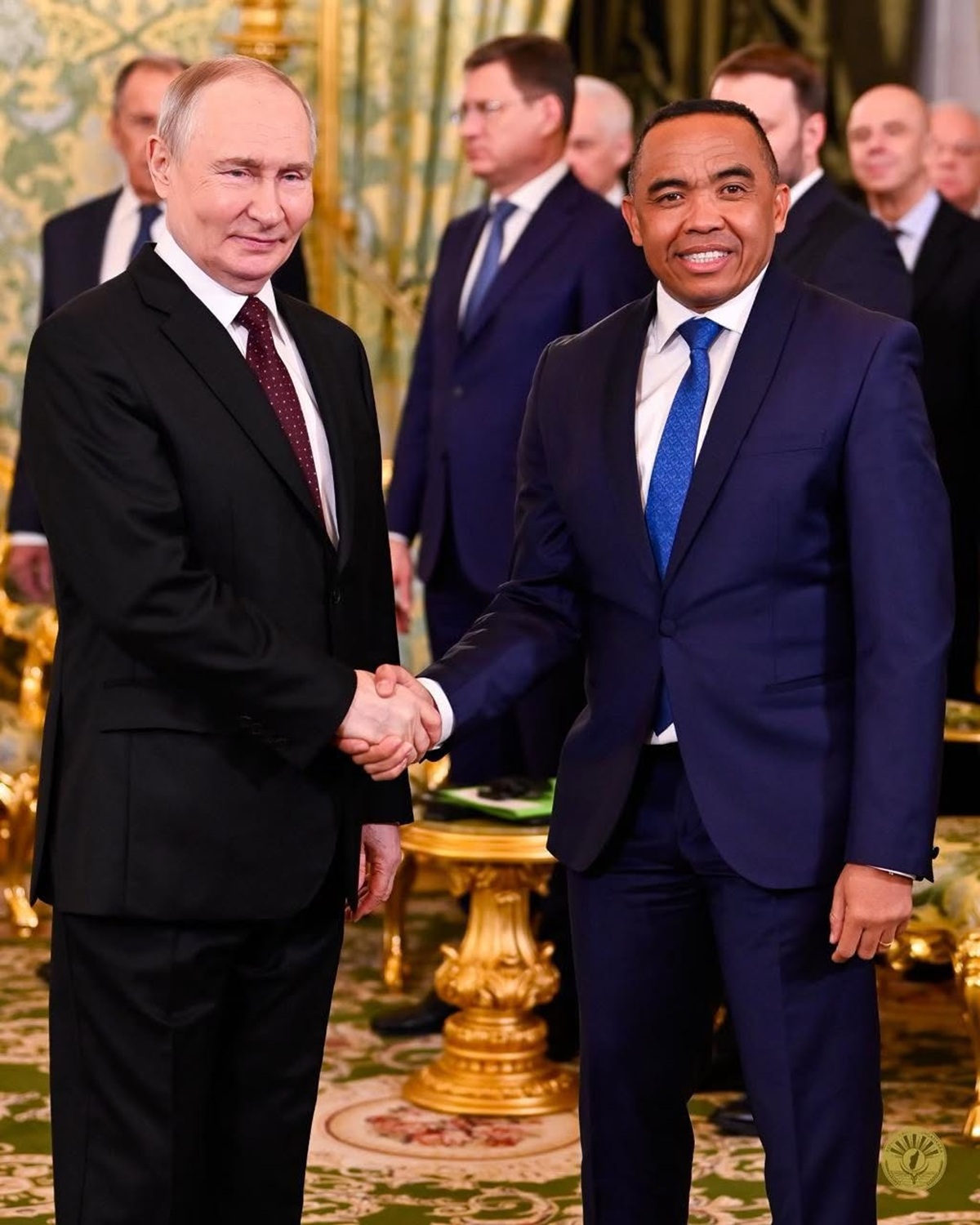
Very quickly, the new president surrounded himself with a praetorian guard of Russian mercenaries. Since then, the authorities have frequently announced alleged coup attempts. “The Russians are the guarantors of his physical security,” says researcher Olivier Vallée, a leading expert on the country. “But his real political risks remain in the streets, with Gen Z and those known as the ‘4 Mi’ — people without family, without money, without a home and without work.” Within weeks, Antananarivo had become a regular stop for Russian envoys. Colonel Randrianirina travelled to Moscow to meet Vladimir Putin on 19 February 2026, shortly before travelling to Paris.
The Ratsiraka precedent
Antananarivo is no stranger to closer ties with Moscow. The Big Island first moved into the Soviet orbit in 1975, when naval lieutenant commander Didier Ratsiraka came to power following the assassination — still unresolved to this day — of his predecessor, Colonel Richard Ratsimandrava. Ratsiraka espoused “scientific socialism”, nationalised the subsidiaries of Western companies and expelled the French from their military base in the north, which was immediately taken over by the Russians without ever becoming operational. Hundreds of young Malagasy went to study in the USSR and Czechoslovakia, forming a Russian-speaking and Russophile elite. Its influence still runs discreetly through today’s networks, fuelling nostalgia among part of the population for that relationship of the past.
The interlude came to an end in 1991 with the collapse of the USSR. For nearly thirty years, the Russian embassy in Antananarivo operated at a low level, on the remnants of that former friendship.
Russia’s real return did not begin with the 2025 coup, but with the 2018 presidential election. That year, Russian tycoon Yevgeny Prigozhin, head of the Wagner paramilitary group, acquired a majority stake in Ferrum Mining, a shell company registered in St Petersburg a few months earlier which was preparing to become a partner of the Malagasy state-owned company Kraoma in the extraction of chrome — a fiasco that ended with Ferrum Mining pulling out of the operation, leaving behind unpaid wages and substantial debts. That same year, Wagner deployed a team of political advisers to the island to protect the investment. Thirty Russian agents openly carried out disinformation and intimidation campaigns against rival candidates, using bundles of cash, and even financed the leader of an apocalyptic sect in an effort to divide the opposition vote.
But their initial candidate, incumbent President Hery Rajaonarimampianina, lost ground during the campaign. The Russians then switched their support to his rival, Andry Rajoelina, who won and, once elected, enabled Yevgeny Prigozhin, Wagner’s chief, to retain his stake in the chrome business. The operation was documented by French-Malagasy journalist Gaëlle Borgia in an investigation co-written with Michael Schwirtz for The New York Times, which earned the US newspaper the Pulitzer Prize for international reporting in 2020.1 The Russians also forged lasting ties at this time with a man who was already a member of parliament, Siteny Randrianasoloniaiko.
Judo passion
Seven years later, Siteny Randrianasoloniaiko has become the linchpin of Russian influence in Madagascar. Now president of the National Assembly and self-appointed protector of the new regime, the man Malagasy people call “Behozatse” (“the muscular one”) has instrumentalised the networks he built at the head of the African Judo Federation, a sport of which Vladimir Putin is himself a keen practitioner and long-standing supporter, to maintain a direct diplomatic channel with the Kremlin.
He is not Moscow’s only gateway into the state apparatus: several business figures who financed Andry Rajoelina’s rise are now working with Michaël Randrianirina, including a French businessman of Indian origin Shemir Sokataly, who is based in Mozambique. Even closer to the centre of power is Briand Andrianirina, the president’s elder brother and owner of the RealTV network, who is married to presidential chief of staff Onitiana Realy. Their nephew, Koufaly Daya, identified as one of the financiers of the October 2025 coup, has gained increasing political visibility through this proximity, amid suspicions of gold trafficking and a public stance as an anti-corruption whistleblower.
But it is above all the new Malagasy ambassador to Moscow, appointed in early May 2026, who embodies this rapprochement: Ny Hasina Andriamanjato is the son of the founder of the Antoko’ny Kongresi’ny Fahaleovantenan’i Madagasikara (AKFM, Party of the Congress for the Independence of Madagascar), a communist party that played an important role in the struggle for independence and became known as a pro-Soviet movement.2 The post had been vacant since 2018. In a twist of irony, Moscow even invited members of the Independent National Electoral Commission (Ceni) to the Russian school of democracy, Africa Intelligence revealed.3 In May, a delegation of six Ceni officials travelled to Russia for training organised by their Russian counterparts.
From mercenaries to businessmen
“Madagascar fits the Russians’ usual targets,” researcher Thierry Vircoulon sums up: “weak governance, a non-democratic regime, a desire to free itself from the former colonial power’s grip, and tempting natural resources.” On the ground, the Russian presence has followed the Kremlin’s familiar trajectory in Africa. After the first wave of military personnel began to deploy, a second, more diffuse wave emerged, made up of entrepreneurs and communications specialists who came “with wives and children to carve out a share of the Malagasy cake,” according to a Malagasy diplomat.
In the mining sector, two names repeatedly come up: Vadim Druzhinin and Evgeny Plekhanov, who head a network of companies affiliated with the “Alpha” brand.
Registered in Antananarivo, Mahajanga and Toliara, these companies are vying to build and operate the country’s first gold refinery, a flagship project championed by Mines Minister Carl Andriamparany. Plekhanov was also sentenced in absentia in 2016 by a commercial court in Antananarivo to twelve months in prison for misappropriation of property and failure to comply with a court ruling — a characterisation he disputes, saying he has never been convicted of fraud.
The appetite for Madagascar’s mineral wealth may not stop at gold and chrome, since the country is a historic producer of graphite, a critical mineral that has become strategically important with the rise of electric batteries, as well as gemstones and rare earths.
Another, more discreet signal comes from American-Belarusian businessman Alexander Zingman, a familiar figure in Russian networks in the Democratic Republic of Congo and Zimbabwe, who has been trying since late 2025 to establish the alternative financial system A7 in Madagascar, backed by the Russian bank Promsvyazbank and its A7A5 cryptocurrency, pegged to the rouble. Representatives of Russia’s Alabuga industrial complex in Tatarstan, where Shahed drones used in the war against Ukraine are assembled, have also travelled to Madagascar to sign cooperation agreements, according to expert David Albright, founder of the Institute for Science and International Security, cited by Voice of America.4 The “Alabuga Start” programme, which mainly targets young African women with misleading promises of employment, is the subject of an Interpol investigation. No case of a Malagasy person being recruited has so far been documented.
A channel under surveillance
At least as much as its mineral resources, it is Madagascar’s position on the maritime routes of the western Indian Ocean that is whetting Moscow’s appetite. In December 2025, a Russian delegation of around forty people, led by Ambassador Andrey Andreev, had already met with the president in an episode dubbed the “Russian jet affair”.
At the end of April 2026, another delegation visited the Secren naval shipyard in Diego-Suarez, heir to the former French naval arsenal transferred to the Malagasy authorities in 1973.
Diego-Suarez, at the northern tip of the island, offers the ability to project naval power along the major routes between the Atlantic and Indian oceans. Washington has also identified the strategic importance of the site: according to the US think tank Critical Threats Project, three senior State Department officials discussed a US military presence at the same base with Randrianirina in early January 2026, following initial contacts established in Dubai. Russian access to the base was also reportedly discussed.
And what about France?
The former colonial power remains one of the Big Island’s main economic partners, behind China, and French companies, or companies run by French nationals, continue to play an important role in the local economy. But French diplomats are walking on eggshells. On 28 April 2026, Antananarivo declared Colonel Pierre Couve, France’s interior security attaché at the embassy since 2022, persona non grata and expelled him. He was suspected of communicating via WhatsApp with members of Gen Z as part of an investigation into an attempted assassination of the president and a planned coup. Another Frenchman, former military officer Guy Baret, was also charged in the case. The French embassy denied rumours of a list of ten French nationals allegedly suspected of involvement, describing them as “false”.
Paris replaced outgoing ambassador Arnaud Guillois with a diplomat experienced in Russian influence operations: Jean-Marc Grosgurin, who held the same post in the Central African Republic between 2020 and 2023. The CAR is one of the most advanced laboratories of Wagner’s strategy on the continent. French researcher Roland Marchal noted, at the end of Grosgurin’s mission, that he had had to “manage France’s thousand and one misadventures amid an accumulation of provoked incidents and imaginary conspiracies”.
A limited Moscow fever
In Madagascar, political figures are now openly displaying their allegiance to Russia: former Defence Minister Léon Jean Richard Rakotonirina has launched an openly pro-Russian — and pro-BRICS — party, the Réveil patriotique de Madagascar uni, and chairs the Friends of Russia association, praised by Ambassador Andreev as a key player in bilateral cooperation. But the initial admiration of part of the public for a “providential” Russia is already fading: military parades, operas and ballets are failing to draw crowds, and commemorations of the 1945 victory over Nazism do not resonate with many people on the Big Island.
The Moscow fever has not taken hold of the entire state apparatus either. The Justice Ministry, headed by Fanirisoa Ernaivo, and the Foreign Ministry, entrusted to career diplomat Alice N’Diaye, remain resistant for the time being, several sources say. And if Colonel Randrianirina has turned towards Moscow, it is also, and perhaps above all, by default. After an unsuccessful first contact with the Americans, caught up in the diplomatic reorganisation of the Trump era, and a failed attempt to recruit Moroccan bodyguards, possibly torpedoed by Paris, Russia was the only option available.
Moscow no longer has the same arsenal of attractions in Madagascar that it possessed during the Soviet era. A Russian cultural institute is reportedly being considered. But large-scale scholarship programmes are no longer on the agenda, and Russia cannot compete with China, which continues to host contingents of Malagasy students and officers every year. “No one wants to go and study in Russia today,” says Olivier Vallée. “It lost its prestige after the Brezhnev years.”
If the strategy is working for now, it is above all because the field has been left open: occupied elsewhere or tired of a Malagasy potential that has never really been transformed into lasting profits, the major foreign powers have one after another distanced themselves. All that remained was for someone to move in.

1Gaelle Borgia, Michael Schwirtz, “How Russia Meddles Abroad for Profit : Cash, Trolls and a Cult Leader”, The New York Times, 11th november 2019.
2In the 1980s, however, Richard Andriamanjato and his son left the original AKFM – then led by Gisèle Rabesahala – to found the AKFM-Fanavaozana, distance themselves from Moscow and join the opposition.
3Laure Verneau, ‘Madagascar: Electoral Commission officials undergoing training in Moscow’, Africa Intelligence, 22 May 2026.
4Matthew Kupfer, Salem Solomon, « Expert : Several African governments unaware of young workers in Russian drone factories », Voice of America, 18 décembre 2024.