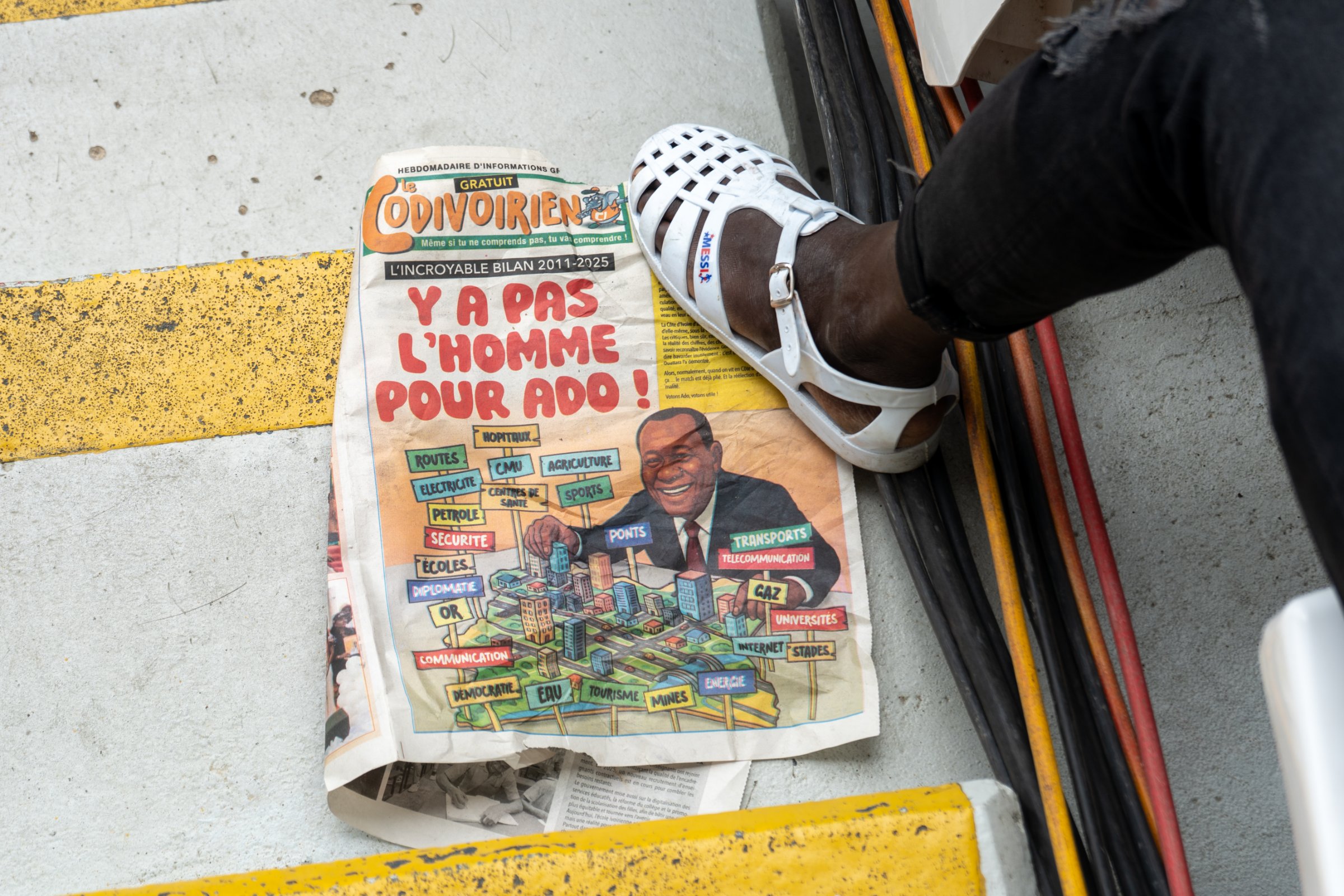
Leaders of the presidential party insist on one point: since 25 October 2025, Alassane Dramane Ouattara (known as ADO) has not been serving a fourth term. In their view, it is the second term of the Third Republic. And the members of the Constitutional Council agreed with them in 2020, an election year that saw the head of state win a third consecutive vote: they ruled that the new constitution of 2016, which limits presidents to two terms, had reset the clock to zero. This reading allowed him to extend his rule by a decade.
Now 84, ADO has ruled with an iron fist for sixteen years over this country of 33.5 million people, France’s last heavyweight ally in West Africa, where the creation of the Alliance of Sahel States (AES) has considerably weakened Paris. Paris is thus careful not to meddle in the internal affairs of Abidjan, where civic space continues to shrink. To international partners, the barons of the Rassemblement des houphouëtistes pour la démocratie et la paix (RHDP, Rally of Houphouëtists for Democracy and Peace) repeat a convenient and unanswerable argument: a half-democracy is better than chaos. It is a weighty argument, given that the post-election crisis of 2010-2011 left 3,000 people dead. That year, the rebellion, which had been based in the north since 2002, brought Alassane Ouattara to power with the help of the UN and France. The deposed president Laurent Gbagbo was dislodged from his bunker before being dispatched to The Hague, where he was ultimately acquitted in 2019.
But never mind that Laurent Gbagbo, now in his eighties, who returned to the country where he launched the Parti des peuples africains (PPA-CI, African Peoples’ Party), no longer has the age or the fire to lead a popular uprising; never mind either that his former right-hand man Charles Blé Goudé, free although convicted by the Ivorian courts, has mellowed considerably under that sword of Damocles; and never mind, finally, that the investment banker Tidjane Thiam, whose candidacy was rejected in 2025, does not have the profile of an agitator. In a country that still bears the scars of civil war and where no major election passes without bloodshed, peace is a cardinal value.
Even if that means trampling on a few democratic principles along the way. Since his fourth election with 90 % of the vote on 25 October 2025, in a ballot marked by the exclusion of his main rivals, Alassane Ouattara has been working to prepare the rise of his younger brother Téné Birahima Ouattara, whose resemblance to his elder sibling has earned him the nickname “Photocopy”. As well as being defence minister, Téné Birahima Ouattara is also deputy prime minister, a post created for him, with prerogatives as vague as they are broad, but which leaves no doubt that it positions him as heir apparent.
ADO’s absolute power
“There is an authoritarian drift to prepare for the advent of Photocopy in 2030,” says the president of a human rights association who asked to remain anonymous, as did most of the observers who still dare to criticise the government. “The president is also cleaning house within his ranks, to concentrate power around his little brother and a handful of barons.” According to Africa Intelligence (20 October 2026), Alassane Ouattara is considering a reshuffle shortly and has instructed his inner circle – Vice-President Tiémoko Meyliet Koné, Prime Minister Robert Beugré Mambé and Téné Birahima Ouattara – to propose candidates from the RHDP.
In its 2025 Democracy Index, the Economist Intelligence Unit (the research, analysis and forecasting arm of the British media group The Economist) ranks Ivory Coast 104th, with a score of 4.22 out of 10, among the “hybrid regimes”, halfway between democracy and authoritarianism1. But the balance is tipping ever more towards the latter. In its 2026 report, the American NGO Freedom House also lowered the country’s score from 49 to 46 out of 100, notably because the authorities excluded the main opposition candidates from the latest presidential election and banned their rallies2.
The government also controls the main organs of the state. In the National Assembly, the RHDP won 197 of the 255 seats in the legislative elections of December 2025, more than three-quarters of the total, against 32 for the Parti démocratique de Côte d’Ivoire (PDCI, Democratic Party of Ivory Coast), the main opposition party, led by Tidjane Thiam. In the Senate, it holds 58 of the 66 seats filled in 2023 by indirect election, to which are added the 33 senators appointed by the president.
A Constitutional Council under his thumb
The Constitutional Council, finally, has six members: three appointed by the head of state, two by the president of the National Assembly and one by the president of the Senate, both chambers dominated by the RHDP. Its president is also appointed by the head of state. The body accepted only five of the 60 candidacies for the presidential election of October 2025, excluding Laurent Gbagbo, Tidjane Thiam and Pascal Affi N’Guessan, among others.
Last May, the government even dissolved the Independent Electoral Commission, long criticised by the opposition, which accused it of partiality. Before the election, in April 2025, the PDCI of Tidjane Thiam and the PPA-CI of Laurent Gbagbo had already suspended their participation in its work, with the former president denouncing a commission that “breaks its own rules to serve the interests of those in power”.
The opposition has been invited to make proposals on the future electoral body. Since early October, the Interior Ministry has been collecting contributions from the parties, which are calling for an independent body made up of experts. But this outstretched hand fools no one. Opposition groups have written to the prime minister to request a broader framework for consultation. Asked about this after the Council of Ministers meeting of 13 October, the government spokesman, Amadou Coulibaly, dashed their hopes: “I have not been informed that there will be a national dialogue, so I cannot relay that information.”
The government is working to finish off an already moribund opposition. Guillaume Soro, the rebel leader and ousted heir apparent of Alassane Ouattara, sentenced in 2021 to life imprisonment for attempting to undermine state security, has been in exile since 2019 and is said to have taken up residence in Niger. Tidjane Thiam, abroad since the spring of 2025, is the target of legal proceedings challenging the leadership of his party, the hearing for which has been postponed to 19 November. The PDCI regularly asks the authorities for guarantees to ensure his return, without harbouring any illusions.
Deaths in detention
Opposition leaders face a wave of prosecutions linked to the electoral unrest of 2025, which officially left 11 dead, including one gendarme, and around 70 injured. Since Monday 19 October, at least nine opponents have been placed under judicial supervision, according to their lawyers.
The fourth vice-president of the PPA-CI, Justin Koné Katinan, was remanded in custody on 11 September. The former secretary general Damana Pickass, accused of terrorist acts, has been jailed since November 2025. The PPA-CI spokeswoman, Habiba Touré, who is in France, is the subject of an arrest warrant, announced by the Ivorian prosecutor on 16 September. On 12 October, Sébastien Dano Djédjé, president of the PPA-CI’s Strategic and Political Council, was charged with seventeen counts, including “terrorist acts” and “murder”, before being placed under judicial supervision.
On 23 October, four other opposition leaders were placed under judicial supervision, including Aziz Thiam, Tidjane Thiam’s brother, and PDCI-RDA officials, among them its vice-president, Georges Philippe Ezaley. In a statement of 15 October, the PPA-CI denounced “a wave of arrests” with “more than 1,600 people imprisoned”, five of whom it says have died “without the causes having been established”. On 7 November, the party announced a sixth death in detention3. It is demanding that “light be shed on this string of deaths” and the release of “people detained for political reasons”. For its part, the government rejects the characterisation of the arrests as political and speaks of “ordinary criminals”.
In March, Amnesty International was already calling for the release of dozens of people arrested on the sidelines of the election protests, some of them, according to the NGO, solely because they were near the unrest4.
The economy before democracy
The few opponents who remain, such as Charles Blé Goudé, Ahoua Don Mello and the businessman Jean-Louis Billon, are forced to operate on the margins, without the backing of a major party, with the exception of Pascal Affi N’Guessan, whose Front populaire ivoirien (FPI, Ivorian Popular Front) was hollowed out after Laurent Gbagbo’s departure. And, for lack of a sufficiently free and well-resourced civil society, no counterweight is able to stand up to the RHDP machine.
Several sources say that France, the country’s main partner, was initially tempted to back Tidjane Thiam’s candidacy. According to them, the fact that his procedure to renounce French nationality was fast-tracked is proof of this. But when the Ivorian courts ruled him ineligible, Paris did not press the point. “Between the putschist regimes of the AES and certain autocracies of the Gulf of Guinea such as Togo, the priority in the sub-region is really not Ivory Coast, where there is no violence and growth of 6 %,” says, fatalistically, a Western diplomatic source who requested anonymity.
Against a backdrop of democratic backsliding around the world, the country’s economic health is enough to reassure investors and keep Ivory Coast in the good books of the IMF. In June, the Fund completed the review of two aid programmes, worth a total of about $4.8 billion (€4.3 billion), and immediately disbursed $832.8 million. Kenji Okamura, deputy managing director of the IMF and acting chair of its executive board, welcomed reforms carried out successfully and programmes that “helped restore macroeconomic stability”5. The government thus has grounds to present its economic record as a success, while pushing into the background the question of democracy, which, in any case, now seems to weigh very little.

1Economist Intelligence Unit, “Democracy Index 2025”, April 2026.
2Freedom House, “Côte d’Ivoire: Freedom in the World 2026 Country Report”, 2026.
3Press release, “Sixième décès d’un détenu d’opinion”, PPA-CI, 7 November 2026, available on the party’s Facebook page.
4Amnesty International, “Côte d’Ivoire. Des femmes enceintes parmi les personnes détenues sans fondement depuis la répression d’octobre 2025”, 10 March 2026.
5IMF press release No. 26/222, 26 June 2026. Text of the press release