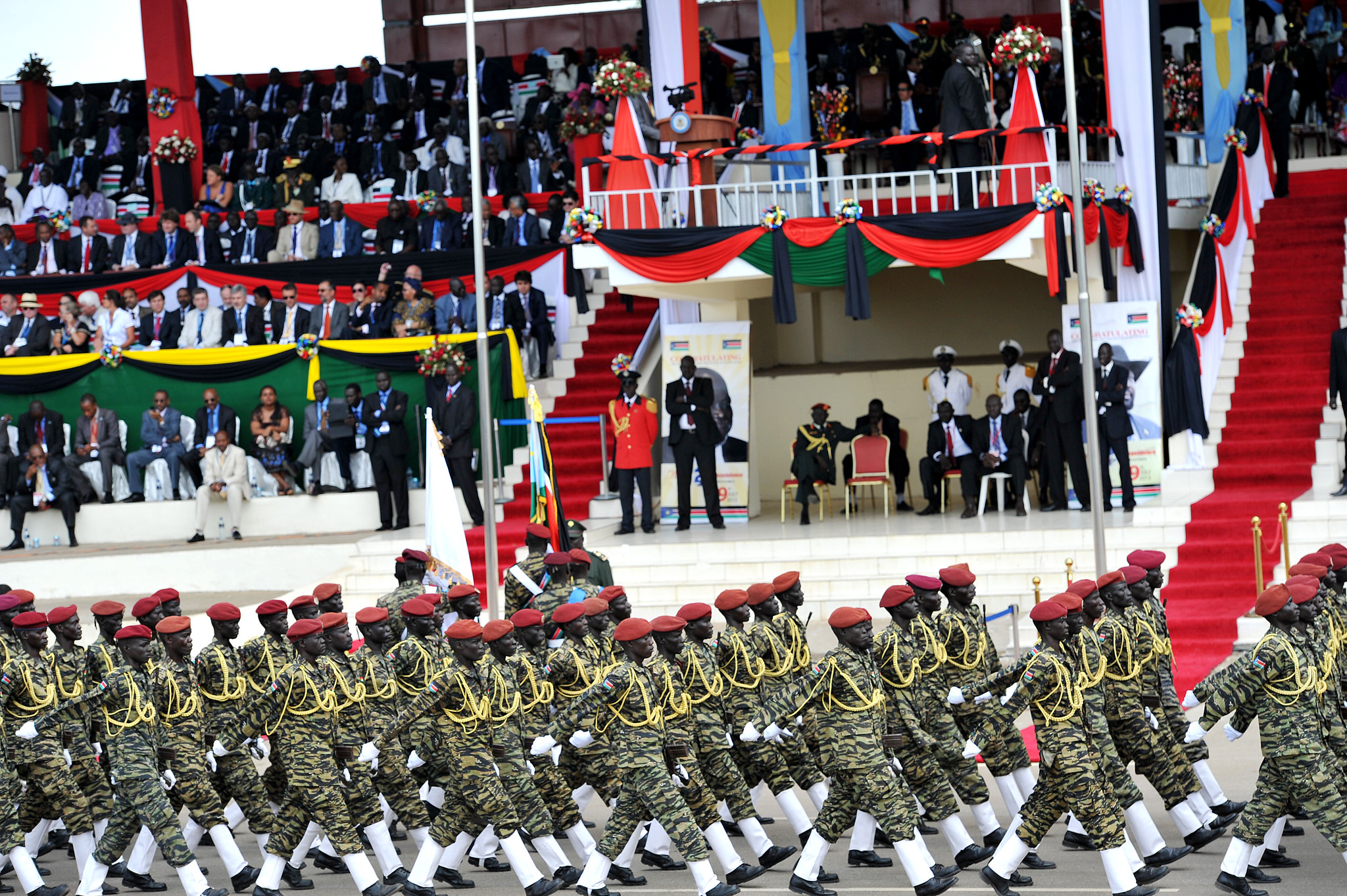
“War is coming, and it will happen. It’s only a matter of time. More and more weapons are starting to circulate. We don’t know when, but it will come, unless something happens to stop it,” says an Italian aid volunteer based in South Sudan, who asked to remain anonymous. She is neither a military analyst nor a diplomat. She is simply describing what she sees and the rumours she picks up around her. In a country that has known decades of war, people have learned to recognise its approach long before it is ever declared.
Her warning is not an isolated one. In its July 2026 report1, the United Nations secretary-general describes a political transition that remains stalled, alongside fighting that continues to rage in Greater Upper Nile, Jonglei, Unity and the Equatorias. Air strikes, ground offensives and attacks on civilians are no longer warning signs — in several regions, the war has already resumed. The question now is whether these local fronts will eventually merge back into a nationwide civil war.
The conflict pits against each other the two main wings of the former liberation movement. On one side stand President Salva Kiir, the ruling Sudan People’s Liberation Movement (SPLM), and the South Sudan People’s Defence Forces (SSPDF). On the other, Riek Machar’s SPLM-IO and its armed wing, the SPLA-IO, now weakened and fragmented. Around these two poles orbit various community militias and former rebel groups whose integration into the army is often more nominal than real. The Agwelek, loyal to General Johnson Olony, are today fighting alongside the government ; the White Army, made up mainly of armed young Nuer men, backs the opposition intermittently, without forming a regular unit under its effective control.
The unfinished business of the 2018 agreement
Kiir is Dinka and Machar is Nuer, and their respective camps have often mobilised ethnic loyalties. But reducing the war to a conflict between two communities would be misleading. It is also a struggle for control of the state, the army, oil revenues — which make up the bulk of the country’s income — and local administrations. Alliances shift, commanders switch sides, and land or pastoral disputes get folded into the wider national confrontation. The mere assumption that a village belongs to one side or the other can be enough to make it a target.
The “revitalised” agreement of September 20182 had brought an end to the deadliest phase of the war that began in 2013 — which killed close to 400 000 people and displaced 4 million between 2013 and 2018 — two years after the referendum that had sealed independence for this former region of Sudan. It provided for a unity government, Machar’s return to the vice-presidency, a new constitution, elections, and, crucially, the merging of rival forces into a single national army. The unity government was indeed formed in 2020, but the most decisive provisions — constitutional reform, cantonment, and the training and deployment of unified forces — were never completed. Each side kept its own men, its own weapons, and its own chain of loyalty.
The breaking point came after fighting in Nasir, in Upper Nile, in early March 2025. The government blamed Machar and several SPLM-IO officials for a White Army attack on a government garrison. General Majur Dak and a number of soldiers were killed as they were being evacuated by a UN helicopter. Placed under house arrest in March 2025, Machar was subsequently prosecuted, among other things for treason and crimes against humanity. The secretary-general’s November 2025 report3 had already noted that his trial, along with the removal of opposition officials, had upended the power-sharing arrangement. The SPLM-IO disputes the charges and denounces what it calls an attempt at political elimination. The detention of its leader has accelerated defections — and pushed the military option firmly back to the centre of the game.
A sharp rise in the number of victims
This is not, then, a battle between two stable armies facing off along a front line. The government is trying to retake areas held or influenced by the SPLA-IO and its allies ; local commanders are defending their own turf, negotiating their allegiance, or switching sides ; ordinary people are caught between military operations, reprisals and community mobilisation. It is this fragmentation that allows a local confrontation to spread without any single actor ever formally declaring a new civil war.
The first quarter of 2026 gives a sense of the scale of the escalation. In its quarterly report on violence affecting civilians4, the UN Mission in South Sudan (UNMISS) recorded 1 388 civilian casualties: 767 killed, 457 wounded, 93 abducted and 71 victims of conflict-related sexual violence. Compared with the previous three months, the overall number of casualties rose by 67 %, and the number of people killed by 89 %. These figures remain incomplete in a territory where access for observers and aid workers is frequently obstructed.
A communication sent to the government in April 2026 by UN experts5 sets out the geography of this violence in detail. Between January and February, more than 263 000 people are believed to have been displaced across Jonglei, Lakes and Upper Nile. At least sixteen health facilities are believed to have been looted or partly destroyed in Jonglei. The document also records the destruction or contamination of water points, the burning of homes and churches, and orders given to civilians and aid organisations alike to evacuate several counties ahead of military operations. It cites an authenticated recording of a senior military officer instructing his men to “leave no one alive” and to destroy homes, livestock and civilian property.
Weapons still flowing in despite the embargo
Alongside the violence, weapons are piling up. The final report of the Security Council’s Panel of Experts, dated 4 May 20266, documents a significant transfer of weapons, ammunition and new military equipment to the SSPDF in 2025. Rifles seized from government soldiers in Upper Nile bore manufacturing marks from 2024, suggesting they entered the country in 2025 in breach of the arms embargo. The Security Council has since renewed that embargo until 31 May 2027.
A further supply of weaponry has arrived from neighbouring Sudan. After the Rapid Support Forces seized Sudan’s Heglig oil zone in December 2025, Sudanese army soldiers crossed the border bringing rifles, machine guns, mortars, artillery, T-72 tanks and armoured vehicles. Officially placed under SSPDF guard, this equipment is believed to have subsequently been used in operations in Jonglei and Upper Nile.
The contrast is stark: brand-new weapons are entering the country even as many soldiers go months without pay or food. The regular army has, as a result, become more dependent on allied formations such as the Agwelek, who keep their own commanders and their own loyalties while nominally fighting under SSPDF authority. One officer summed up the logic to UN experts: “Sometimes you have to make war in order to make peace.” In this system, pay, looting and the protection of one’s own group have become the real tools of recruitment.
War is also undermining the country’s main economic asset. South Sudan depends almost entirely on oil, exported through pipelines that run across Sudanese territory. Fighting, damage to infrastructure and disruptions to production are eating into state revenue. Meanwhile, a share of that revenue continues to disappear into opaque channels linked to political and military figures. The economic crisis is not simply starving the state of resources — it is fuelling armed recruitment, looting and the diversion of humanitarian aid.
Elections on the calendar, but far from certain
The conflict also has a regional dimension. At Juba’s request, Uganda has deployed troops to South Sudan in support of the government, including air support, as government forces stepped up bombing raids against areas associated with the opposition. Kampala had already played this role at the outset of the 2013 civil war. Its return reduces the risk of an immediate collapse of the government, but it also internationalises the confrontation and reinforces the opposition’s conviction that the balance envisaged by the peace agreement has vanished.
After repeated postponements, the country’s first national elections since independence have been set for 22 December 2026. But the vote itself risks becoming a new flashpoint. In an interview given on 23 July to ACI Africa, the Bishop of Tombura-Yambio, Edward Hiiboro Kussala, notes that civic education, voter registration and the training of election observers have barely begun. More importantly, several political figures still command their own armed groups. “How can you go to the polls with a rifle on your shoulder?” he asks. A defeat at the ballot box could then be read not as a peaceful transfer of power, but as an existential threat to an entire political and military network.
The African Union and the Intergovernmental Authority on Development (IGAD, the regional body bringing together countries from East Africa and the Horn of Africa) are calling for an end to hostilities and a return to dialogue, though so far without the means to enforce either7. The Church, for its part, is trying to keep less visible channels open. Hiiboro explains that religious leaders meet separately with rival camps in an effort to bring them closer together. He says he has also travelled into the bush on numerous occasions to persuade young rebels to lay down their arms.
These efforts are limited, but they are a reminder that the escalation can still be halted, and that it remains, in the end, the product of political choices. Yet every postponement of a negotiated settlement gives weapons more time to accumulate, and local wars more room to merge. “It will come, unless something happens to stop it” — the people of South Sudan need no one to tell them that conflict is close at hand. They can already hear it coming.

1«La situation au Soudan du Sud», rapport du Secrétaire général, 31 juillet 2026, PDF available here.
2«Revitalised Agreement on the Resolution of the Conflict in the Republic of South Sudan (R-ARCSS)», 12 septembre 2018, PDF available here.
3«Rapport d’activité du Groupe d’experts sur le Soudan du Sud présenté en application de la résolution 2781 (2025)», Lettre datée du 25 novembre 2025, adressée au président du Conseil de sécurité par le Groupe d’experts sur le Soudan du Sud créé en application de la résolution 2206 (2015) du Conseil de sécurité, PDF available here.
4«Brief on Violence Affecting Civilians», Human Rights Division, United Nations Mission in South Sudan, janvier-mars 2026, PDF available here.
5April, 1st, 2026, available here.
6«Letter dated 21 April 2026 from the Panel of Experts on South Sudan established pursuant to Security Council resolution 2206 (2015) addressed to the President of the Security Council», 4 mai 2026 PDF available here.
7«The Chairperson of the African Union Commission Calls for De-escalation and Respect for the Revitalized Peace Agreement in South Sudan», Union africaine, 27 janvier 2026, available here, et «Report of the Executive Secretary of the Intergovernmental Authority on Development (IGAD) to the 43rd Extraordinary Summit of IGAD Heads of State and Government on the Situation in the Republic of South Sudan», Igad, available here.