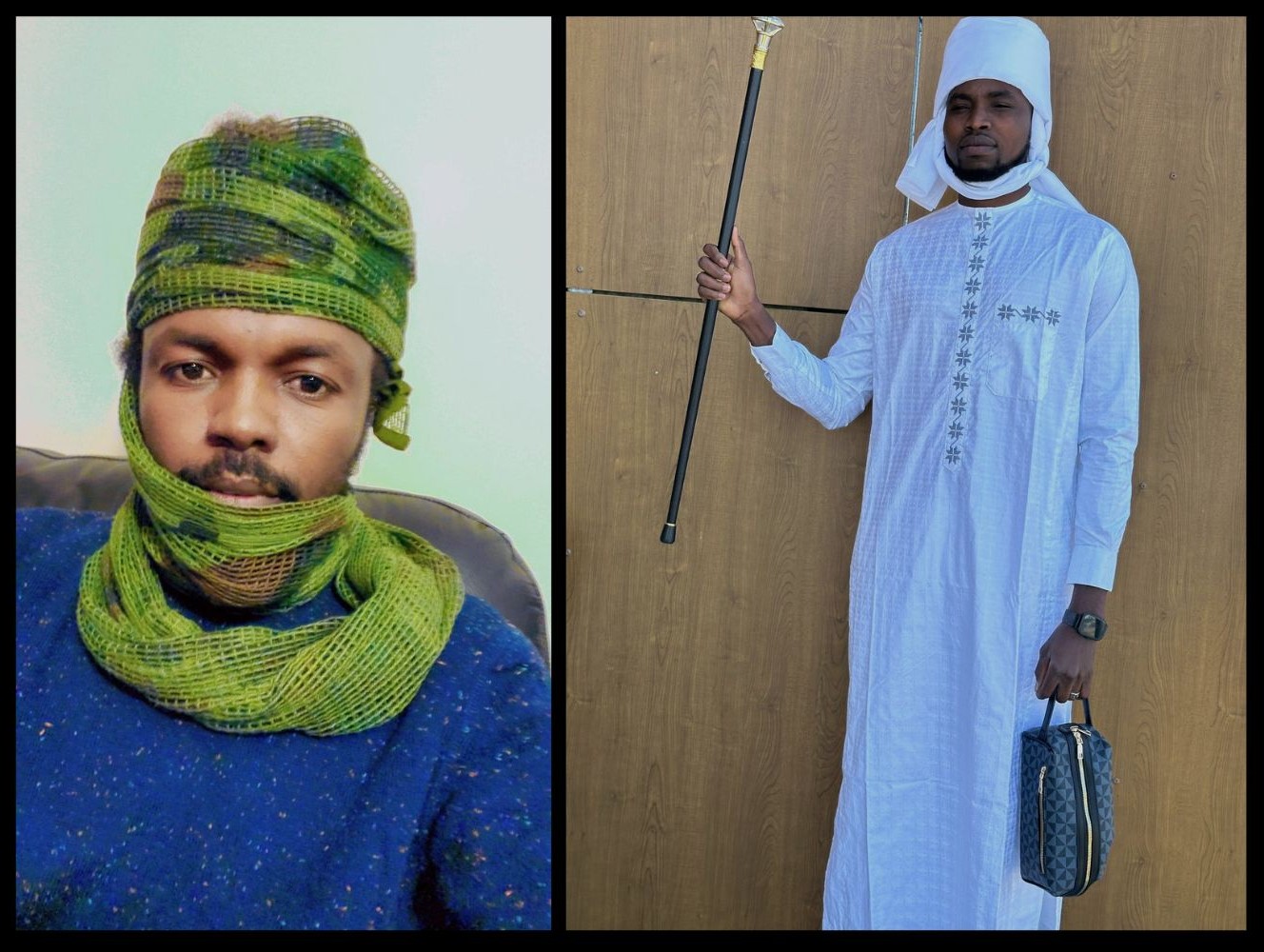
Before the outbreak of the war in Sudan on April 15, 2023, Badr worked in an electronics store. Shortly after the first clashes, he changed careers and opened a shop specializing in military clothing and accessories in North Darfur. The kadamoul is among his best-selling products. This long turban, wrapped around the head, mouth, or neck, comes in different styles, including a white cotton “civilian” version worn for special occasions (weddings, family gatherings, etc.), and beige or khaki versions used for military camouflage. The latter, the most sought-after by his customers, is manufactured in China and imported from neighboring Chad. Over the past two years, sales have steadily increased. Badr even receives orders from abroad. “At first, it was mainly soldiers from the Sudanese army or from the joint forces [allied with the army, editor’s note] who bought it, but now it has become a fashion accessory for civilians who support them,” the shopkeeper explains over the phone. A transformation that has not gone unnoticed in the public landscape. Before the conflict erupted, few residents dared to be seen wearing a kadamoul, whether military or civilian, especially in cities, as the authorities associated it with criminality. For some Sudanese, this perception still persists.
The kadamoul is a common attribute among the peoples of the Sahara Desert, and its name varies from region to region. The well-known veil worn by the Tuareg peoples, for example, is called the “tagelmust”. Since Sudan’s climate is largely dry and arid, the primary function of the kadamoul is to provide protection from the sun, dust, and sandstorms in desert regions such as Darfur and Kordofan. However, it is also worn elsewhere across the country – mainly by men. Although those who wear it perceive this scarf as an ancestral heritage, part of the Sudanese population has regarded it as a “foreign” cultural element. “In high school, during cultural week [an annual celebration aimed at promoting the traditions of each ethnic group in the country, editor’s note], if you came wearing a kadamoul, they would tell you, ’You’re Chadian, you’re not Sudanese, that’s a Zaghawa thing,” recalls Sadam, who attended high school in South Darfur in the 2010s. Such remarks reflect the discrimination against certain ethnic groups under the dictatorship of Omar al-Bashir, who was in power from 1989 to 2019.
The former head of state often appeared wearing a white cloth headdress that an uninformed observer might mistake for a kadamoul. This head covering, known as the imam, carries a religious dimension. Wearing this turban is part of a prophetic tradition that caliphs and Ottoman rulers notably embraced. Having come to power through a military coup in 1989, Omar al-Bashir established an Islamist and racist regime that favored Arab elites from the capital and northern Sudan, reinforcing a sense of belonging to Arab and Muslim culture in a country rich in cultural diversity. A population census conducted in 19561, the year of the country’s independence, counted fifty-six major ethnic groups, while more than one hundred languages are still spoken today. In 2009, the International Criminal Court issued an arrest warrant against Omar al-Bashir, accusing him, among other charges, of ethnic cleansing against Black communities such as the Fur, the Masalit, and the Zaghawa in the context of the Darfur war, which began in 2003 and has never truly come to an end.
Under Omar al-Bashir: A Strict Dress Code
The regime of the former president imposed a strict dress code, regulated by law as early as 1991. The Sudanese Penal Code provided for a maximum penalty of forty lashes for anyone who “committed an indecent act, violated public morality, or wore indecent clothing.” As a result, tens of thousands of women were arrested2 for wearing trousers deemed too tight. In Khartoum, the urban space was divided in order to be more effectively monitored3. Members of neighborhood committees – regime loyalists appointed to head local districts – were selected according to their degree of “Arabness” and Islamisation. They were supported by morality police tasked with enforcing public decency, including dress regulations.
The school textbook “Our Clothes”, a study resource for primary school pupils that is still in use, reflects this Islamist supremacist ideology. Among its illustrations is a map that claims to present the different regional dress customs. In reality, it offers a homogeneous and exclusive representation, and – like other local sartorial particularities – the kadamoul is absent from the iconography. The reference male attire consists of a galabiya for men and a thob for women.
During the war in Darfur, decrees were issued in several states of this vast region (North Darfur4, West Darfur) and in other localities, including the capital, banning the wearing of the kadamoul, with penalties ranging from fines to imprisonment. The authorities justified this measure on security grounds. It directly targeted rebels who wore the kadamoul as protection and as a means of concealing their faces in the context of armed struggle, but also as an emblem of their revolt. Opponents of the regime notably denounced its policy of marginalisation. Since independence, no president originating from the states of Darfur, the East, or the South has governed the country. All have come from the North.
A Symbol of Marginalised Africanness
In May 2008, the war between the government and rebel groups reached a turning point when, for the first time, one of them – the Justice and Equality Movement (JEM) – managed to carry out an attack in the suburbs of the capital, Khartoum. According to Mohamed Torchin, a Sudanese researcher at Dimensions for Strategic Studies and a specialist in African geopolitics, this event helped to “give visibility and strength to the kadamoul.”
Associated with Sahelian African societies, the kadamoul thus came to be perceived as a symbol of marginalized Africanness within a state that sought to define itself as Arab. The history of the kadamoul shows how the dynamics of power, identity, and culture intersect in the construction of Sudanese nationalism and in the regime’s policies of symbolic exclusion.
A decade later, in 2018, a revolution broke out. Omar al-Bashir was overthrown on April 11, 2019. Among the protesters’ grievances was the regime’s identity politics5. This critique was reflected in the slogan, “We are all Darfuris.” Demonstrators advocated for an inclusive, multicultural Afro-Arab Sudan. The sit-ins, mainly in Khartoum, allowed Sudanese from diverse backgrounds to meet and unite around a common goal: the fall of the regime and the transfer of power to civilians. Several artistic and cultural initiatives were organized to strengthen social cohesion and intercultural dialogue6.
“In Khartoum, I Would Advise Him Not to Wear a Kadamoul”
A political event a few years later, in October 2020, brought hope for a future peace: the signing of a peace agreement in Juba, South Sudan, between the transitional government formed after the revolution and some of the rebel groups. Throughout the negotiation process for peace in Darfur, rebel leaders wore the kadamoul, as they had in Doha in 2013 and in Juba. “After Bashir’s fall, political authorities believed that the kadamoul was no longer a source of anxiety or threat, but rather a symbol of cultural diversity,” explains Mohamed Torchin. We are in a transitional phase where this diversity can be expressed and remains open.”
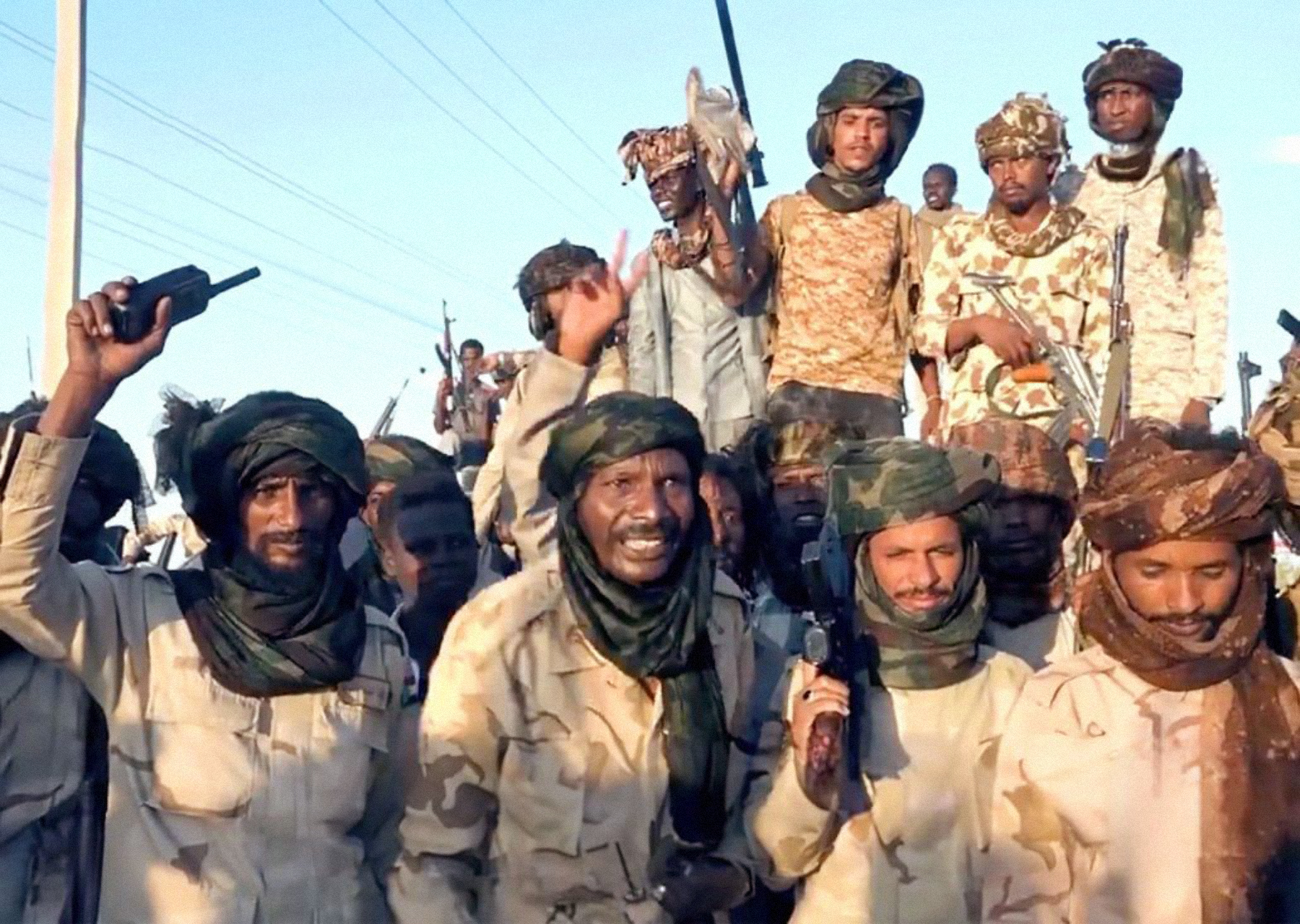
The armed conflict that erupted in April 2023 between the Sudanese Armed Forces (SAF), led by Abdel Fattah al-Burhan, and the Rapid Support Forces (RSF), led by Mohamed Hamdan Dagalo, known as Hemetti, along with their respective local and international supporters, has swept aside popular aspirations for the establishment of a civilian government. Since then, the country has been plunged into a deadly new war. Both sides have committed human rights violations and are responsible for the deaths of tens of thousands of civilians. In this context, the kadamoul has been instrumentalized by each party, even though it had previously been banned within their ranks. The RSF has made it a symbol of rallying and unity, while the SAF, supported by several rebel movements (the joint forces), also display the kadamoul, refusing to allow it to be monopolised by the RSF. The main difference between the two lies in a subtle color choice: the former favor beige and the latter khaki. This traditional turban has thus become “a cultural battlefield, where the moral legitimacy of combatants and the identity future of the peoples of Darfur are at stake,” observes Mada El Fatih in an article7 for the digital media outlet The New Arab. The journalist and researcher at the Centre for Diplomatic & Strategic Studies in Paris argues that “this is not merely a garment, but a vector of accusation or rehabilitation in a conflict deeply rooted in Sudan’s ethnic, political, and symbolic fractures.”
On social media, politicians and activists suspected of siding with the RSF are digitally adorned with a kadamoul by internet users through photomontage. Cartoonists chronicling the war also often reduce paramilitaries to their beige turbans. “If a friend goes to Khartoum, I would advise him not to wear a kadamoul,” says Mada El Fatih, emphasizing that the garment continues to inspire fear and terror among the population. The RSF target particular ethnic groups – including the Zaghawa, Fur, and Masalit – and continue to commit crimes against humanity, according to the International Criminal Court8, such as in El Fasher in October 2025. These attacks are comparable to those carried out a few years earlier by the Janjaweed, Arab militias whom Omar al-Bashir called upon to suppress the Darfur rebellion and enforce his policy of Arabization. Hemetti, who now leads the RSF, was one of the leaders of the Janjaweed. The same man who once served as the former dictator against rebel groups now claims to be the defender of the marginalized, opposing the political and military elites of Khartoum.
“The Goal Is to Convey a Political Message”
This turnaround is illustrated by the appearance of the kadamoul on the heads of his men. Previously, the red beret was part of the RSF uniform – not the desert turban. “Hemetti did not hesitate to forbid the kadamoul for his fighters at first, and then later authorized it,” notes Mohamed Torchin. “I believe he wanted this identity marker to serve as a gateway for attracting all the groups present in the Darfur region and across the Sahel. Through the kadamoul, the goal is to convey a political message aimed at creating a new alliance or reaching a common understanding despite political differences.” Some Sudanese observers even refer9 to Hemetti’s policy as the “Republic of the Kadamoul.” The warlord’s reputation has extended far beyond Sudan’s borders, with mercenaries from various Sahelian countries such as Niger and Chad joining the ranks of the RSF.
On the army’s side, prominent figures have been seen wearing a kadamoul: Yasser al-Atta, Deputy Commander-in-Chief of the Sudanese Armed Forces, and General Shams al-Din Kabbashi, Deputy Chief of Staff of the SAF. According to Hamid Hagar, a general within the joint forces, speaking to Afrique XXI, this is a message of “recognition” toward the armed movements from Darfur who have been fighting alongside the SAF since April 2024 (mainly the Justice and Equality Movement and one of the Sudan Liberation Army factions led by Minni Minnawi).
The Sudanese army reluctantly accepted the kadamoul as part of its agreement with the joint forces. Previously, it had opposed armed movements that wore it and had not acknowledged the environmental and cultural needs of the desert populations.
It justifies this mea culpa “given the necessity of the services of the joint forces and the urgency of evolving the military leaders’ thinking regarding the region, as well as their respect for the inhabitants of the desert border areas of Darfur.”
On social media, civilians in Sudan and in the diaspora also wrap themselves in the military khaki kadamoul to show support for the joint forces. Thousands of kilometers from his homeland, Sadam, exiled in France, is somewhat surprised by this new trend, which he doubts represents a genuine cultural opening. He sees the army’s attitude as opportunistic: “For twenty-four years, the state economically and socially destroyed Darfur. And now, people love us because the leaders of the joint forces are Zaghawas and fought against the RSF. And now, people love us because the leaders of the joint forces are Zaghawas and fought against the RSF.” From his shop on the ground, Badr observes that mindsets around him are changing: “People are realizing that the kadamoul has nothing to do with criminality, as some claimed before, but is indeed a cultural symbol. Thank God, the people have finally understood.” Today, he proudly wraps the kadamoul around his son’s head.

1Abdu Mukhtar Musa, « Marginalization and ethnicization in the Sudan: how the elite failed to stabilize a diverse country », Contemporary Arab Affairs, 2010, available here.
2AFP, “Wearing Trousers by Women in Sudan: Arbitrary Repression,” September 8, 2009, available here.
3Armelle Choplin, “Khartoum Facing the Challenge of Peace: The Sudanese Capital Between Urban Violence and a Symbol of Reconciliation,” September 25, 2009, available here.
4Dabanga, “North Darfur Sit-in Achieves Ban on Motorcycles,” July 10, 2020.
5Clément Deshayes, “Challenging the Identity Politics of the Sudanese Regime,” Cahiers d’études africaines, 2020, available here.
6For example, the Diversity Festivalheld at the National Museum of Sudan in 2021.
7Mada al-Fatih, “Kadamoul”… On Clothing and War in Sudan,” October 21, 2024, available here.
8Merve Aydogan, “International Criminal Court Reports War Crimes, Crimes Against Humanity Committed in Sudan,” Anadolu Agency, January 20, 2026, available here.
9Joshua Craze and Raga Makawi, “The Republic of Kadamol: A Portrait of the Rapid Support Forces at War,” Small Arms Survey, 2025, available here.