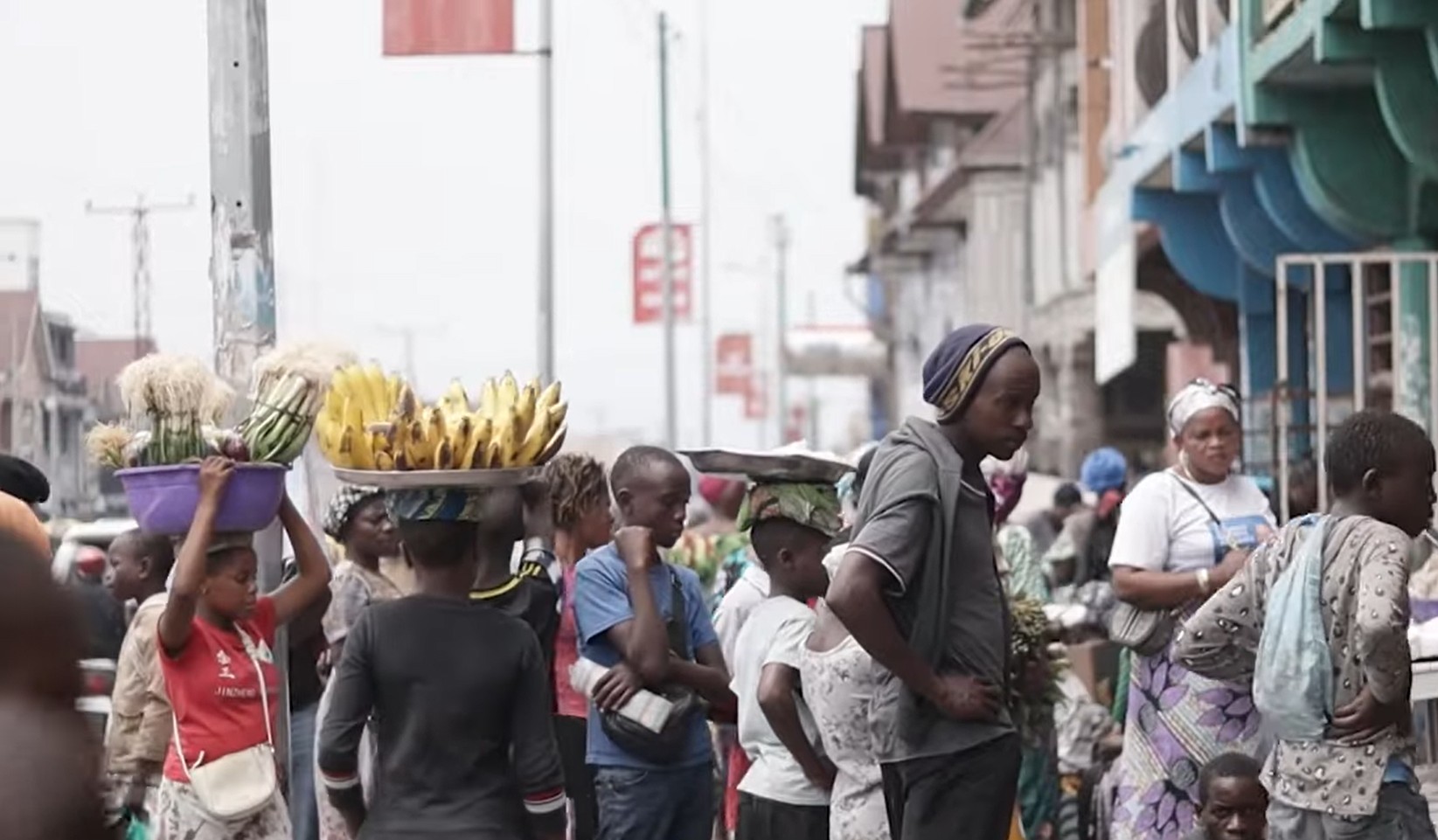
At the end of January 2025, the fall of Goma, the capital of North Kivu province with a population of around 900,000, marked a major turning point in the region’s conflict, brutally highlighting the fragility of the east of the Democratic Republic of Congo (DRC) and the Great Lakes region. The lightning offensive, led by the M23 and supported by the Rwandan Defence Forces (RDF), quickly routed the Congolese army and its allies – a motley and poorly coordinated collection of local forces, armed groups and contingents from African countries, as well as a few hundred foreign mercenaries, mainly Romanians.
The rebel group’s victory had immediate and profound consequences, paralysing the province’s institutions and overturning its military and political balance. Above all, the capture of Goma forced at least 700,000 people to flee their homes, exacerbating an already acute humanitarian crisis. A year later, its repercussions continue to shape the security, humanitarian and diplomatic dynamics in the Great Lakes region.
Ideological training
Immediately after capturing Goma, the M23 sought to transform its military victory into lasting political control. It quickly extended its territorial hold by removing officials appointed by Kinshasa, including territorial administrators, local officials and traditional chiefs, the latter perceived as representatives of the Congolese state. The M23 replaced them with its own “administrators”. This led to an unprecedented duplication of provincial administrative structures: on the one hand, pro-M23 institutions, based in Goma and operating under the rebels; on the other, authorities loyal to President Félix Tshisekedi who retreated to Beni, a town 355 km north of Goma, from where they continue to administer the small part of North Kivu that is not under rebel control.
Indoctrination plays a central role in the rebellion’s consolidation. The M23 requires its leaders and anyone wishing to join it, including administrators, to undergo ideological training. The movement thus aims to shape a disciplined and loyal elite around a narrative of “transformation/revolution” of the Congolese state through armed struggle. It also hopes to consolidate its parallel governance.
Faced with this new administrative and political power, inhabitants of Goma and the territories under rebel control have neither swung massively in support of their new rulers, nor expressed outright opposition. As the M23 deploys incentives and coercion, and as institutions collapse and violence and poverty gain ground, people have adapted through caution, calculation and silence.
Self-interested support or silent protest
Rebel leaders promise favours and jobs in the new administration to civilians who are willing to show loyalty. For some of the inhabitants of Goma and its region, collaboration with the new authorities is therefore opportunistic, dictated by survival (finding a job or avoiding trouble) rather than adherence to the M23’s ideology.
At the same time, the M23 is quick to resort to violence. Human rights organisations, United Nations experts and eyewitnesses from Goma all report arbitrary imprisonment, beatings and intimidation of civilians aimed at silencing dissenting voices.1 The message is clear: any visible or audible opposition will be punished by force. Unsurprisingly, rejection of the M23 is expressed mainly in hushed tones and private conversations. It is also felt through passive resistance, such as inhabitants’ reluctance to sign up to the rebel-run savings bank, which was launched in March 2025 following Kinshasa’s closure of the formal banking system in the region.
This silent defiance is fuelled by several factors, including the close ties between the M23 and Rwanda, which continue to provoke deep mistrust in a city marked by decades of regional conflict.2 Many in Goma see this rebellion as part of a cycle in which armed groups promise stability and change before engaging in the same predation and exclusion as those who came before.
Pockets of armed resistance
It is unsurprising that the rebels are struggling to gain popular support. The M23 presents itself as a “revolutionary” movement, promising to break away from the Congolese state, which it accuses of failure and corruption. However, in reality, it is little different from the system it claims to be fighting. Concentration of authority, excessive taxation, lack of accountability: rebel governance appears less like an alternative and more like a duplication of the Congolese state, using the same methods and the same brute force.
One of the main arguments put forward by the M23 to justify its seizure of power is the promise to restore security and public order. In most neighbourhoods of Goma, the decline in petty crime and the visible presence of rebel forces initially gave the impression of improved security. However, the M23’s security operations, often indiscriminate, end up reinforcing local resentment and fuelling latent hostility rather than reinforcing the M23’s legitimacy.
The armed group’s control is also being challenged by pockets of armed resistance. In the outskirts of Goma and in several areas under rebel control, loyalist groups, local self-defence groups known as “Wazalendo” (“patriots” in Swahili) and other armed actors continue to carry out sporadic attacks, including sabotage, assassinations and ambushes. They are a regular reminder the M23’s military victory has reconfigured the conflict but has not ended it. For example, the northbound route from Goma to the commercial city of Butembo has once again seen regular robberies and kidnappings after just a few months of calm following the occupation of this area by the M23.
Blocked salaries, inaccessible savings...
Faced with the collapse of its defence of Goma and unable to retake the city, the Congolese government has opted for other forms of resistance: institutional, administrative and legal. Kinshasa has refused to acknowledge the M23’s takeover and attempted to reduce its opponent’s room for manoeuvre, with sometimes severe consequences for the civilian population.
Among the first measures were the closure of banks and the suspension of financial operations in and around Goma. By cutting off access to the formal banking system, the Congolese state sought to prevent the M23 from securing resources, paying its parallel administration and normalising its governance. But in doing so, the government has plunged people further into poverty: salaries were frozen, savings became inaccessible and economic activity was paralysed in a city already suffering from the war.
The Congolese authorities have revoked travel documents issued by the M23 administration and declared all legal acts carried out under rebel occupation null and void. Their aim is to delegitimise any claim by the movement to exercise de facto sovereignty. But their approach places thousands of civilians in an administrative grey area, impeding or blocking access to essential documents such as marriage certificates and land titles.
Kinshasa’s measures’ limited impact
A stark example of this remote confrontation is the case of Goma International Airport. It was closed following violent fighting in January 2025. Since then, the M23, despite its desire to give an impression of normality, has blocked initiatives to reopen it. This is probably because the armed group and the Rwandan government want to use it as leverage in negotiations. They may also fear that Kinshasa’s troops or allies may use the airport to infiltrate the city, although such a scenario seems unlikely at present. Kinshasa has not taken a clear position on reopening the airport, wary of any initiative to reopen infrastructure that could appear to legitimise the rebels’ power. As a result, Goma, a landlocked city dependent on air links for humanitarian aid, trade and diplomacy, finds itself even more isolated.
Kinshasa wants to draw a red line: there can be no legitimate rival power on Congolese territory. But one year after the capture of Goma, the limits of this strategy are clear. By seeking to suffocate the M23 administratively, the government has failed to reverse the balance of power on the ground. Rather, it has increased the vulnerability of populations living under rebel control, caught between an abusive armed group and a central state that is physically absent but still places restrictions on their daily lives.
Faced with evidence of its involvement, Kigali has, since 2024, justified its presence in the DRC as being for “defensive measures”. More recently, in January 2026, the Rwandan ambassador to Washington responded to accusations by members of the US Congress concerning Kigali’s support for the M23 by referring to Rwanda’s “security coordination” with the rebels. However, these statements, which suggest discreet and limited support for M23, are far from the reality of massive and sustained backing.
According to the United Nations and International Crisis Group’s own sources, Rwanda provided decisive military support to the M23 during the January 2025 offensive that led to the capture of Goma before the fighting spread across the east of the country. This support reportedly took the form of several thousand RDF soldiers on Congolese territory – up to 6,000 in the first months of 2025 – and advanced military capabilities including short-range air defence, electronic jamming equipment and armed drones.
Rwanda’s strategy is based on calculated ambiguity
This deployment is part of Rwanda’s long-term strategic agenda: the consolidation of a zone of influence in eastern DRC. Such a zone offers several advantages for Kigali. In terms of security, it keeps armed groups hostile to the Rwandan regime, particularly the Democratic Forces for the Liberation of Rwanda, at bay and shifts confrontation further from Rwandan territory. Economically, it opens up access to investments in DRC, natural resources and cross-border flows that are essential to the Rwandan economy. Finally, politically, it strengthens Rwanda’s status as a key player in the region’s balance of power that is capable of imposing faits accompli while negotiating from a position of strength.
Rwanda’s strategy is thus based on calculated ambiguity. By neither formally annexing North Kivu nor officially acknowledging its presence, Kigali can limit diplomatic costs while maximising strategic gains. In this sense, the M23 is a low-cost political instrument for Kigali that has a strong regional impact in terms of projecting its power.
One year after the capture of Goma, the city remains caught between a rebel administration imposed by force, institutional opposition led remotely from Kinshasa, and Rwanda’s security and regional priorities. This has created a window of relative stability, but the M23 rebels have not secured lasting legitimacy and have continued predatory practices that they claim to oppose. Meanwhile Kinshasa’s attempts to suffocate the M23’s administration and deny it legitimacy have not altered the balance of power and have mainly increased citizens’ vulnerability, caught between a local armed authority and a central state doing little that is constructive but still able to make people’s lives more difficult.
A more comprehensive solution to the violence inflicted on the population would require a more accountable civilian government and the disarmament of armed groups on all sides. Few support the M23’s plan to establish a new state forged at the barrel of a gun. However, this comprehensive solution seems increasingly remote as the rebels consolidate their power and plan for long-term occupation. In this context, diplomats engaged in the latest round of negotiations, for example in Qatar, where talks between the M23 and Kinshasa resumed at the end of January, should focus on negotiating humanitarian access in order to alleviate widespread suffering. They should also ensure that the international presence, including that of the UN, can offer support to Goma’s usually very dynamic civil society and deter the M23 from committing its most egregious abuses.
