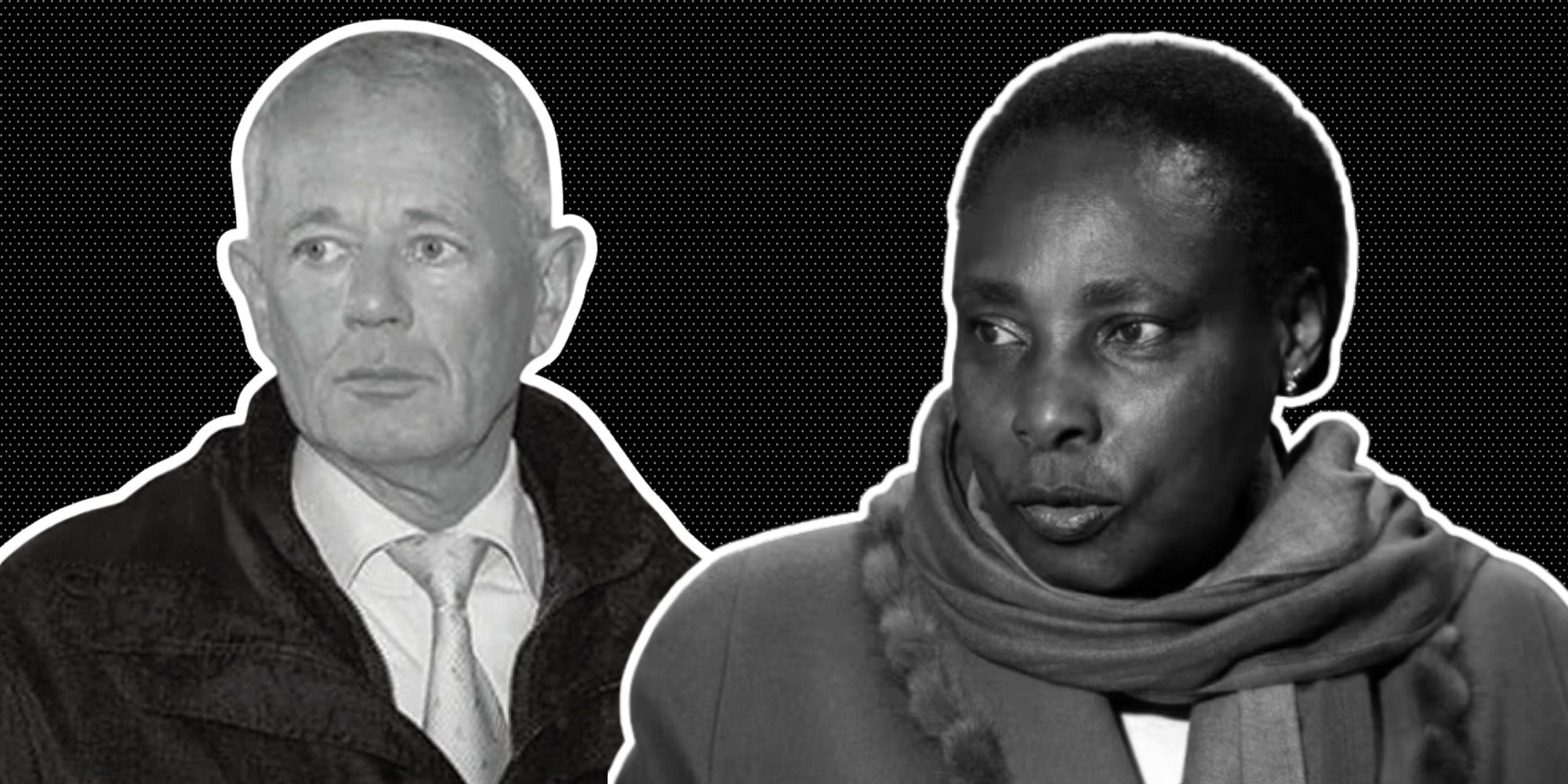
“[…] At Mrs Habyarimana’s request, I went to Kigali as soon as the attack [of 6 April 1994, which cost the life of the Rwandan president Juvénal Habyarimana] took place, and I made several stays there until the fall of Kigali at the end of July 1994 in order to carry out an investigation into this criminal act.” A hatchet man for the French Republic since the 1980s, after heading the GIGN gendarmerie special-forces unit and the Élysée’s counter-terrorism cell, Paul Barril, who died on 20 October 2026, comes across as a talkative mercenary when questioned by Judge Jean-Louis Bruguière. Since 1998 the judge had been in charge of an inquiry into the attack that gave the signal for the genocide of the Tutsis of Rwanda and cost the lives of two presidents of the Republic [Rwandan and Burundian], their aides and the three French crew members of the Falcon 50 aircraft, felled by a missile. Bruguière’s investigators questioned the mercenary chief several times, so his closeness to the widow of the Rwandan president Juvénal Habyarimana is beyond doubt.
Agathe Habyarimana-Kanziga, 83, is for her part being prosecuted in France by the National Anti-Terrorist Prosecutor’s Office (PNAT, which oversees the Central Office for the Fight against Crimes against Humanity and Hate Crimes) for conspiracy to commit the genocide of the Tutsis of Rwanda in 1994. The proceedings follow a complaint lodged in 2007 for “complicity in genocide”, “complicity in crimes against humanity” and “conspiracy to commit genocide and crimes against humanity”. The woman who had bought the mercenary’s services to defend her interests and those of her family had the case against her dismissed on 20 August 2025. The PNAT and the civil parties contested that decision and referred it to the Investigation Chamber, which will rule on 8 April. A few days later, on 13 April, Paul Barril celebrated his 80th birthday. Despite the closeness between the two, the mercenary’s name appears nowhere in the file of the former first lady.
For more than three decades, doubts have lingered over his role in the events of April to July 1994, which claimed nearly 1 million lives. Curiously, during his interrogations, Bruguière and his team never asked him where exactly he was on 6 April 1994, the day of the attack. Barril lifts a corner of the veil in his partly autobiographical book Guerres secrètes à l’Elysée (“Secret Wars at the Élysée”, Albin Michel, 1996), when he pays tribute to his protector at the Élysée, François de Grossouvre, an adviser to François Mitterrand, who killed himself in his office the day after the attack on Juvénal Habyarimana: “I learned of the death of the man I regarded as the commander-in-chief of a new army of the shadows, able to restore France, on a lost hill in the middle of Africa. […] François de Grossouvre died on 7 April 1994, shortly before 8 pm. Exactly 24 hours earlier, on 6 April at the same hour, the plane of the Rwandan president Habyarimana exploded in mid-air above the presidential palace in Kigali.”
Where was Paul Barril on 6 April 1994?
For all that he likes to feed confusion and doubt with his often contradictory chatter, Paul Barril also knows how to keep secrets, notably about the contracts concluded with Agathe Habyarimana-Kanziga and also with the “Government of Saviours”1 which, immediately after the attack, methodically organised the extermination of the Tutsis.
Colonel Sébastien Ntahobari, who died in 1999 and with whom Barril was in frequent contact at the time, left a letter dated 28 September 1998, addressed to the former French defence minister Paul Quilès, then chairman of the parliamentary fact-finding mission on Rwanda, which was charged with shedding light on France’s role in the genocide of the Tutsis in Rwanda. In it, the Rwandan officer says he asked Barril where he was at the time of the attack: “I got to know Captain Barril after the attack. […] As for his presence in Kigali at that time, it was his secret, he said.”
Some of Paul Barril’s “secrets”, however, were known to the Directorate-General for External Security (DGSE), France’s external intelligence agency, which kept a close watch on two groups of French mercenaries, Barril’s and that of Bob Denard, both of whom had offered their services at a premium to the Habyarimana family and to the interim government, which was struggling militarily. In a DGSE “special memo” of 25 May 1994 headed “Attempts by the presidential clan to hold on to power” (No. 18651/N), one reads:
Seeing its room for manoeuvre shrink as the rebel troops advance, the family of the former Rwandan president is ready to use every means to hold on to power. It is therefore engaged in intense diplomatic activity, notably with a view to delivering arms and ammunition to the government forces, which are desperately short of them. At the same time, Mr Bob Denard is pursuing preparations for an operation that could be linked to the recapture of Kigali international airport and the delivery of reinforcements in ammunition. He intends to reach Rwanda as early as Thursday 26 May 1994. Lastly, it appears that Captain Barril, head of the company “Secrets”, is engaged, in liaison with the Habyarimana family, who have taken refuge in Paris, in a conspicuous effort to supply ammunition and weaponry to the government forces.
On several occasions the DGSE drew the attention of the Élysée and of Édouard Balladur’s government to the Habyarimana family’s efforts to find ammunition to send to the Rwandan Armed Forces with Paul Barril’s help. Yet politicians took no step whatsoever to enforce the embargo voted by the UN.
“Supplying some fifty tonnes of ammunition and weaponry”
A DGSE “Rwanda-France” special memo of 17 June 1994, devoted to the “Elements on the activities of the Habyarimana Family in France”, describes his activism as follows:
Since its arrival in Paris, the family of the late Rwandan president Juvénal Habyarimana has been engaged in intense activity whose sole aim is to keep in power the northern Hutu faction, the most extremist and the most opposed to any democratic transition. The strategy of the presidential clan operates on two levels. First, in the media (letters, requests for a right of reply…), it is striving to curb the anti-Hutu campaign orchestrated by the Rwandan Patriotic Front (RPF), which names the Hutu militias as chiefly responsible for the massacres. In addition, the presidential clan is working, just as intensely but more discreetly, to circumvent the United Nations embargo on exports of arms and ammunition to Rwanda. […] Moreover, Captain Barril has apparently committed himself, through his company, to supplying some fifty tonnes of ammunition and assorted weaponry to the government forces […].
Paul Barril did not content himself with helping the perpetrators of the genocide and the Habyarimana family from the Paris offices of his company, “Secrets”. His presence in the land of a thousand hills during the genocide, attested by witnesses, raised many questions. In 1998 the French parliamentary fact-finding mission was careful not to investigate the point. Fourteen years later, after taking over the “Bruguière inquiry”, the investigating judges Marc Trévidic and Nathalie Poux set out to document the contracts Paul Barril had signed with Agathe Habyarimana and with the genocidal government, as well as the mercenaries’ journeys.
Reinforcing the Rwandan Armed Forces against the RPF
The searches of the homes and of the head office of Barril’s company, ordered in 2012 by the two investigating judges, revealed a number of items of information.
Substantial expense claims were found on one of the company’s computers under the heading “Mission Kigali”, covering trips on 20 May, 24 May, 2 June and 21 June 1994, for nearly 7 million francs. Apparently these were round trips by Falcon 50. There was also the pay of four men “plus twenty men to come” (20 May 1994), exactly the number provided for in an “Assistance Contract” signed with the interim government. Lastly, 1.5 million francs excluding VAT for “munitions and weaponry” (about $300,000). Paul Barril was questioned yet again. He told the two judges: “The company was authorised to sell defence and hunting equipment. With optics, it adds up fast.”
The search turned up the draft of a contract between Agathe Habyarimana-Kanziga and Paul Barril. Entitled “Fichier SAM” and supposedly signed on 5 May 1994, it is an “investigation and research mandate […] to conduct all investigations […] into the attack that caused the deaths of twelve people including [her] husband President Juvénal Habyarimana”. Why is this contract dated 5 May when Paul Barril claims to have started investigating a month earlier? Why does it contain no mention – among other things – of any payment?
On his expeditions to Rwanda, Paul Barril was accompanied by two of the Habyarimana sons. And the search made it possible to identify the mercenaries who went with him: Marc Poussard, known as “Maurice”, Luc Dupriez, known as “Damien”, Christophe Meynard, alias “Christian”, Jean-Marc Souren, a Canadian, alias “John”, and Franck Appietto, alias “François”, all regulars of the lucrative dirty jobs in Africa brokered by Barril. It emerges from the documents found at Paul Barril’s and from the mercenaries’ various hearings before the courts that they boasted of coming to reinforce the Rwandan Armed Forces (FAR) in the thick of the war against the RPF.
“It’s African mayonnaise”
The mercenary chief was questioned one last time on Thursday 7 June 2012. Besides the contract for the supply of 1,000 mercenaries, investigators recovered invoices for weapons, ammunition and personnel linked to an “assistance contract” between him and the Rwandan government, dated 28 May 1994. On 20 December 2011, Judge Marc Trévidic questioned Captain Barril about these documents2. The assistance contract? “It never existed”, the man himself claims. The invoices? “That was never done.” Barril sums it up cynically: “It’s African mayonnaise.”
The complaint against his client Agathe Habyarimana-Kanziga had been lodged five years earlier. The investigation proved difficult because Agathe Habyarimana left nothing in writing, and the witnesses are, to say the least, cautious, discredited or dead. Agathe Habyarimana-Kanziga and Paul Barril did, however, acknowledge a contractual relationship, and it is astonishing that the investigating magistrates make no mention of it and did not question President Habyarimana’s widow about these facts.
The 70 pages of the dismissal order of 20 August 2025 do not mention Paul Barril’s name once. As if he were a ghost. The ten magistrates who succeeded one another on the case never took any interest in him. For his part, he was still the subject of a judicial investigation for “complicity in genocide”. But, suffering from Parkinson’s disease, he was deemed unfit to answer investigators. Nor did he respond to our request for contact while this article was being written.

1This is what the interim government, formed on 9 April 1994 and led by Jean Kambanda, called itself. Kambanda was sentenced on 4 September 1998 to life imprisonment by the International Criminal Tribunal for Rwanda for his part in the genocide.
2Office of Marc Trévidic and Nathalie Poux, record of Paul Barril’s hearing, 20 December 2012.