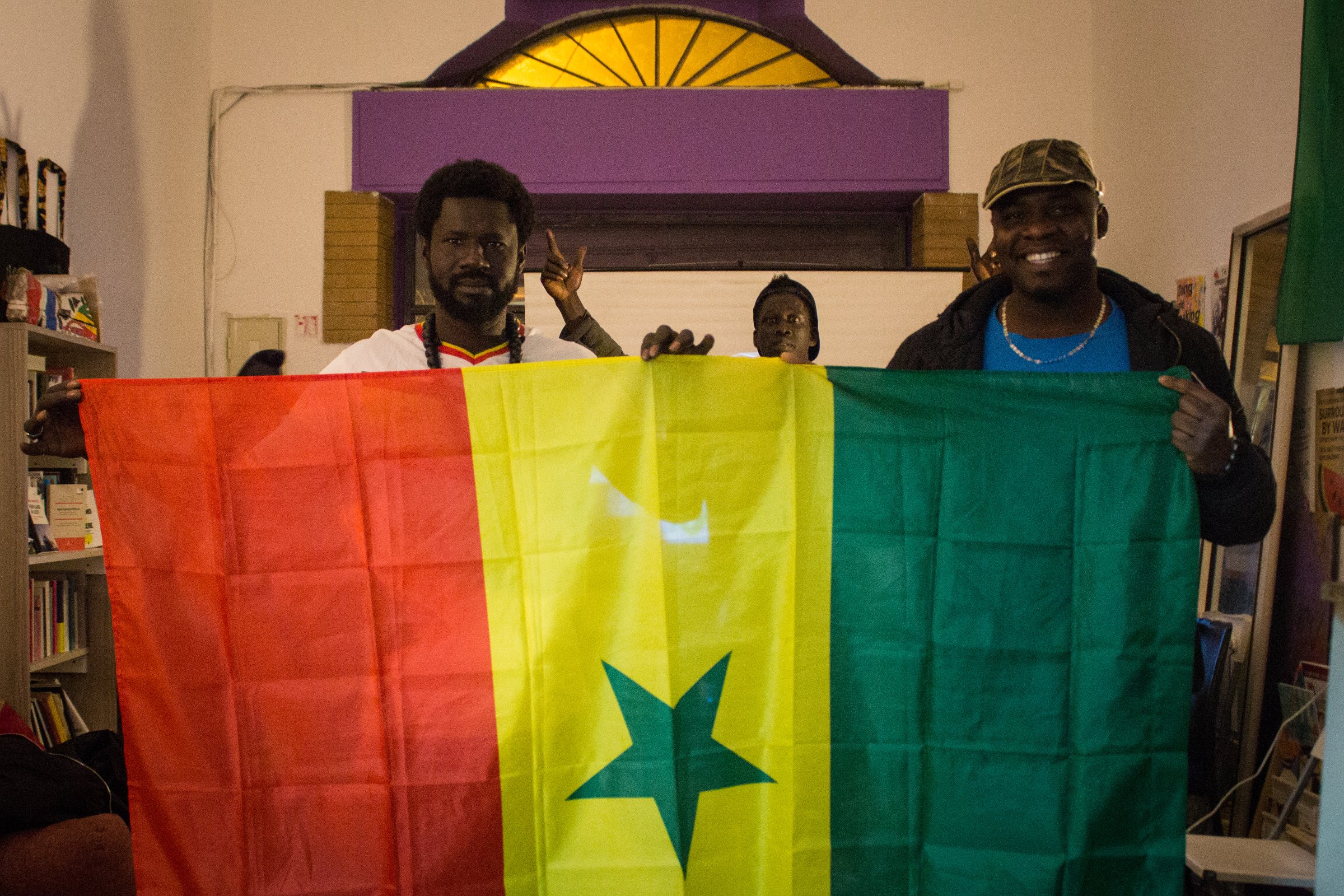
Since selling her enoteca (wine bar, editor’s note), Ornella no longer has the heart to stop when she passes by Piazza Sant’Oliva, a small green haven located in the quiet Politeama Theatre district of Palermo. From those joyful months spent serving local wines to the sounds of Miles Davis and Nina Simone, she has kept a host of fond memories – and one employee, Haroun, who followed her to the Bellotti Officine, the cultural centre where she now runs a bistro.
From here, Haroun is only about a hundred meters on foot from the premises of Maldusa1, the association he co-founded in 2023 in Palermo with around ten other members of the Baye Fall movement – a semi-autonomous religious branch of the Sufi tradition that promotes an altruistic and pious way of life, removed from material concerns. That day, like almost every day after finishing his lunch shift, he bids farewell to his colleagues and heads over to join his “brothers,” most of whom, like him, come from Senegal. “We’re lucky to have a place like this.” Lucky? Not only. Maldusa actually emerged from initiatives launched on the shores of Lampedusa as early as 2022 by several autonomous groups, including former members of Alarm Phone – a hotline platform monitoring distress calls and coordinating rescue efforts in the Mediterranean Sea – the Louise Michel rescue vessel2, the association Mediterranea, and the Baye Fall community.
That year, the United Nations3 estimated that at least 1,413 people lost their lives attempting to reach Europe via the Central Mediterranean—2, 271 the following year. How can the extreme gravity of the situation be conveyed without falling into paternalistic miserabilism? Maldusa was born out of this aspiration, with a clear guiding line: to establish in the collective imagination the idea of the Mediterranean as a space of connection and solidarity rather than reducing it to its deadly dimension – a mirror of the inequalities between the North and the South. It also seeks to remind us that those who cross it at the risk of their lives are, first and foremost, active agents who take their destiny into their own hands before becoming victims of policies that work against them. “People do not begin to exist only when they are in danger. This victimization fails to recognize people’s capacity to act and to exist outside the white-centred vision of European actors. This situation may be just as dehumanizing as portraying people on the move as dangerous criminals,” the collective explains today.
“We have all been through it.”
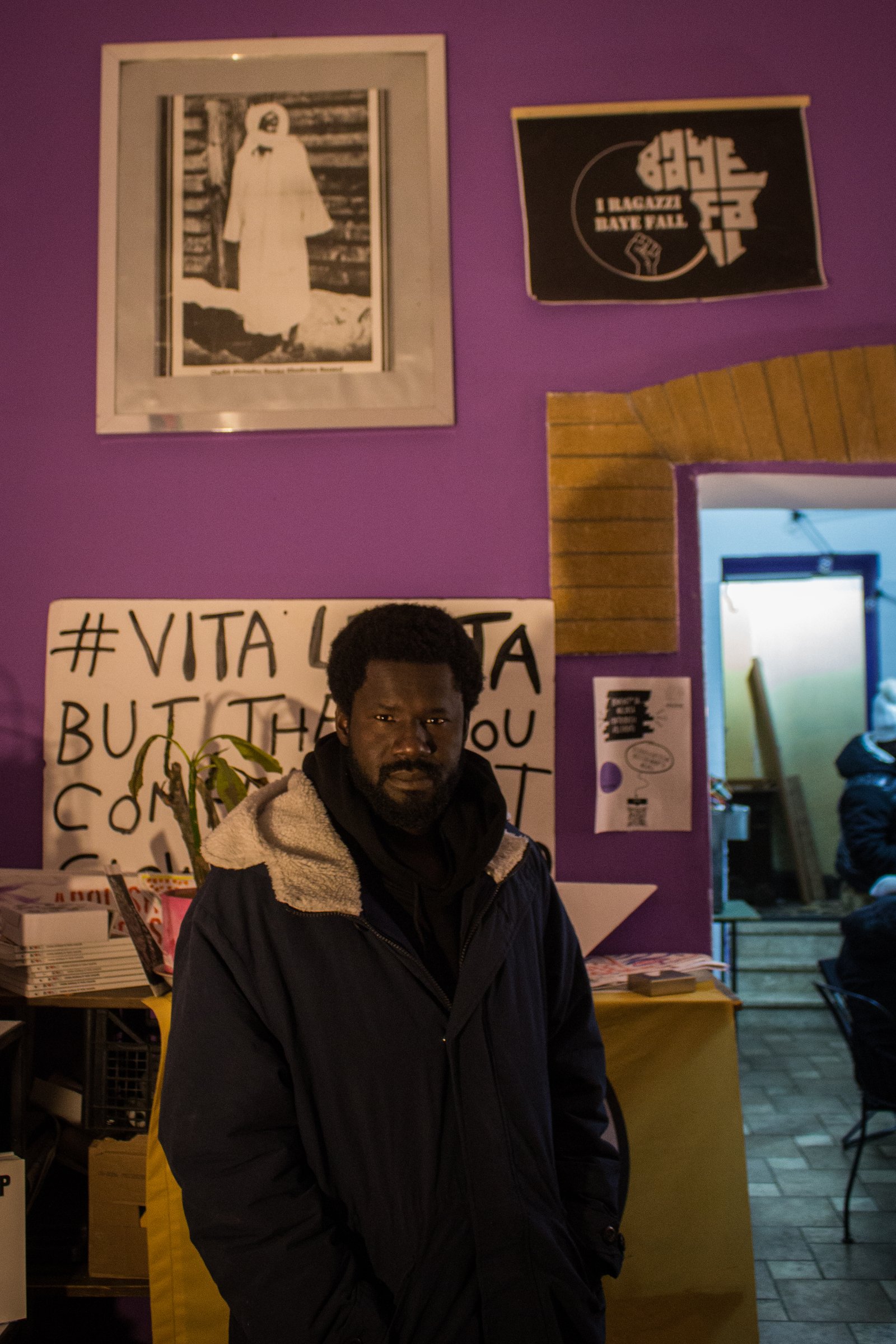
But at the time, the urgency was first and foremost on the ground. Cheikh Sene, Maldusa’s coordinator in Palermo, recounts:
We realized, among other things, that the people steering the boats from Africa to Europe, fearing that they would be identified as captains and convicted upon arrival, would cut the engine as soon as they entered international waters. This led to many shipwrecks. And very few people know this. We had to regain control not only of the situation, but also of the narrative surrounding migration stories.
Three years later, the issue of the almost systematic imprisonment of captains of makeshift boats remains a crucial concern for the association, which is multiplying initiatives to prevent such detentions, notably alongside the Captain Support group. “We now know that most of these pilots do not really have a choice and are compelled either by real traffickers or by the necessity to leave,” Cheikh Sene continues.
In addition to discussion circles and debates open to the general public, a Maldusa team also holds numerous internal meetings, organizes prison visits, and launches legal battles for imprisoned comrades, with whom they manage to maintain contact thanks to a network built over the years with local solidarity actors.
“We know what it’s like. We’ve all been through it,” explains the former fisherman from M’Bour, south of Dakar, who built with his own hands the boat on which he set out to sea in 2016. An artist in his spare time and already deeply involved in local sociocultural activities, he would have preferred to stay: “But the sea had been emptied of its fish by European and Chinese companies. Their equipment is too powerful, their boats too fast. We could no longer compete.” So, Europe became the destination.
“‘De-whitening’ the organisation’s structure”
Upon arriving in Italy, Cheikh Sene was immediately arrested and sent to prison, where he served a two-year sentence. After his release, he went to Palermo, joining several members of the Baye Fall community within the Catholic organization Caritas. We were being helped, but we weren’t really being listened to. It was hard to understand when and how to see a lawyer, or how to get papers… We quickly realized we would be more effective by organizing among ourselves,” he continues.
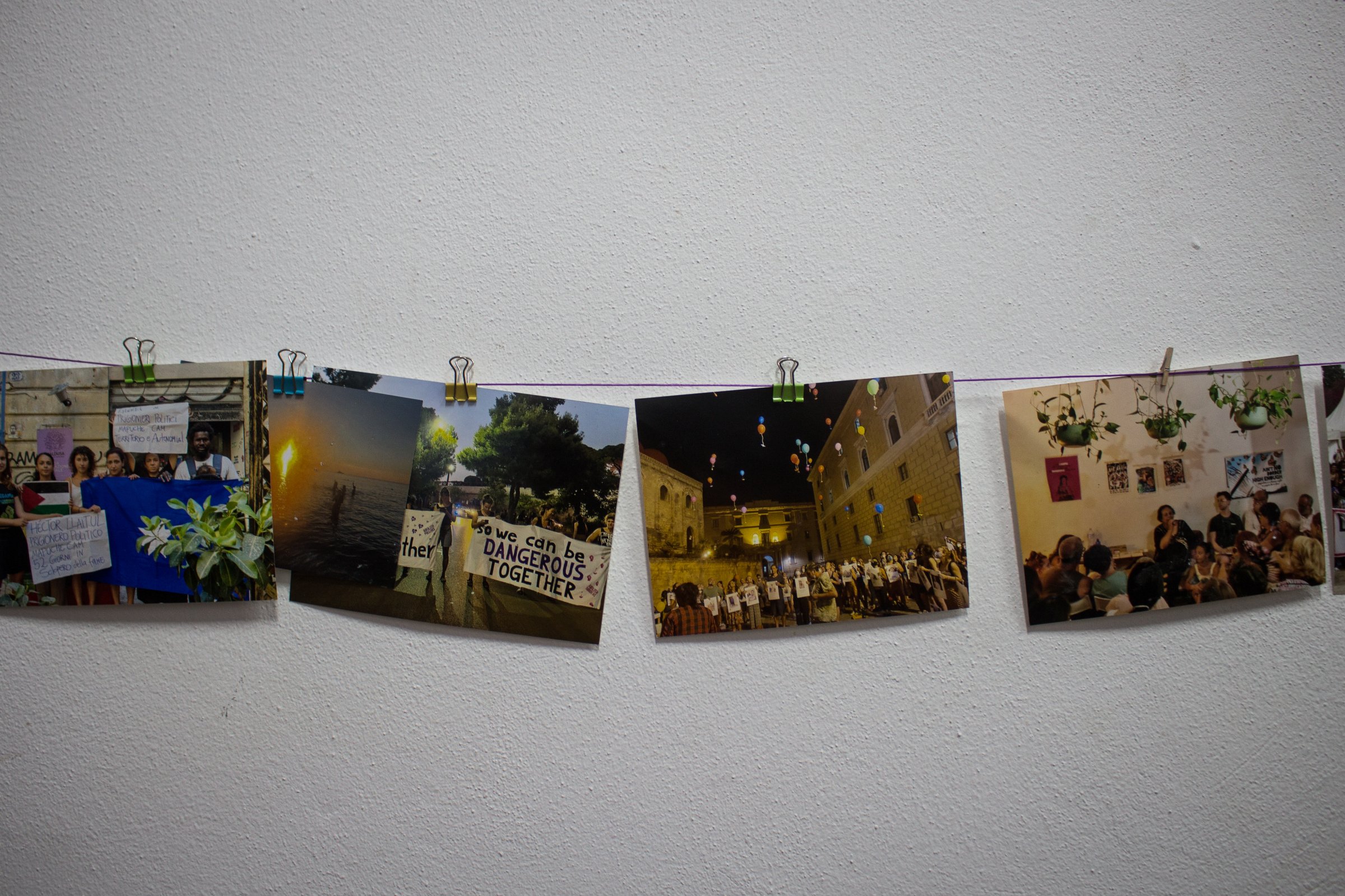
This is Maldusa’s strength: most of its founding members – all volunteers except for Cheikh Sene – were born on the African continent and have personal migration experience. “It seemed crucial to involve as many members as possible from communities that have crossed borders, in order to ‘de-whiten’ the organization’s structure. Most migrant aid associations founded by white people come in with a whole set of solutions for what they think are our problems. But we know the problems – we’ve lived them, and sometimes still do.” He points out. Furthermore, “most associations reduce exiles to their status as victims. But we don’t want to be reduced to victims, detainees, smugglers, or exploited labour. Maldusa is also about showing that we are not a problem, but a solution.” To “break the labels,” members commit to diligent knowledge-sharing, one of the cornerstones of the Baye Fall movement.
We are capable of thinking about what is best for us and deciding how we consider it wise and useful to integrate into society. If a member of our community faces a difficulty, we don’t just help them – we seek to understand why it happened and make sure it doesn’t happen again.
This does not mean closing the door to other communities – quite the opposite. In Palermo, as in Lampedusa, the association – funded by a few German foundations and private donations – has multiplied exchanges and collaborations with most of the activist groups and social operators working on the ground. “All victims of discrimination have lessons to share,” says Cheikh Sene. This horizontal and collaborative approach with various anti-colonial, solidarity, and feminist collectives in Palermo, as Deanna Dadusc, an active member of Maldusa, noted in a 2023 interview with Melting Pot Europa4, makes it possible to “create a structured and solid network across the entire Italian territory” and to highlight the work of the “clandestine railways,” in reference to the nineteenth-century American Underground Railroad.
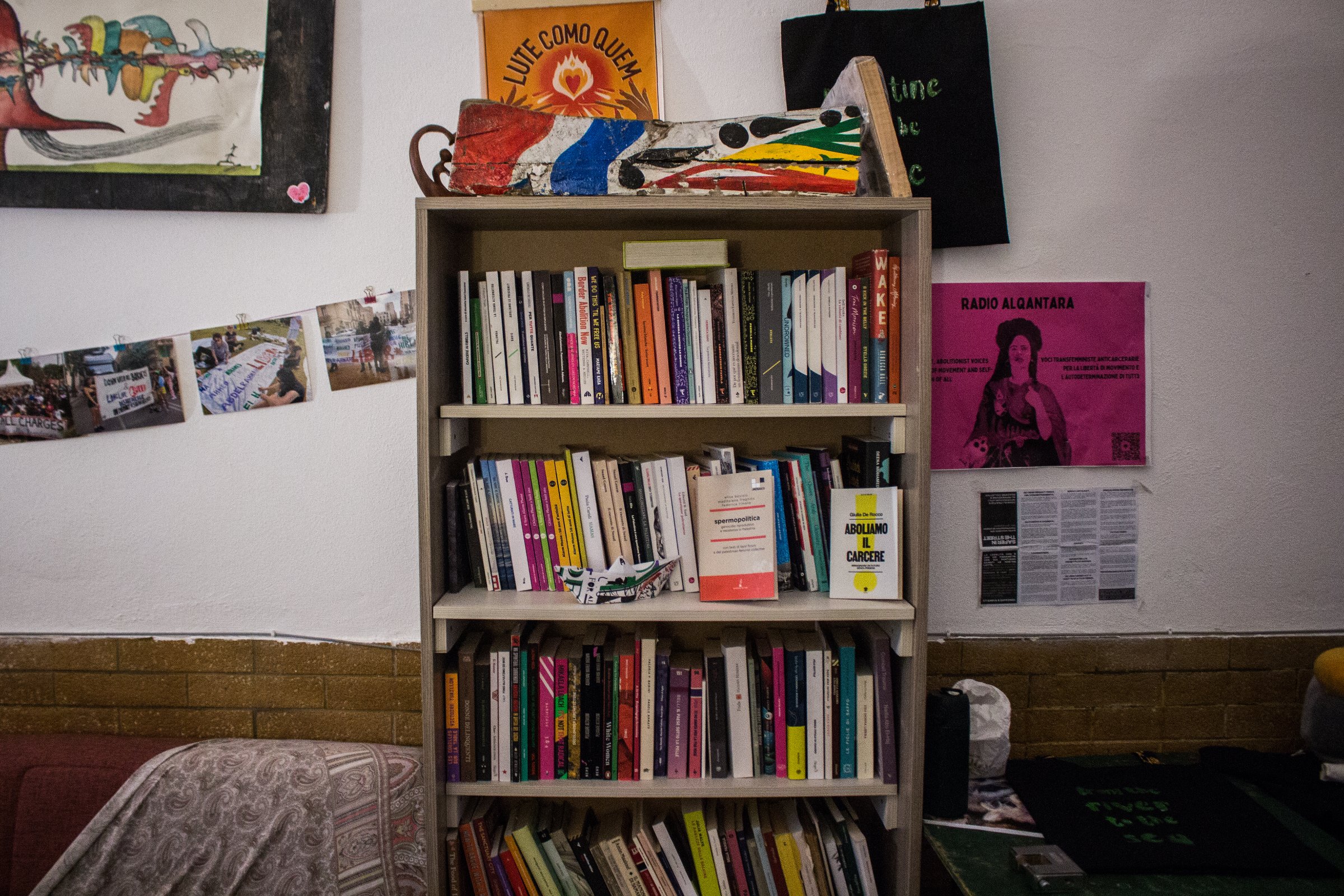
That evening, as yet another meeting is devoted to the issue of boat captains, the voices of the small group of about ten participants are drowned out by the sound of Giuliana’s drill. A committed member of the feminist association Non-Una Di Meno (“Not One Less”), she is busy assembling the new library shelves. A few minutes later, the shelves will hold a mix of titles: poetry collections, the essay Aboliamo il carcere5 (“Let’s Abolish Prison”) by Italian researcher Giulia De Rocco, and copies of the French magazine La Déferlante.
“Fighting ignorance”
“Besides, they’re not just meant to be read,” Pietro jokes on the evening of Sunday, January 18, as he wedges the projector screen in place with a stack of books. A few hours later, it will be used to broadcast the final of the Africa Cup of Nations (AFCON), pitting the Senegal national football team against the Morocco national football team. The room quickly fills up around the bar, where people mainly drink mango and guava juice. In a cheerful atmosphere, teasing begins to fly toward the few Moroccan supporters present as the match heads into extra. Bolted to his seat, Bassirou, who is in charge of the screening, tries as best he can to contain Haroun’s excitement, as he stands a little too close to the computer: “Do you know how much this thing costs?” In the 120th minute, the room erupts in joy: Senegal are crowned African champions thanks to a goal by Pape Gueye in the 94th minute. “You know it was tough,” Abdul says quietly. “Gambia, Mali and every country close to ours was supporting Morocco. What a joy to all be together.” Outside, Gabriel, a young Sicilian boy, improvises passes against a low wall. He won’t be pocketing the €100 promised by the Baye Fall members in the event of a Moroccan victory. “But I’ll give you five to cheer you up,” Haroun teases him.
But that Sunday, what happens at Maldusa stays at Maldusa. In the otherwise lively streets of Palermo, the cheers and cries of “Forza Senegal” from Haroun and his friends draw not a single knowing smile, but rather a string of puzzled – if not wary – looks. A mood in step with a national policy increasingly hostile to cultural mixing. Six years after the publication of the so-called Salvini Decrees, aimed at drastically restricting migrants’ rights in Italy and access to residence permits, the rise to power in 2022 of Georgia Meloni, leader of the far-right party Brothers of Italy, unsurprisingly cemented the previous government’s anti-immigration policies. Beyond strengthening her policy of outsourcing border control to Libya – and now also to Albania – the head of government has since, like many European countries, continued to introduce measures that further curb the reception of migrants.
So today, more than just a gathering place for African communities, the association’s premises have become something of an island of resistance. The day after Senegal’s victory at the Africa Cup of Nations, meetings resume. In a few days, Italian authors will come to present their book on reproductive genocide6 and resistance in Palestine. Next will come preparations for the Ramadan iftars (scheduled from mid-February to mid-March), also partly organized by the Baye Fall community. In the meantime, Maldusa’s members will do what they do best: keep their doors open. “We don’t have the solution to the rise of racism or the hardening of migration policies. But continuing to talk about it in order to try to find one – that’s our way of fighting ignorance. And for now, it’s the best way to resist.”

1This word stems from a linguistic misunderstanding: during a call to the Alarm Phone rescue centre, the person on the boat in distress said, ‘I’m going to Malta.’ On the other end of the line, the person understood ‘Maldusa.’ This word has come to symbolise an unknown destination.
2The MV Louise Michel is a former French Navy ship converted into a rescue vessel. See its website here.
3‘Migrant and refugee movements across the central Mediterranean in 2022 – IOM/UNHCR,’ United Nations, 29 November 2023. Read here (Italian).
4Rossella Marvulli, ‘The Maldusa Project as a Connector Between Informal Realities,’ Melting Pot, 23 October 2023, available here.
5Giulia De Rocco, Let’s Abolish Prisons. Imagining a Future Without Prisons, Eris, 7 April 2025, 60 pages.
6On this subject, see in particular Physicians for Human Rights and the Global Human Rights Clinic at the University of Chicago Law School, ‘Destroying Hope for the Future: Reproductive Violence in Gaza’, 14 January 2026, report available here.