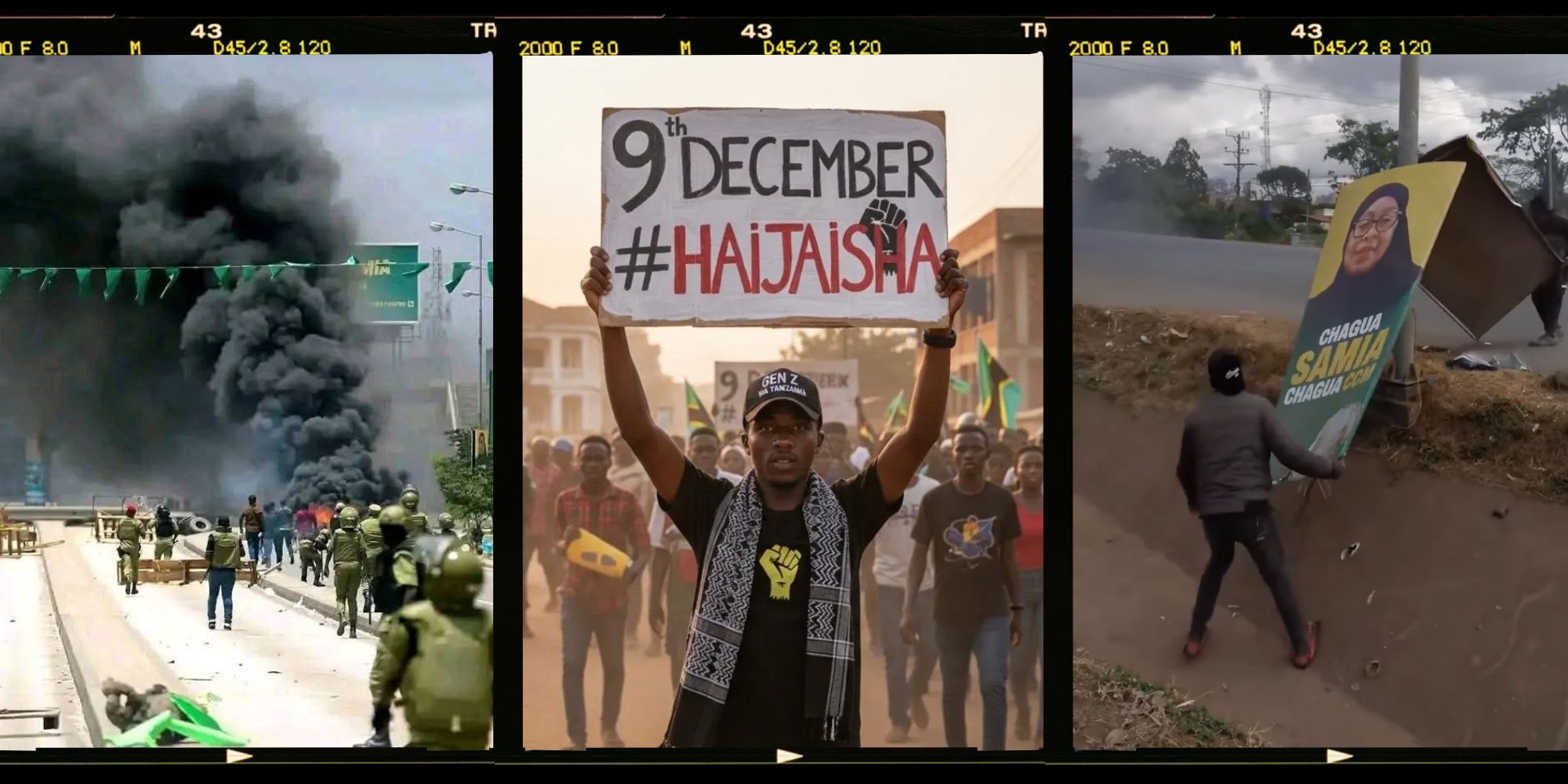
In Dar es-Salaam, Damian (name changed) hadn’t seen anything coming before the October 29th vote. That day, “friends” told him about ballot stuffing from the polling stations. Then the street ignited. He keeps one figure in mind: two days later, on November 1st, there were four deaths on the street perpendicular to his. On the same day, Samia Suluhu Hassan officially won the Tanzanian presidential election with 97.66% of the vote. The man in his thirties, like a part of the 31.9 million voters, learned the news on his phone, whose connection “was only re-established for forty-five minutes, just enough time to announce the results”, after several days of outage.
Even the “TikTok Challenges”, which encouraged people to denounce government abuses, and the few autonomous activists who called for gatherings in the streets starting at 6 a.m., hadn’t prepared him “for a movement of such magnitude”. Like everyone else, for days, he saw thousands of Tanzanians in the streets of Dar es-Salaam, Mwanza, Mbeya, Tunduma, and Arusha, burning garbage and buildings, mass arrests, and police firing live ammunition.
The country rose up as one in a context of a growing crisis of confidence between the State and its citizens, fueled by dozens of unexplained disappearances of political opponents during the campaign and the disqualification of the president’s adversaries.
«Tanzanians are Cowards»
“Since most opposition leaders are in prison or have disappeared, the coordination of the movement essentially came from activists exiled in the United States or Nairobi, via social networks”, explains Festo Mulinda, a political communication expert based in Dar es-Salaam. His testimony aligns with Damian’s: the crowd began to fill the streets in the late morning on October 29th, “after the diffusion of videos on social networks”, some of which were “posted by members of the CCM (the ruling party) mocking the inaction of Tanzanians. Like: ’Tanzanians are cowards’, or it’s not in their DNA to protest’”, specifies Damian. He continues :
Gradually, people started coming out and gathered in the main arteries. Some shared their location live, which must have motivated more people to come out.
Very quickly, the internet was cut off. “I imagine that, in the urgency, it was the best solution for the government to regain control of the situation and disorient the protesters who no longer had access to information from the coordinators, continues Festo Mulinda. But the blackout only worsened the already critical relationship between citizens and the police, which was involved in too many kidnappings of political opponents with impunity”, he analyzes.
« The Situation Became Uncontrollable »
Faced with the determination of the protesters, a large majority of whom were (very) young men (70% of inhabitants are under 30 in the country and 50% are minors, according to UNICEF figures), the police began, according to Damian, Festo and several converging sources, to use tear gas. Then came the first barricades and the first fires of official buildings. Damian recalls :
In the early afternoon, a friend called me from Arusha to tell me that all the roads were cut off, and that protesters were throwing stones at the police. That’s when I understood that something serious was really happening. After that, the situation became uncontrollable.
In response, the government again tightened its grip and sent a text message to Tanzanians, enjoining them to avoid “diffusing images or videos likely to cause distress or prejudice the dignity of others”, reminding them that “such behavior constitutes a criminal offense and will be subject to legal prosecution.” While bodies piled up in the streets, television continued to broadcast the usual programs, and the radio, music. A curfew was imposed starting at 6 p.m. “I think it is 90% responsible for all the deaths that followed”, estimates Festo Mulinda.
People “Killed in Their Gardens”
While authorities still today evade the question of human toll, the main opposition party, Chadema, disqualified from the election and whose leader, Tindu Lissu, is still in prison, first put forward the figure of 800 deaths. “Many of us think it’s more like several thousand”, whispers Damian. “They were shooting at everyone, most of the people weren’t even protesters.” Numerous people were, according to the communication expert, “killed by the police after 6 p.m. while they were in their gardens, away from the eyes of witnesses.”
Losses were also “probably accentuated by the blackout”, which caused confusion across the country, adds Festo Mulinda: “Here, most people perform their bank transactions with their phone, so everyone rushed to the banks, and stores were closing one after the other.” The outage also severely affected hospitals, where several machines require an internet connection. “Many people certainly could have been saved if the connection had been re-established”, says the researcher.
Three weeks later, the count, like everything else, remains unclear. Faced with the opacity of the institutions, Maria Sarungi Tsehai, a Tanzanian journalist exiled in Nairobi, put an online form to gather testimonials and centralize reports. She confided to Afrique XXI that “more than a hundred” had reached her three weeks after the elections. Supported by other organizations and autonomous activists, she plans to launch a website where the figures will be made available. In the absence of an official human toll, Tanzanians are currently turning to a recent CNN investigation, conducted with the support of an investigator specializing in open sources. This investigation attests, with geolocated videos and audio analyses, to shootings of visibly unarmed people, dozens of bodies piled up in morgues, and recent remodeling of the soil in the Kondo cemetery, north of Dar es-Salaam, suggesting that bodies may have been buried there in a mass grave.
“Stacked Ballots” and “Ballot Stuffing”
Another outstanding question: what really happened in the polling stations on October 29th? In a preliminary report published on November 3rd, the SADC (The Southern African Development Community) pointed out a series of irregularities: difficulty in accessing information, absence of national observers in most polling stations, “stacked ballots” in some, “which gives the impression of ballot stuffing” or “multiple votes for certain people”. To this is added the observation of a “very low participation rate in all observed polling stations.” The body asserts that due to the overflow, most of its observers were unable to attend the counting. Festo Mulinda was also assigned as an observer on election day. “Nothing like the queues from previous elections. Out of the five polling stations visited in the space of two hours, I must have only come across five voters”, he assures.
And now? The country is stunned. The journalist Maria Sarungi Tsehai, although very active on social networks, does not wish to elaborate. A social science researcher based in Nairobi also finally declined an interview: “I was too personally affected.” Finally, Godless Lema, a historical figure of the Chadema party, has also ceased responding to our requests.
On November 14th, Samia Suluhu finally acknowledged in a speech to Parliament that Tanzanians had died during the election-related violence. She announced the opening of an “independent” investigation commission composed of eight members – most of them former senior civil servants or retired security officials, all members of the CCM – as well as the creation of a ministry dedicated to youth and the amnesty1 of hundreds of protesters arrested during the elections. This commission of inquiry was immediately rejected by the opposition, which considers that a government accused of electoral fraud and human rights violations cannot appoint its own investigators. Especially since the president of this commission reserves the right not to share the results of the report.
The Determination of “GenZ Tanzania”
“The accused cannot be the judge of the crime they have committed”, states John Heche, the vice-president of Chadema, in an official communiqué2. He demands the intervention of the United Nations, the International Criminal Court, or the African Union. For its part, the Tanganyika Law Society (TLS), the country’s bar association, has filed a constitutional petition against the government. It contests the legality of the five-day curfew imposed in Dar es-Salaam following the elections, pointing out numerous constitutional violations in its execution. The government was quick to react. In a (very long) communiqué issued on November 23rd, the government spokesperson condemned the CNN investigation, which he accused of “distorting information” with the aim of “inciting Tanzanians to hate their government and provoking conflicts among Tanzanians themselves”, and pointed to an “instrumentalization of the narrative” aimed at driving away tourists and investors. And, once again, it invites its nationals to limit the diffusion of content that could “threaten” national unity.
This propaganda does not convince the population, which is now determined to be heard. Besides the main opposition parties, Chadema and ACT-Wazalendo, autonomous activist collectives are forming. Among them, “GenZ Tanzania”, the nickname given to the generation born between the late 1990s and the early 2010s, which is also making itself heard in other countries in the region, such as Kenya, Uganda, and Madagascar.
“Most Tanzanians belong to Generation Z, and most of the people who participated in the demonstrations were from this generation”, explains one of its members, who prefers to remain anonymous. Three months after its creation, the movement’s official account is already followed by more than 15,000 people on Instagram.
To protest the election results they contest, as well as the kidnappings and murders of political opponents, they are calling for a peaceful gathering on December 9th. “We are convinced that changes are underway. Tanzania is being reborn”, continues the young man. In addition to the creation of a new Constitution (asked for years by the opposition parties), the movement is also demanding more measures towards Tanzanian youth, including greater support for education and better access to employment. “We hope that the demands of the youth will be heard, because we will not yield until we have overthrown the CCM”, promises the young man.
In Contrast, the European Union Plans to Freeze Aid
Internationally, relations also seem to be strained. The European Parliament approved a resolution on November 27th aimed at cutting a portion of aid destined for Tanzania, which should result (if validated by the Council of the European Commission) in the blocking of a first payment of 156 million euros. This half-hearted support leaves Festo Mulinda, the communication expert cited above, perplexed: “When you cut off aid, it’s not the political class that suffers. What we expect from supportive countries are sanctions that penalize the government, not the citizens: preventing Samia Suluhu from traveling to Europe, freezing the assets of leaders in European countries...”.
On December 5th, in a joint communiqué, the diplomatic services of sixteen countries as well as the European delegation3 called on the authorities “to urgently return all the bodies of the deceased to their families, to release all political prisoners, and to allow detainees to benefit from legal and medical assistance.”

1“Treason Charges Dropped Against Hundreds of Tanzanian Youths Following Presidential Directive,” The Chanzo Reporter, November 25, 2025.