African women have been writing and producing remarkable works for as long as literature has existed. Writing is a political act that allows authors to demonstrate ingenuity, sensitivity, and agency. Those from the African continent, and more specifically from Senegal, engage in this in a beautiful manner. In the case of Senegal, regarding the themes of exile and travel, Ken Bugul, Fatou Diome, and Aminata Sophie Dièye have produced remarkable works that, to this day, constitute a formidable framework for questioning the politically situated dimension of travel.
Before speaking more extensively about the writings of these women and their impact, it is important to provide a brief historical reminder. On December 1, 2024, Senegal celebrated the 80th anniversary of the massacre of the Senegalese Tirailleurs in both Senegal and France. France today seems more committed to the perspective of reparations for this crime, even if gray areas remain. Sembène Ousmane paid tribute to these brave soldiers in his unforgettable 1988 film Camp de Thiaroye. Other fictional works, both filmic and literary, would follow, but they remained focused on the heroic experiences of these Black African men who died for France.
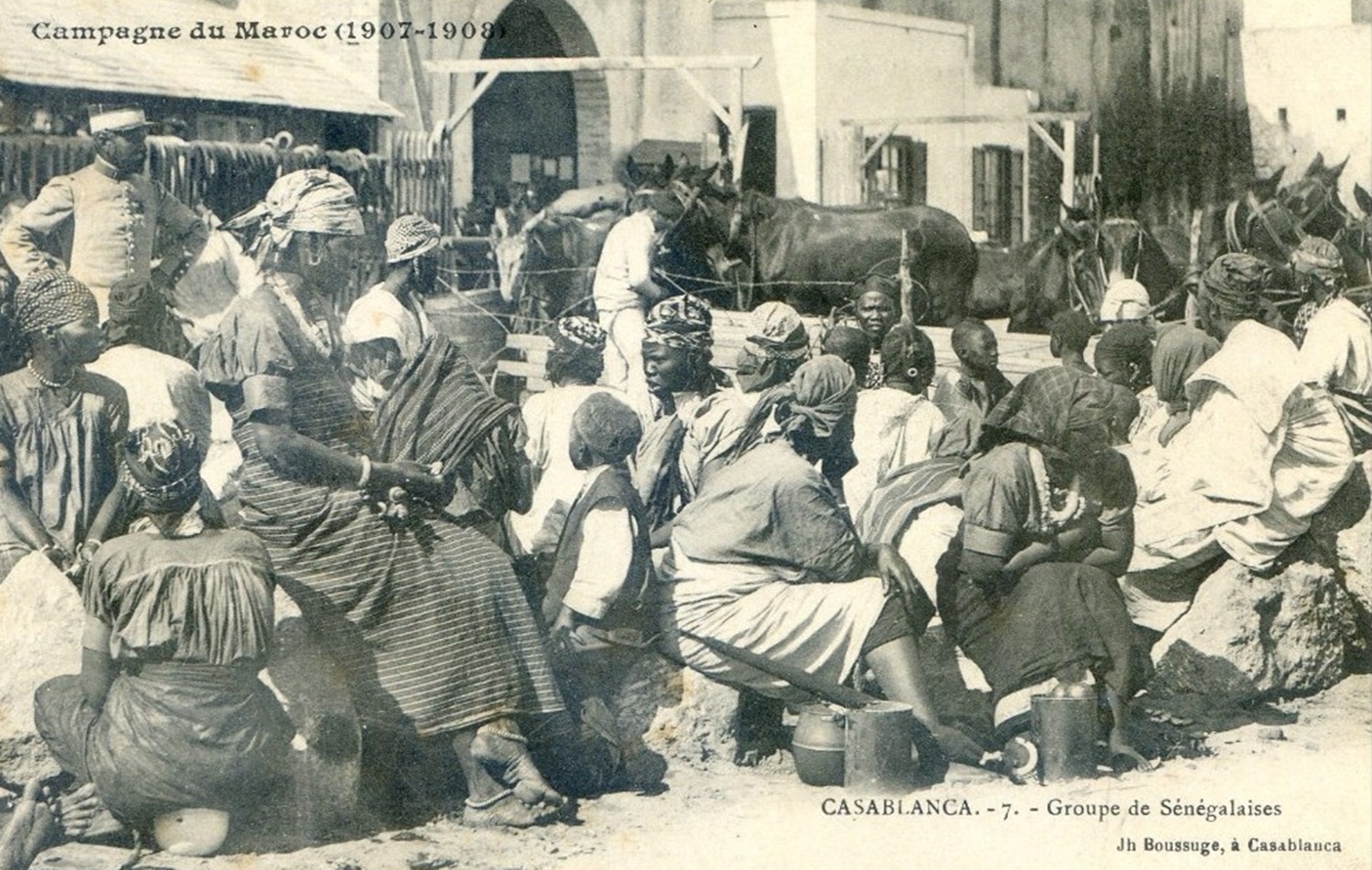
However, these men had female companions, some of whom followed them to the front. Under the nickname “Madame Tirailleur,” they were requisitioned to handle logistics and ammunition supplies, sometimes at the risk of their lives. Today, very little is known about them. These women lived on their husbands’ pay and replaced traditional supply vans so their spouses could fight the enemy. Until the end of the First World War, combatants were accompanied by their wives.
The Triptych of Gender-Race-Class
When these women lost their lives, they received timid tributes, such as that of Mouina, “wife of Corporal Goumier Ahmed Yacoub, mortally wounded in the battle of Talmeust while distributing cartridges on the firing line”. What do we remember today of these early migrants? They were migrants under constraint, just like their combatant partners. But for them, as Black African women, leaving can carry a double or even triple cost: their gender, their social class, and their race. The gender-race-class triptych perfectly illustrates this quest for self within a forced, imposed displacement that leads to the erasure of the self. Because they are women, they are plunged into a rhetoric centered on their duties.
One cannot speak of women’s literature and exile without mentioning Mariétou Mbaye, alias Ken Bugul. Without minimizing the impact of her peers on Senegalese (women’s) letters, the person and writings of Ken Bugul crystallize exile in a beautiful way. She could be called “the queen of introspective writing”. She has the dazzling ability to dig deep within herself for material to create narratives, to politicize the intimate, and to offer it to readers. She may be considered subversive or even provocative, but what would art, and especially literature, be if it did not push us to question ourselves, sometimes to the point of discomfort? When exile and the journey to Europe—that vastness of all possibilities—are added, this woman speaks so bluntly of her experiences, of the (re)discovery of herself, and the delight she draws from it with such grit and sincerity that it becomes vulnerable.
A passage from Riwan ou Le Chemin de sable (Presence Africaine, 1999) is striking :
To remain oneself, with the energy of despair, and to impose one’s identity, no matter which one for that matter, until the total destruction of the gene of human stupidity.
In short, Ken Bugul pushes us to constantly (re)interrogate our identity, which is in perpetual mutation. When distance is involved, doubt regarding oneself and one’s torments becomes a full-time exercise.
The Frantic Quest for Happiness
In Celles qui attendent (Those Who Wait) (Flammarion, 2010), Fatou Diome makes us realize “that a confrontation with one’s own shadow could prove as fearsome as a face-to-face with a werewolf”. These “well-named” women who wait put their existence, joys, and sorrows on hold because the men have left, taking a part of THEM with them. In this novel, intimately linked to Fatou Diome’s own trajectory, women forget themselves and persist in waiting for sons, spouses, and brothers who have left to explore an “elsewhere” so full of promise.
From those who wait, we could shift toward those who leave, as migration is becoming increasingly feminized. According to Frontex, women represent 10% of irregular entrants into European territories. They leave in search of a better future for themselves and their children, but also for the families they leave behind and for whom they must provide.
This quest for a better future is also the leitmotif of Dior Touré and her friend, the narrator in La nuit est tombée sur Dakar (Night Has Fallen on Dakar) (Grasset, 2004). In this magnificent novel by Aminata Sophie Dièye, she narrates the frantic quest for happiness, even unto tragedy. Happiness, for the two young girls in this book, only makes sense through travel and the “elsewhere,” away from the village and its dusty roads. Ultimately, they realize “the tragic dimension of all human destiny”. The fragility of human destiny—and more specifically female destiny—with its share of constraints and social coercion, is the narrative thread of Aminata Sophie Dièye’s writing.
From Aminata Zaaria to Ndèye Takhawalu, her pseudonyms, the quest for inner peace without complexes or fear in a society quick to break the wings of those who stray from the path, would be her guiding principle. From Dakar to Paris and back to Dakar, she leads us through all her adventures, and her largely autobiographical work serves as true inspiration today.
Departure as a Radical Solution
In Americanah (Gallimard, 2015), Chimamanda Ngozi Adichie offers a striking socio-political and cultural fresco. Against the backdrop of the love story between Ifemelu and Obinze, the Nigerian author questions the departure to the United States and its impact on an African woman regarding her new socialization, her romantic relationships, and her integration into this immense country of possibilities. Upon returning to Nigeria after several years in the U.S., the narrator says: “Stepping off the plane in Lagos, I felt like I had ceased to be black”. With this phrase, Adichie questions the process of inverted racialization that shifts from one geographical zone to another.
Diary Sow also left to seek and find herself. Je pars (I am leaving) (Robert Laffont, 2021) is a work of quests—of the self first, but also of liberation in the face of a world and society that hinders freedom. Leaving can be the (radical) solution that allows one to rebuild and find oneself.
A dual objective animated me when I wrote Le Malheur de vivre (The Misfortune of Living) (L’Harmattan, 2014), my first novel published eleven years ago. I wanted to pay tribute to a Senegal and a Dakar that I had known very little—as the novel is set in the Dakar of the 1970s and 80s—but also to honor my Pulaar origins. After a few years in the country that welcomed me for my studies, I became increasingly aware of my quintuple condition: Black, Pulaar, woman (the feminist would come later), Senegalese, and Dakaroise. Distance had the effect of making me eager to return to my roots.
“Freeing obsessive questions”
Torn between the new universe I was navigating and the one I had left behind, I put all the questions, not to mention the torments, that were mine into this novel, using fiction as a starting point. Because even if fiction is a creation of the imagination, it ultimately always stems from reality and is based on tangible facts. And as Maryse Condé says in La Vie sans fard (JC Lattès, 2012): “Literature is the place where I express my fears and anxieties, where I attempt to free myself from haunting questions".
Starting from the writings of African women who, through their books and their public discourse, have contributed to fully establishing the issue of departing for exile, we can see that their writings have helped and continue to help construct trajectories, for identities are multiform. Although not all representations are textual in nature, texts play a decisive role in the process of identity construction...
When you are an African woman in this ’globalized’ world, the attempts to silence you are manifold. And when you make the choice to leave, the labels do the rest of the work. Is it necessary to point out, speaking of labels and prefabricated boxes, whether we are in Dakar, Abidjan, Paris, or any other city in the world today, that for us women, identity is both hybrid and constantly evolving? Sometimes, this quest stays with us throughout our entire lives.
