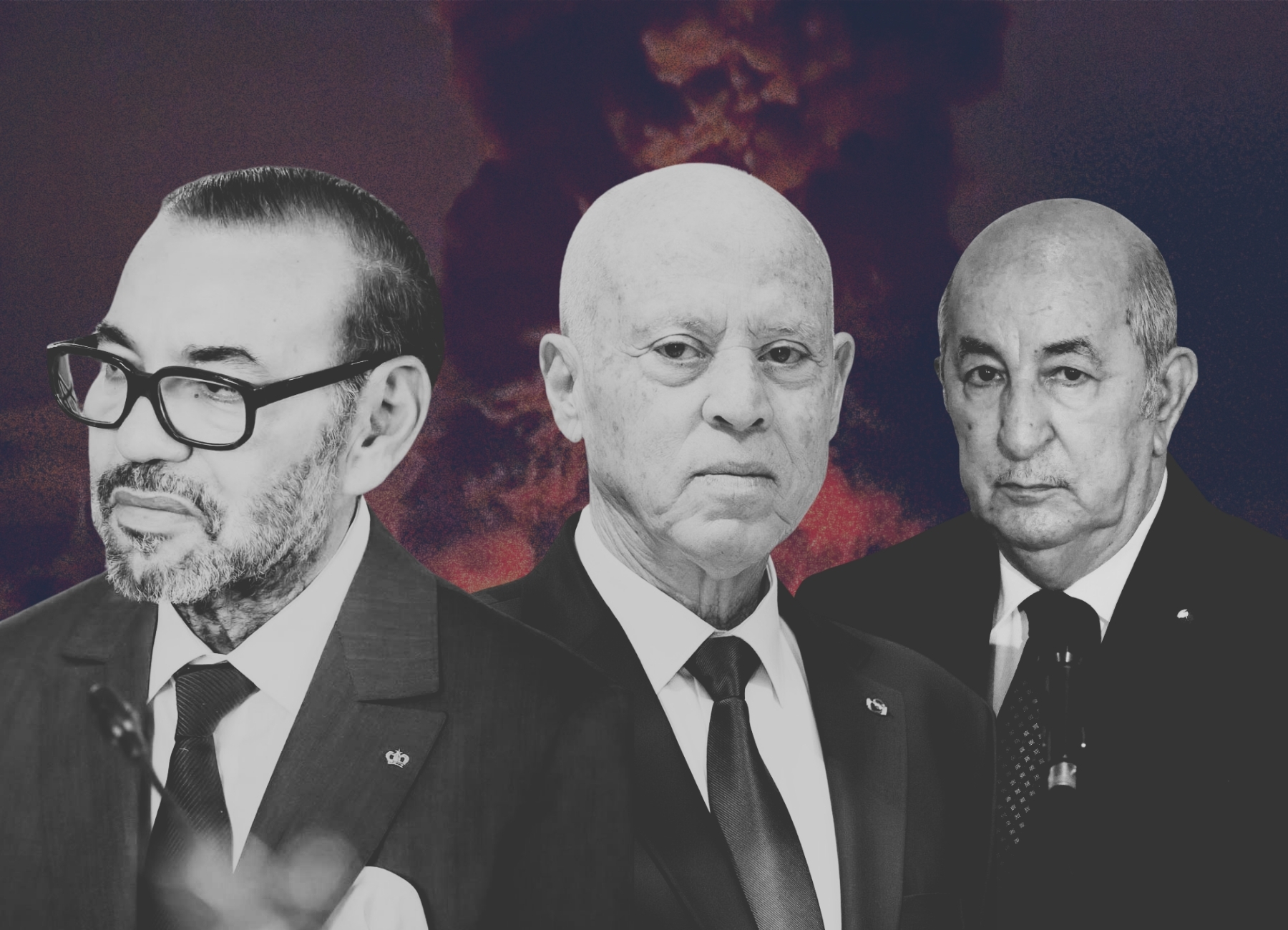
The war waged against Iran by Israel and the United States comes at a moment when negotiations over Western Sahara are under way under US auspices and the stewardship of President Donald Trump. Washington, which has already recognised Morocco’s sovereignty over the territory, is backing Rabat in this dispute. Beyond this initial constraint, Morocco’s position is shaped by the strategic and economic partnership it maintains with the Trump administration, as well as by its ties with Israel since the normalisation of relations in 2020.
These factors help explain why Rabat condemned Iranian missile strikes against Gulf countries without expressing any reservations about the operation launched against Iran. Morocco’s stance appears all the more consistent given that, in June 2025, during the so-called “12-day war” that had already pitted Israel—and later the United States—against Iran, Rabat issued no official statement.
A long-standing hostility to the Islamic Republic
Morocco’s hostility towards the Islamic Republic of Iran is not new. The first rupture between the two countries dates back to 1980, when Iran under Ayatollah Ruhollah Khomeini recognised the Polisario Front independence movement. The second occurred in 2018, when Morocco severed diplomatic relations with Iran, accusing it of supplying arms to the Polisario Front.
It is therefore unsurprising that Moroccan authorities described Iranian strikes on Gulf countries in March as “abject”, calling them a “flagrant violation of these states’ national sovereignty, unacceptable for their security, and a direct threat to regional stability”.
This position is not shared by all Moroccan political forces. Some, such as the Justice and Development party (PJD) and the Federation of the Democratic Left (FGD), issued statements condemning the attack on Iran. Others called for mobilisation. The National Action Group for Palestine, for instance, sought to organise a sit-in to “denounce the US-Zionist aggression against Iran”. But gatherings were blocked by the authorities, as was a demonstration held on 2 March in Tetouan by the Moroccan Front for Support of Palestine and Against Normalisation with Israel, a coalition of NGOs and political parties.
Opposition has also emerged from religious circles. In a statement, several Moroccan ulema expressed solidarity with Iran as a Muslim country. The theologian Ahmed Raïssouni, a former leader of the Movement for Unity and Reform and past president of the International Union of Muslim Scholars, was unequivocal: “I stand with Iran because they are Muslims and because they are oppressed. I stand against the criminal aggressors and their allies.” Although coming from a figure who has long advocated the separation of political and religious authority in a country where the king is commander of the faithful, such remarks directly challenge Morocco’s official alignment against Iran.
Washington and Tel Aviv: the kingdom’s key allies
The authorities in Rabat, however, pay little heed to these dissenting voices and stand firmly alongside the Gulf states, with which they maintain strong ties. The benefits Morocco derives from its partnerships with the United States and Israel help explain the absence of any condemnation of their strikes.
In 2020, Donald Trump recognised Morocco’s claim to Western Sahara, paving the way for similar shifts by other countries, including Spain and France. The Trump administration has since multiplied diplomatic efforts aimed at resolving the conflict by promoting autonomy under Moroccan sovereignty. It also supported Rabat during the 31 January UN Security Council vote on resolution 2797, which recognised Morocco’s autonomy plan as the main basis for a solution.
The quid pro quo was Morocco’s signing of the Abraham Accords in 2020. Since then, Washington has regarded the country as a pillar of stability in the Maghreb and Africa. Morocco has been invited to join the Peace Council and is expected to contribute troops to a future international stabilisation force in Gaza.
Preferential treatment extends beyond the Western Sahara dossier. US tariffs on Moroccan goods stand at 10%, compared with 30% for Algeria and 25% for Tunisia. Another sign of favour is Washington’s consideration of relocating the US Africa Command (Africom) headquarters from Stuttgart to Rabat, which regularly hosts the multinational African Lion exercises. Alongside US investments in Western Sahara, these gains are not ones Morocco is prepared to jeopardise over the war in Iran.
Morocco is also engaged in growing defence cooperation with Israel, illustrated by the purchase of the Barak MX air defence system and the opening, this April, of a drone manufacturing facility by BlueBird Aero Systems in Benslimane, near Casablanca. This dual partnership firmly anchors Morocco within the anti-Iran camp. In response to criticism, Rabat highlights its role as a mediator for the Palestinians, whether in efforts to unblock funds withheld by Israel or to facilitate humanitarian aid into Gaza—though with limited success so far.
Algeria’s diplomatic shift
If Morocco’s position follows the logic of the Abraham Accords, Algeria’s stance marks a break with its traditional diplomatic principles, particularly regarding Iran.
On 1 March, Algerian foreign minister Ahmed Attaf expressed “full solidarity with the brotherly Arab countries that have been victims of military attacks”. Yet Algiers did not react to the death of Iran’s supreme leader Ali Khamenei, despite having previously condemned Israeli strikes during the “12-day war” as “an aggression made possible by the impunity enjoyed by the aggressor”.
This is not the first rupture between Algeria and Tehran. Relations were severed between 1993 and 1999, when Algiers accused Iran of backing Islamist armed groups during the country’s civil war. They were restored in 2000 under President Abdelaziz Bouteflika, and ties gradually improved, with visits by Iranian presidents Mohammad Khatami and Mahmoud Ahmadinejad in 2004 and 2007. A visit by Ali Khamenei had even been expected in the coming months.
In recent years, Algeria had defended Iran’s right to develop nuclear technology for peaceful purposes. Today, however, it has refrained from condemning Israeli and US strikes.
A gas card to play?
Keen to avoid alienating Donald Trump, Algeria may see in the conflict an economic opportunity. A prolonged war in the Middle East could allow it to capitalise on its proximity to Europe by increasing oil production and exports to countries facing supply disruptions.
According to energy outlet Attaqa, Algeria could also position itself as a strategic gas supplier amid rising demand linked to conflicts in Iran and Ukraine. Liquefied natural gas exports to Europe could increase via the TransMed and Medgaz pipelines beneath the Mediterranean—though such prospects remain uncertain given the state of the sector.
Algiers also hopes to break out of its diplomatic isolation, the result of rigid doctrine and limited adaptability to geopolitical shifts. Since 2021, relations have deteriorated with several partners: Morocco, Spain, France and the United Arab Emirates. In the Sahel, Algeria has lost influence to new military-led governments, while also distancing itself from Russia, its long-time ally.
Aware of this isolation, Algeria has sought closer ties with Washington. This shift helps explain its abstention on the UN vote regarding Western Sahara autonomy and its silence on US and Israeli strikes.
Tunisia’s diplomacy of restraint
Tunisia, too, has adjusted its stance. President Kaïs Saïed had moved closer to Tehran in recent years, exploring cooperation in artificial intelligence and visiting Iran in May 2024 following the death of President Ebrahim Raisi. During the “12-day war”, Tunis had denounced violations of Iran’s sovereignty and of international law.
Yet a foreign ministry statement issued on 1 March marks a clear shift. It makes no mention of Ali Khamenei’s assassination, does not condemn Israel or the United States, and limits itself to calling for restraint and a return to negotiations.
Unlike Algeria, however, Tunisia has allowed public anger to surface. On the ninth day of the war, demonstrations took place in central Tunis, with protesters waving Iranian and Palestinian flags and holding portraits of Khamenei.
At the same time, Tunis has sought to reassure Washington by arresting seven members of the Global Sumud Flotilla campaign, which had organised a maritime mission to break the Gaza blockade in 2025 and planned to do so again. They were accused of money laundering linked to fundraising efforts.
In a statement issued on 17 March, several organisations, including the Tunisian League for Human Rights, denounced what they described as an “abusive” use of such charges in politically motivated cases. They argued that the aim extended beyond preventing aid missions to Gaza, seeking instead to weaken broader support for the Palestinian cause.
These arrests reflect the Tunisian government’s unease. In recent years, its diplomacy has often mirrored Algeria’s. At the same time, the sovereignist stance championed by Kaïs Saïed leaves little room for confrontation with Donald Trump, particularly as the Tunisian military relies partly on US funding and the country depends on financial support from Gulf states, notably Saudi Arabia.
Carthage’s room for manoeuvre is therefore narrow. Like Algeria, Tunisia no longer has the means to pursue a dissident foreign policy—and little space left to assert an independent voice.
