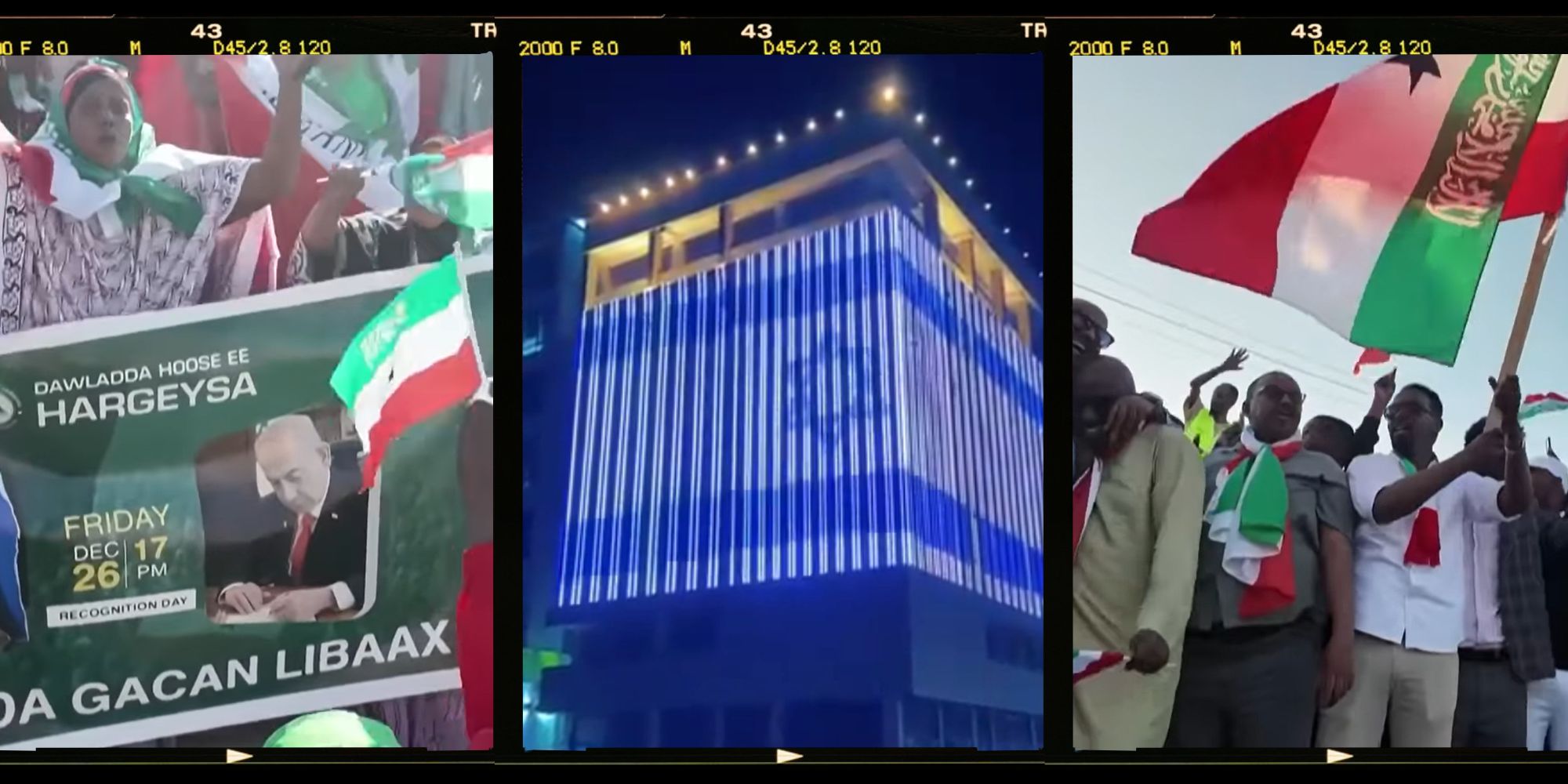
"Unlike ’Palestine,’ Somaliland is not a virtual state1." Somaliland President Abdirahman Mohamed Abdullahi—known as ‘Irro’—found no fault with the provocative remarks made by Israeli Foreign Minister Gideon Sa’ar on January 6th from Hargeisa, the capital of Somaliland.
For ten days earlier, on December 26, 2025, Israel became the first state in the world to recognize Somaliland since its unilateral declaration of independence from Somalia in May 1991. This discretionary move nevertheless met with widespread disapproval, ranging from the European Union and the African Union (AU) to the Arab League. There have been numerous expressions of support for the integrity of the Somali state, and no other country has yet followed in Israel’s footsteps.
Since December 26, all Somalilander2 political forces have been working to promote Israeli recognition as the legitimate expression of a sovereign Somalilander state. For more than three decades now, international recognition of a state definitively separated from a Somalia described as ’failed’ has been presented as the only conceivable horizon.
Thirty-five years of deadlock
Until now, the Somaliland cause had found little resonance. Indeed, the ’de facto State’ has always clashed with the principle of the inviolability of borders3, which, through its rigidity, renders the international system hostile to its existence. Yet the failure of its union with Somalia between 1960 and 1991 was highlighted4 by the AU in a 2005 report, which recognized a quest for recognition that is ’historically unique and self-justified in African political history.’
However, many voices refuse to recognize its legitimacy, even at the cost of caricaturing Somaliland’s history and dismissing its unique political trajectory and the mass crimes that defined it. In the late 1980s, the former Somali leader Mohamed Siad Barre—who held power from 1969 to 1991—brutally suppressed an uprising by the Somaliland population, which is predominantly Somali Isaaq. Although the Isaaq are a clan confederation that is a minority at the national level, tens of thousands of their members were killed during the repression.
Countering the detractors of the de facto state, Israel and its supporters have emerged as vocal advocates for Somaliland and its right to self-determination. This stance, however, is merely the expression of an opportunistic strategy—one that instrumentalizes the grievances of regional minorities in a manner reminiscent of the Israeli “Periphery Doctrine.” Formulated in the 1950s, this doctrine aimed to turn the region’s non-Arab states and ethnic minorities into Israeli allies. Tel Aviv’s support for Iraqi Kurdish independence in 2017 and for the Druze community in Syria in 2025 serve as other recent examples of this approach. By doing so, Israel seeks to weaken its neighbors, assert its hegemony, and ensure the long-term survival of its colonial project in Palestine.
A pro-US foreign policy
The December 26 initiative is part of a broader Somalilander diplomacy that is openly aligned with Washington. Following the abduction of Nicolás Maduro in Caracas on January 3, the de facto state was, for instance, the only country on the African continent to forcefully back the U.S. action in Venezuela, deeming5 it ’calibrated.’
This tropism took shape during the presidency of Muse Bihi Abdi, between 2017 and 2024. Hargeisa first established diplomatic ties with Taipei in 2020, thereby alienating Beijing and swimming against the tide of other African nations—all of whom, except for Eswatini, eventually broke off relations with Taiwan. Bihi and his inner circle subsequently forged significant relationships within U.S. Republican circles, particularly with the staunchly conservative (and pro-Israel) Heritage Foundation. In 2023, the foundation officially called for the recognition of Somaliland. Today, President Irro appears open to hosting a U.S. military base and granting mining concessions—hoping to entice Donald Trump and perhaps secure formal recognition for the country.
The Trump administration, however, remains ambiguous. On December 29, the United States representative to the UN Security Council stood apart6 from her counterparts by defending Israel’s right to maintain the diplomatic relations of its choosing. Mimicking Tel Aviv would provide Washington with additional leverage to counter China’s regional influence. Furthermore, Trump has recently kept up his attacks on Somalia, which he labeled7 the “most corrupt country on earth” before claiming that the state “doesn’t even exist.” In early January, these accusations of corruption were used to justify the cancellation of all U.S. aid programs destined for the Somali federal government.
The rift between Somalia and the United Arab Emirates
However, recognizing Somaliland would lead to a major deterioration of U.S. relations with Somalia, at the risk of further worsening the country’s instability and weakening the fight against Al-Shabaab jihadist militants. Moreover, many of Washington’s regional partners who are close to the Somali government—such as Egypt, Turkey, and Djibouti—oppose such a move. Consequently, it is difficult to predict what Trump might or might not decide regarding Somaliland.
Other states, which have remained relatively discreet since December 26, could follow Israel’s lead. Chief among them is the United Arab Emirates (UAE), which have maintained a strong presence in Somaliland since 2017, particularly through the company DP World (Dubai Ports World), which manages the port of Berbera. Over the past decade, Abu Dhabi’s growing proximity to Hargeisa and other autonomous Somali regions—Puntland in the north and Jubbaland in the south—has strained its relations with Mogadishu. Somali President Hassan Sheikh Mohamud reportedly views the Emiratis as the facilitators of Hargeisa’s rapprochement with Tel Aviv. Consequently, on January 12, he terminated all cooperation agreements with the UAE, demanding the departure of all UAE-linked entities from Somali territory. This decision is, of course, unenforceable—not only in Somaliland due to its de facto independence, but also in Puntland, given the significant autonomy the region enjoys.
Finally, the Ethiopian government has remained rather silent. Close to the UAE and Israel, and eager to gain access to the Somaliland coast for military and economic purposes, Prime Minister Abiy Ahmed promised in January 2024 to recognize the de facto state. This promise, which has remained a dead letter, had already sparked sharp international reactions and the ire of the Somali government. Ankara eventually managed to bring Addis Ababa and Mogadishu closer together. Indeed, Abiy Ahmed must contend with Turkey and China—both very close to Somalia, but also the two main foreign investors in Ethiopia.
A new string to an Israeli-Emirati bow
After more than two years of war and an ongoing genocide in Gaza that have earned it pariah status in the region, Israel has gained a new partner just a stone’s throw from the Bab el-Mandeb Strait—a gateway for nearly 12% of global trade. Tel Aviv will now have a strategic foothold to protect its economic interests, which were significantly impacted by Houthi attacks in the Red Sea between 2023 and 2025.
At this stage, the exact concessions granted by the Somaliland government remain uncertain and are undoubtedly still under negotiation. They will likely include a strengthening of intelligence cooperation with the Mossad, a key player in the negotiations that led to recognition. A military foothold in Berbera is also a possibility8. On the other hand, the absurd hypothesis of ’hosting’ displaced Gazans—the premise on which the two countries first entered talks in April-May 2025—now appears to have been ruled out.
More broadly, Somaliland is aligning itself with a regional architecture favorable to Tel Aviv, of which the Abraham Accords of August 13, 2020, form the backbone—accords that President Irro has promised to sign during an upcoming visit to Israel. As a leading figure of these agreements, the UAE wields influence across East Africa and the Gulf of Aden—stretching from Libya to Yemen and including the Sudan of the Rapid Support Forces—which could benefit Israel beyond the case of Somaliland alone. Supported by Abu Dhabi, the Yemeni leader Aidarous Al-Zubaidi, head of the Southern Transitional Council (currently facing difficulties), had stated, for example, that an independent state in Southern Yemen would join the Abraham Accords9.
A risky geopolitical exposure
The regional power projections of Israel and the United Arab Emirates are opposed by numerous countries, particularly traditional supporters of the Somali federal government such as Turkey, Egypt, and Qatar. An Israeli presence in the Gulf of Aden—especially a military one—could thus expose Somaliland’s territory to destabilization attempts. The Houthis have already threatened to make it a target10.
Furthermore, Saudi Arabia stands out today as one of Somalia’s primary supporters. Amid growing rivalries with Abu Dhabi, Riyadh is striving to curb Emirati regional influence. This opposition is also linked to Saudi Arabia’s ties with Pakistan and those of the UAE with India—a country close to Tel Aviv, where some voices are calling for the recognition of Somaliland.
Israeli recognition—against the backdrop of enthusiastic promotion of Israel by Somaliland’s leaders—is therefore no guarantee of stability for the de facto state. The latter is lastingly antagonizing a large portion of Africa and the Arab world, where the principle of the inviolability of borders remains a structural pillar and the Palestinian issue carries significant weight. Finally, the economic fallout from hypothetical Israeli investments remains uncertain at this stage.
Consolidating the Somaliland project
Israel’s promotion of the right to self-determination facilitated the support of a significant portion of the Somaliland population for the mutual recognition of the two countries. For many, more than three decades of diplomatic isolation have ultimately relegated the Palestinian cause behind the Israeli opportunity. Starting on December 26, major celebrations took place, primarily in downtown Hargeisa near the National Museum, where a massive Israeli flag was projected onto the building. The flag of the UAE and the DP World logo were also projected as a sign of gratitude, but above all to underscore Somaliland’s radical independence and its rejection of the Somali decision to expel Emiratis from the territory.
But Somaliland is not a monolith. Other images—fewer in number, certainly—have also circulated on social media, particularly of protests. In Borama, the capital of the western Awdal province, individuals expressed their opposition to this recognition. Several people were even arrested, including some displaying Palestinian flags, as well as intellectuals and religious leaders who have been critical11.
Nevertheless, it remains difficult to gauge the extent of internal opposition, given that it is criminalized and viewed as hostile to Somaliland. The allegiance of the western and eastern regions to the Somaliland project—portions of which were lost in 202312—has always been fluid. Their populations, drawn from minority Somali clans, have long been marginalized in favor of the central Isaaq provinces around which the national project was structured. Ultimately, it is therefore possible that some of these peripheral populations may use Israeli recognition as a further tool to challenge the authorities, whose effective exercise of sovereignty could be weakened.

2« Somaliland Political Parties Endorse Israel Ties, Hail Recognition as Historic Breakthrough », Horn Diplomat, Dec 30, 2025, read more here.
3The Assembly of Heads of State and Government of the Organization of African Unity (OAU), meeting in Cairo, opted for the ’principle of the inviolability’ of borders in Africa on July 21, 1964.
4African Union, “AU Fact-Finding Mission to Somaliland (30April to 4 May 2005)”, 2005, available as a PDF here.
6Tammy Bruce, Deputy Representative of the United States of America to the United Nations, “Remarks at a UN Security Council Emergency Meeting on Somaliland,” December 29, 2025, statement available here.
7See, for example, Ulysse Bellier, “The Trump administration targets Somali immigrants and tightens its migration policy,” La Presse, December 31, 2025, available here. Or even “‘Somalia Is Not Even a Country,’ Trump Says in Anti-Immigrant Ramble,” Al Jazeera, January 20, 2026, available here.
8Lazar Berman, “Somaliland Official Confirms Talks with Israel on Hosting a Military Base,” The Times of Israel, January 8, 2026, read here.
9Mohamad Ali Harisi, “Yemen’s Al Zubaidi on Southern independence and what comes next,” The National, September 24, 2025, read it here.
10« Any Israeli presence in Somaliland will be a “target” : Houthi leader », Al Jazeera, December 28, 2025, view here.
11« Somaliland lawmakers accuse government of repression after arrests linked to Palestinian flag », Hiiraan Online, January 4, 2026, read more.
12AFP, « Somali President Visits City Claimed by Breakaway Region », Al Arabiya English, January 17th, 2026, available here.